
Villanova’s Rule of Three: An Analytical Study of the Lewis-Lindsay-Perkins Guard Unit
Isabella Chmil
December 26, 2025
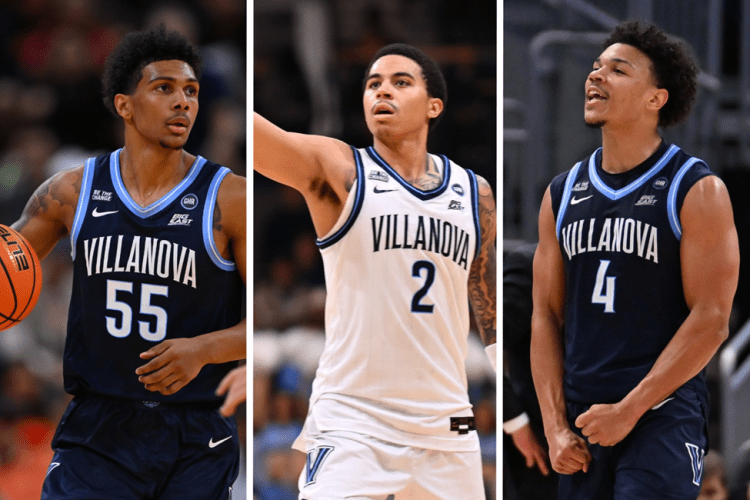
With Big East play now underway following an impressive win over Seton Hall, Villanova enters conference competition with a clearer sense of an offensive identity. The non-conference slate offered valuable perspective allowing rotations to settle and roles to take shape prior to Big East competition. While the team has demonstrated a lot of promise so far, the factors that drive Villanova’s offense are starting to highlight an underlying identity. These trends now serve as a foundation for understanding Villanova’s offensive identity as conference play continues.
With this being said, there has been one major factor in this new Villanova offense that has been obvious to me. That is that the offense consistently flows through the starting guard trio of Acaden Lewis, Bryce Lindsay, and Tyler Perkins. Rather than centering possessions around one guard, this three-guard lineup has put a focus on shared decision-making and creating balance that compensate for production on areas of the roster that have yet to assert themselves. Overall, this structure creates opportunities that align with each guard’s offensive strengths and shape an offense built on versatility and spacing.
This project uses publicly available data from Sports Reference to evaluate how the Lewis–Lindsay–Perkins guard unit has shaped Villanova’s offense through the first eleven non-conference games. While advanced tracking and possession-level metrics available through Synergy were not accessible, game-by-game box score data still allows for the construction of meaningful offensive indicators for each guard, including minutes, shot attempts, turnovers, and usage rates. By aggregating these metrics across all non-conference games, this project establishes a framework for evaluating offensive balance, involvement, and efficiency at the guard level.
It is important to note that this analysis is purposefully limited. The sample consists of just eleven non-conference games, and the metrics and visualizations used are derived only from publicly available data rather than advanced tracking or possession-level analytics. As a result, this project does not aim to offer any specific conclusions or model-driven predictions. Instead, it provides an early and analytical snapshot of how Villanova’s these three guards have functioned to the point of conference play and offers a meaningful framework for understanding how Lewis, Lindsay, and Perkins may continue to shape the offense as conference play unfolds.
The sections that follow analyze each guard’s offensive profile before using those findings to assess the broader impact of the Lewis–Lindsay–Perkins guard unit as Villanova enters Big East play. For each guard, the analysis focuses on four key areas: offensive usage on a game-by-game basis, shot aggressiveness relative to time on the floor, decision-making tendencies as reflected by assist and turnover rates, and game-to-game variability as a measure of consistency within Villanova’s evolving offensive structure.
Acaden Lewis
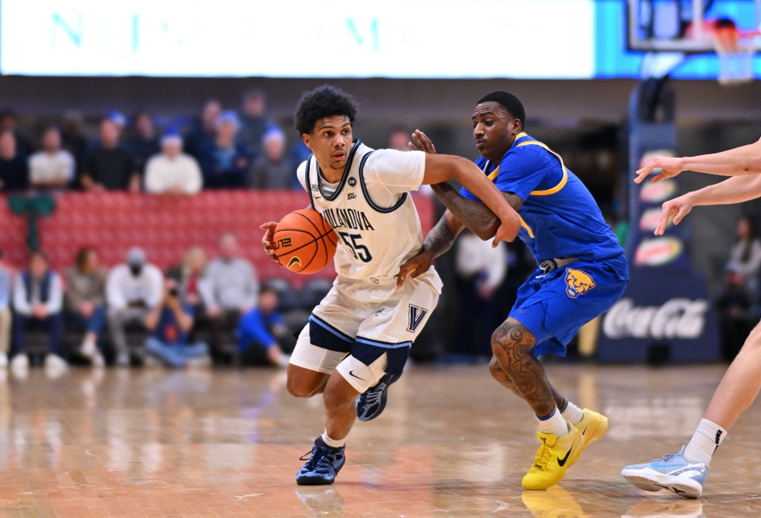
Acaden Lewis has stepped into a central role as Villanova’s starting point guard despite being a freshman and has quickly established himself as the engine of the offense. Already earning multiple Big East Freshman of the Week honors, Lewis has shown a feel for control and playmaking that exceeds his experience level. As an ambidextrous guard who is comfortable making plays on both sides of the floor, he consistently organizes the offense, creates advantages off the dribble, and sets the tone for Villanova’s offense. The analytics that follow provide a clearer picture of how this responsibility has been translated on a game-to-game basis.
Offensive Usage by Game
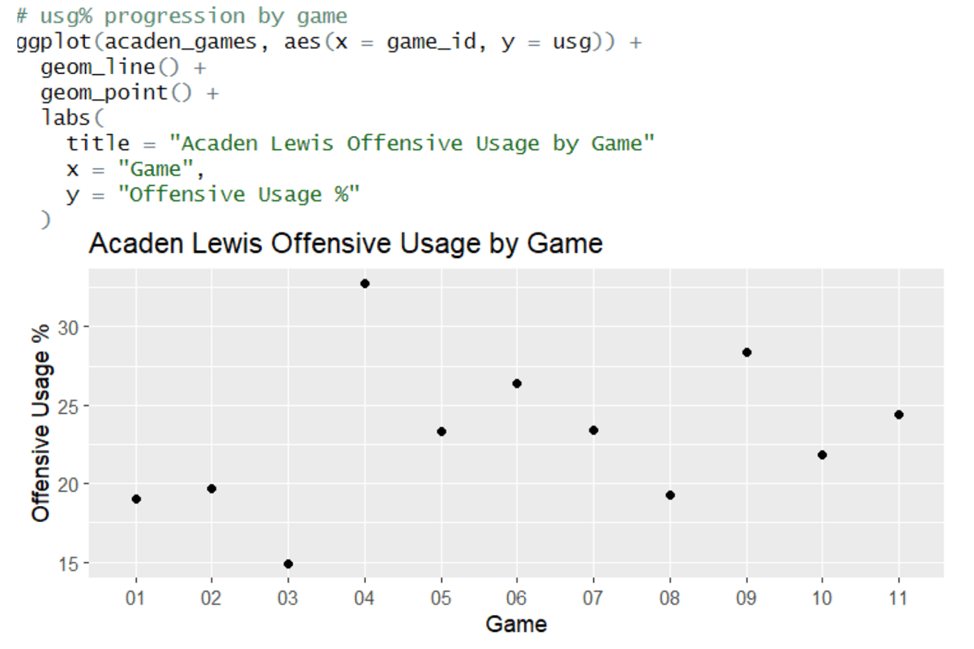
Acaden Lewis’ offensive usage shows clear variability across the non-conference games, displaying a role that adjusts based on game context. His usage spikes notably in a few games, most prominently against Duquesne and Michigan (games 4 and 9), suggesting moments where he was leaned more heavily to initiate possessions. At the same time, several lower-usage games reflect a Villanova offense able to flow elsewhere without removing Lewis. Overall, the visual points to Lewis as a flexible offensive engine whose involvement is relative to the context of the game being played rather than a constant, ball-dominant presence.
Shot Aggressiveness vs. Time on Floor
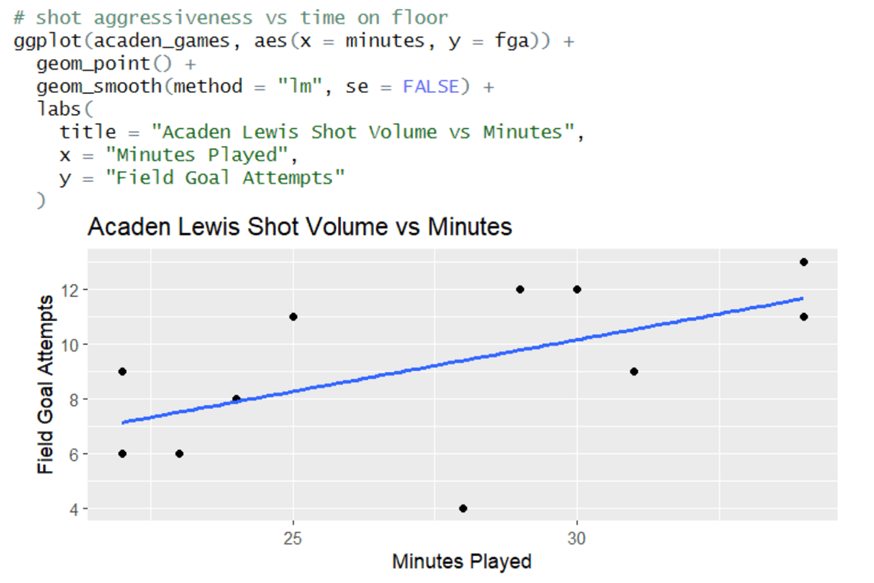
The positive slope in the trend line indicates that Lewis’ shot volume is higher in the games where he plays more, solidifying his role as a guard who becomes more assertive when trusted with more floor time. While there is some scattering around the trend line highlighted by a low-attempt outlier despite moderate minutes, the overall relationship between minutes played and field goal attempts shows intentional scaling rather than randomness. Lewis does not appear to look for shots immediately but instead increases his shot aggressiveness as his responsibility within the offense takes shape. This pattern aligns with a guard who adapts his scoring based on opportunity rather than forcing shots that are independent of game flow.
Decision-Making Profile
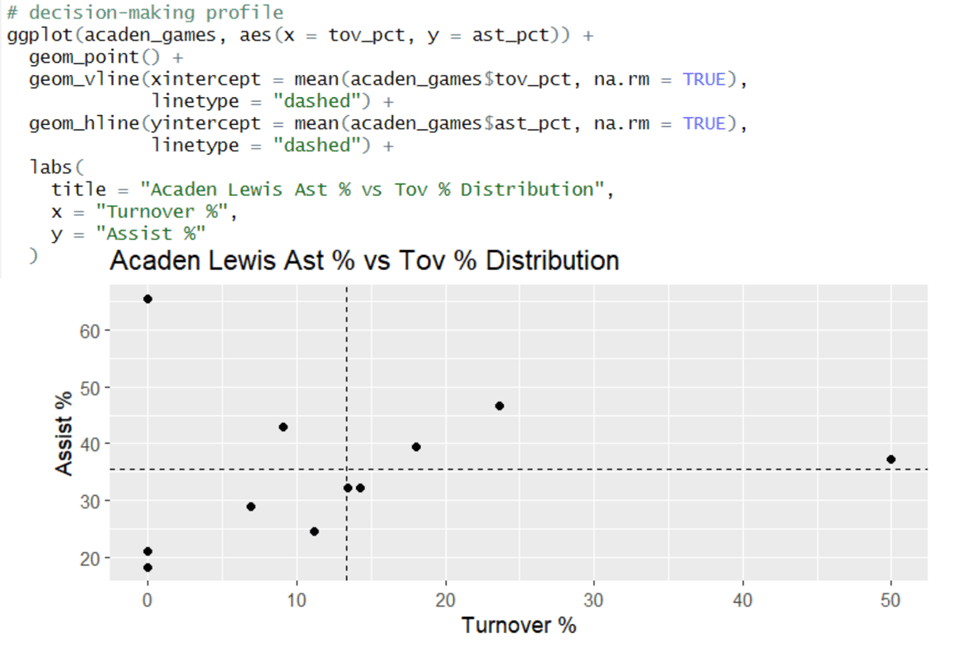
This distribution shows the trade-off in Lewis’ decision-making profile, with assist percentage varying widely depending on his turnover percentage in a given game. Several games fall above the average assist line while remaining near or below the average turnover rate, showing stretches where Lewis effectively balances playmaking responsibility with ball security. The presence of high-assist, low-turnover outliers points to his ceiling as a primary initiator within the Villanova offense. At the same time, games in the high-turnover quadrant illustrate the volatility that comes with expanded offensive involvement, reinforcing the importance of shared initiation alongside Lindsay and Perkins.
Game-to-Game Variability
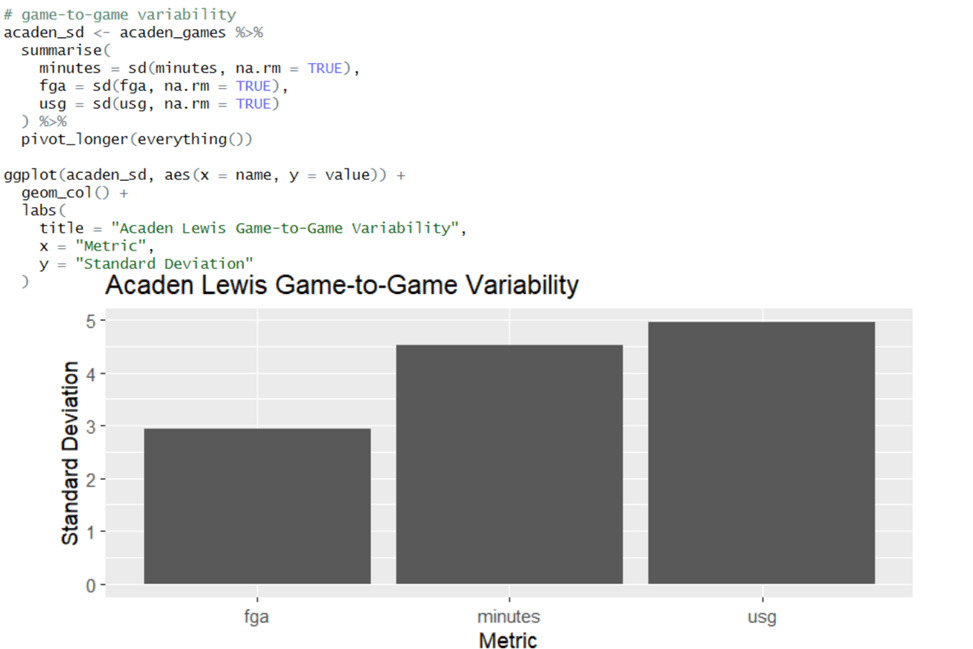
The variability profile shows that Acaden Lewis’ role is most stable in terms of shot volume, with field goal attempts exhibiting the lowest game-to-game variability among the measured metrics. Minutes played and usage display higher variability, showing that while his scoring aggression remains steady, the extent of his overall offensive responsibility shifts based on matchup and game flow. This pattern reinforces Lewis’ function as a consistent scoring option whose involvement can vary within the offense Entering Big East play, that flexibility allows Villanova to adjust Lewis’ role without disrupting the offense’s broader structure.
Bryce Lindsay
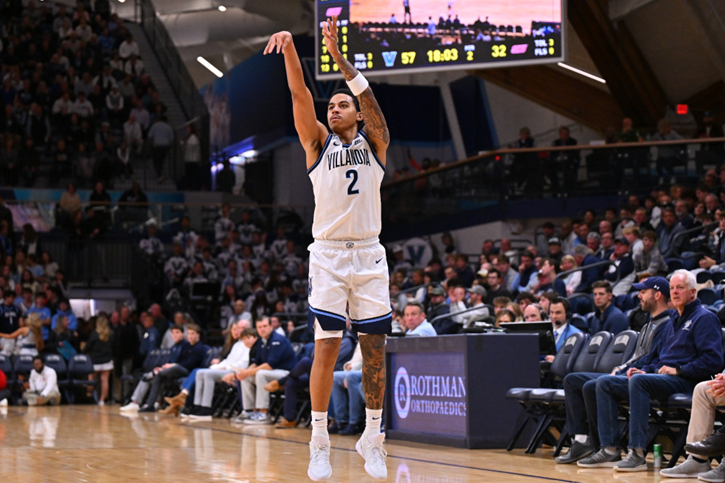
Bryce Lindsay has brought immediate offensive value to Villanova after transferring from James Madison University, where he earned Sun Belt Sixth Man of the Year honors and led the conference in three-point shooting. That shooting efficiency has translated effortlessly with Lindsay quickly emerging as Villanova’s leading scorer and a primary source of perimeter scoring within the offense. His ability to space the floor has elevated Villanova’s offense, and the analytics below highlight how his efficiency and shot profile have made an impact early in the season.
Offensive Usage by Game
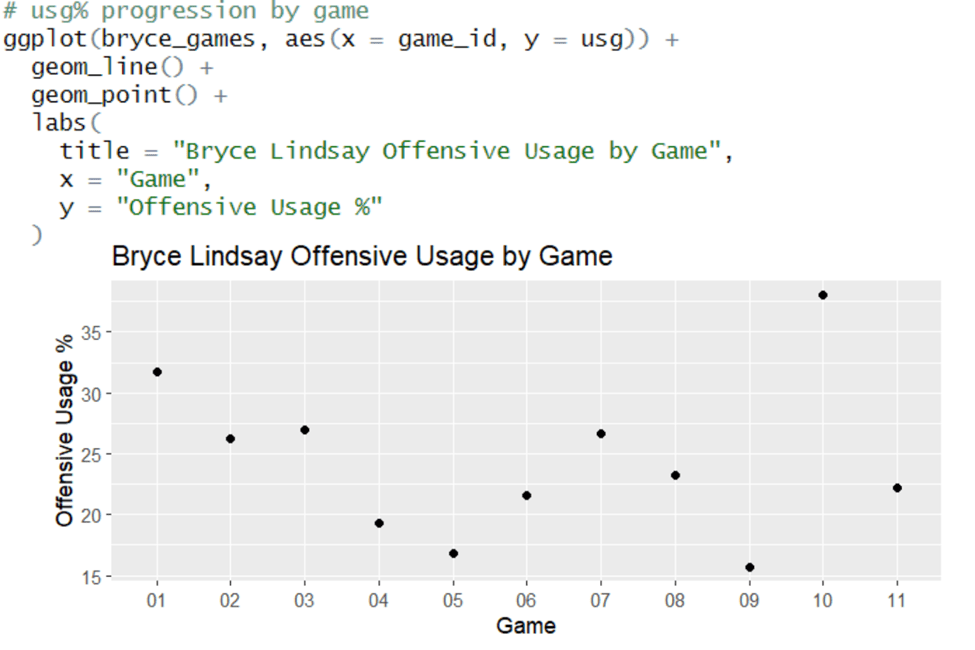
Bryce Lindsay’s offensive usage changes noticeably across the non-conference schedule, reflecting a role that can vary between being a complementary scorer and higher-usage option that leads the team in scoring depending on game context. His usage decreases through the middle portion of the slate of non-conference games before increasing sharply in the game against Pittsburgh (game 10) displaying moments where Villanova leaned more heavily on his shot-making. Several lower-usage games indicate that Lindsay is comfortable impacting the offense without dominating possessions, consistent with a guard who thrives off movement and opportunity rather than constant initiation.
Shot Aggressiveness vs. Time on Floor

The upward trend in the shot volume–minutes relationship shows that Lindsay’s aggressiveness scales clearly with more floor time. As his minutes rise, his field goal attempts increase at a steeper rate than a purely opportunistic shooter, showing intentional usage throughout the non-conference games. The spread of points indicates that while his shot output is tied to opportunity, there are games where he consistently proves himself offensively even without a great amount of minutes played. Overall, the pattern supports Lindsay’s role as a guard whose scoring impact expands with more minutes played, reinforcing his value within Villanova’s offense as both a spacing threat and a situational shot creator.
Decision-Making Profile

This distribution highlights Lindsay’s decision-making profile as more situational than consistently playmaking driven. Several games cluster at low turnover rates with moderate assist percentages, showing that his offensive value often comes from quick decisions rather than creation. At the same time, the presence of higher-turnover games with varied assist output suggests that when Lindsay’s offensive role expands, efficiency can change. Overall, the plot reinforces Lindsay’s fit within the offense complementary playmaker whose decision-making is strongest when he operates within the flow rather than taking on heavy initiation responsibility.
Game-to-Game Variability
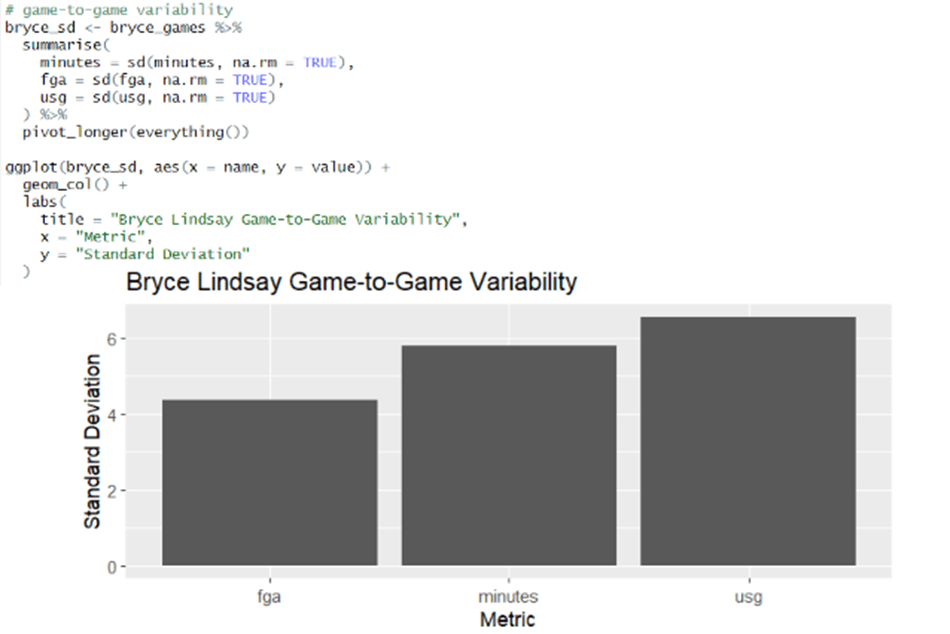
Bryce Lindsay’s variability profile shows greater alteration in usage rate and minutes than in shot volume, showing a role that can increase or decrease on lineup needs and game context. His field goal attempt variability is comparatively lower, suggesting that when he is on the floor, his shot selection and willingness to shoot remain consistent. The higher standard deviation in usage reflects that Lindsay is occasionally asked to take on more of an offensive role, but not on a game-to-game basis. Overall, this pattern reinforces Lindsay’s function as a flexible offensive piece whose involvement can scale up when needed without fundamentally altering the structure of Villanova’s offense.
Tyler Perkins

Tyler Perkins enters this season as the lone player returning minutes from last year where he served as the sixth man within a veteran and tightly defined rotation. Now as a junior adjusting to a new coaching staff and a new group of teammates on the court, Perkins has naturally stepped into a leadership role and has provided stability on both ends of the floor. That stability has positioned him as a vocal, on-court leader and has helped set the tone for a team still establishing its identity. His impact has been evident in his increased assertiveness on defense and a more confident presence on offense. The analytics that follow show how his presence has helped anchor Villanova’s offense across the non-conference slate.
Offensive Usage by Game
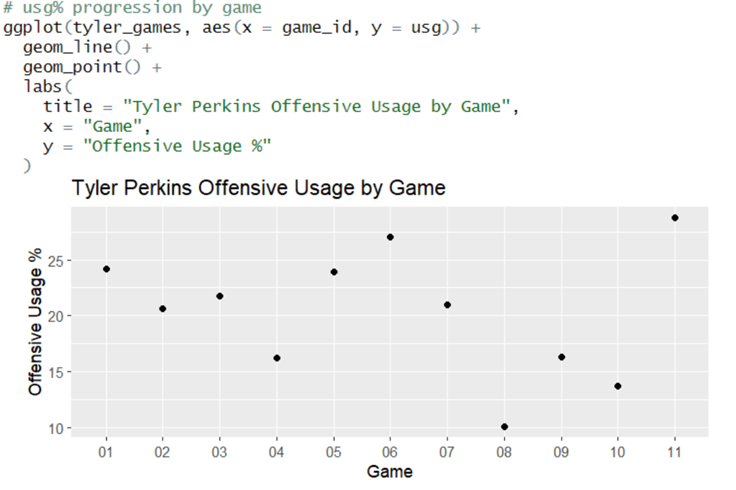
Tyler Perkins’ offensive usage shows noticeable swings across the non-conference slate, reflecting a role that is highly context-dependent rather than being usage-driven. His usage reaches its height in the games where Villanova relies on his versatility to balance out the offense, while low points in the visual show stretches where he shifts into a lower-usage and connective role. Unlike a primary scoring guard, Perkins’s involvement changes based on game flow rather than increasing over time. Overall, the pattern displayed underscores his value within the offense as a flexible player whose impact is made through adaptability rather than consistent offensive volume.
Shot Aggressiveness vs. Time on Floor
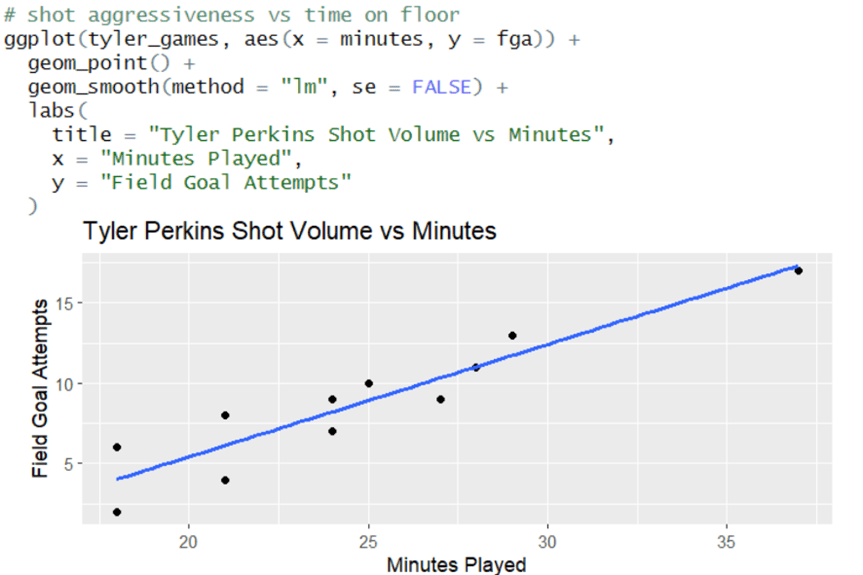
The strong positive relationship between minutes played and field goal attempts suggests that Perkins’ shot aggressiveness scales directly with opportunity. As his time on the floor increases, his willingness to take shots rises in a near-linear fashion, reflecting a guard who responds to increased responsibility rather than forcing shot attempts in limited minutes. The tight clustering around the trend line points to a relatively predictable offensive role when Perkins is playing for longer on-court stints. The pattern displayed supports his profile as a reliable scoring option whose offensive assertiveness is closely tied to trust and lineup context within Villanova’s offense.
Decision-Making Profile
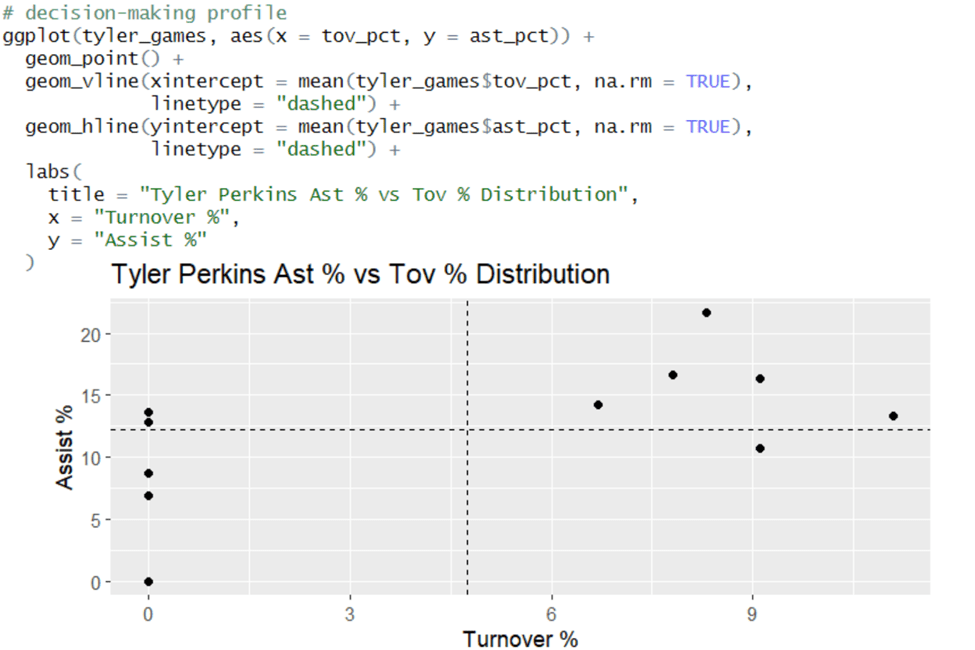
This distribution reinforces Tyler Perkins’ role as a low initiating guard whose offensive value is rooted more in efficiency and connectivity rather than playmaking. Most of his games display low turnover rates with assist percentages around or below average, showing a guard who favors clean decisions and ball movement over high-volume creation. Unlike Acaden Lewis, Perkins rarely occupies the high-assist, high-turnover quadrant associated with primary initiators. Instead, his profile aligns with a steady secondary guard who keeps the offense organized, moves the ball quickly, and allows the offense to function without unnecessary risk.
Game-to-Game Variability
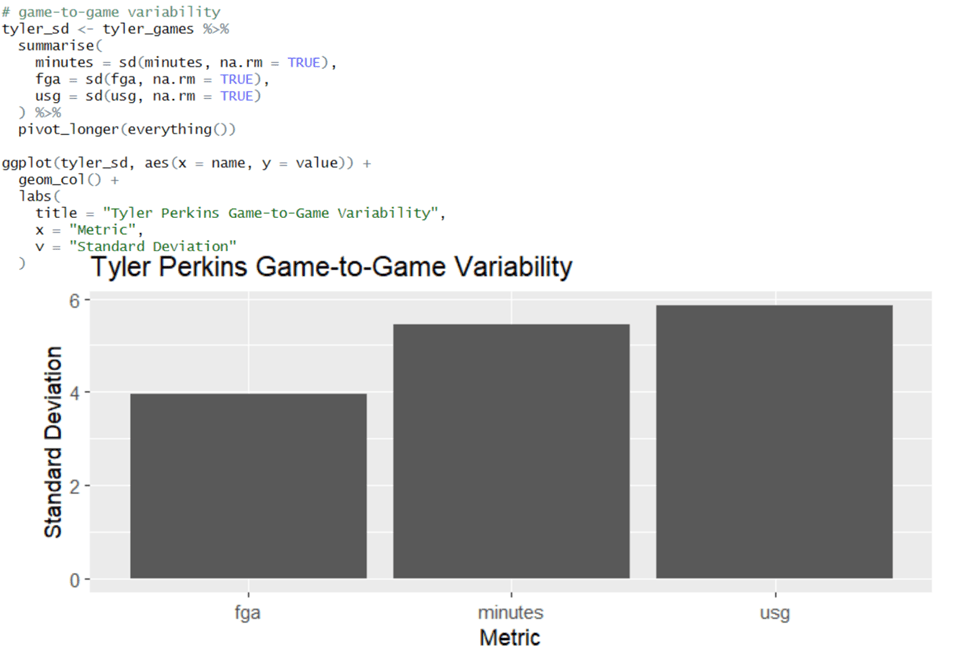
Tyler Perkins’ game-to-game variability shows the greatest change in usage and minutes, while his shot volume remains comparatively more stable. This suggests that although his role within the offense can change depending on lineup needs, his approach when on the floor stays relatively consistent. The higher variability in usage reflects Perkins’s situational role within the rotation rather than an inconsistent offensive role. Overall, this profile reinforces his value as a steady connector whose impact is shaped by context rather than by dramatic swings in shot-taking behavior.
As a Three-Guard Unit

This section shifts focus from the individual guard profiles to the collective impact of the Lewis–Lindsay–Perkins unit as a whole. Using lineup-level metrics, the analysis evaluates how usage balance evolves over time, how shot composition reflects a perimeter-oriented identity, how collective assist and turnover indicators capture decision-making efficiency, and how minute distribution illustrate the degree of rotational reliance placed on these three guards. Together, these measures provide a comprehensive view of how Villanova’s offense functions when responsibility is shared across the backcourt, offering a clearer sense of how this structure may translate into Big East competition.
Collective Offensive Usage by Game

This usage balance trend illustrates how the offensive impact of Lewis, Lindsay, and Perkins has evolved over the non-conference schedule. Lower standard deviation values in several early and mid-season games indicate stretches where offensive responsibility was evenly distributed across Lewis, Lindsay, and Perkins, reinforcing the team’s preference for shared guard play. Peaks later in the slate reflect games in which one guard temporarily carried a larger part of the offense, often in response to matchup demands or the flow of the game. Overall, the pattern suggests that while Villanova is capable of leaning on an individual guard when it is necessary, the most stable offensive structure is built around balance as the team enters Big East play.
Combined Shot Volume (2PA vs 3PA)
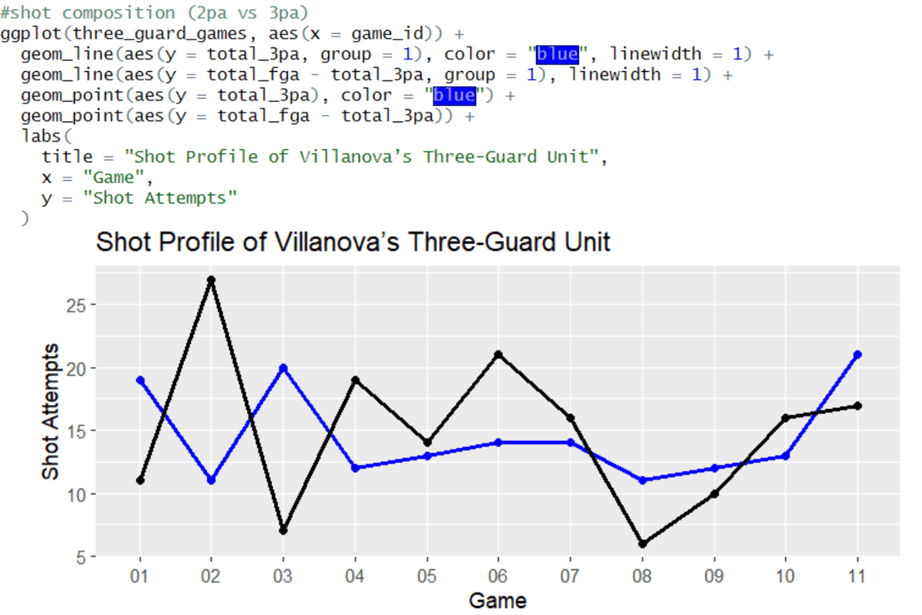
This shot composition trend highlights the balance between two-point and three-point attempts within the three-guard unit across the non-conference schedule. While overall shot volume changes from game to game, three-point attempts (shown in blue) remain a consistent component of the offense, highlighting their reliance on floor spacing and perimeter shot-making. Much of that perimeter volume is driven by Bryce Lindsay, whose willingness to take and efficiency make threes has enhanced spacing across the floor and created cleaner driving opportunities for other players including Lewis and Perkins. As a result, the three-guard unit sustains its offensive structure even as interior opportunities vary, emphasizing a perimeter-driven approach entering Big East play.
Collective Decision-Making Profile
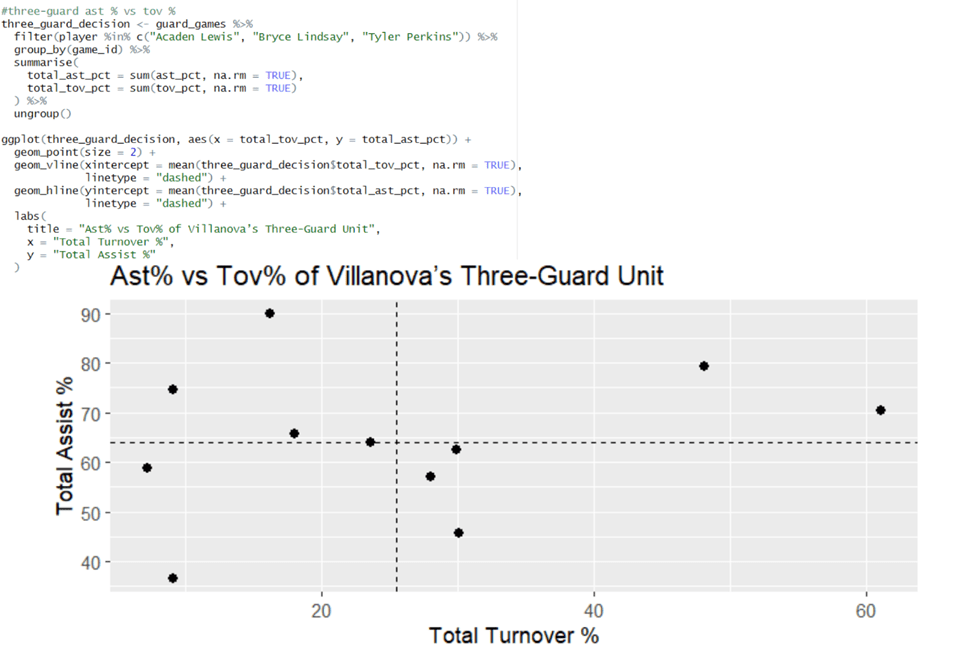
This collective decision-making profile shows that Villanova’s three-guard unit maintains a low combined turnover rate while consistently generating high assist totals a strong indicator considering the extent of the backcourt’s offensive involvement across the non-conference game. Many games fall in the high-assist, moderate-to-low turnover quadrants, indicating that ball movement remains a defining feature of the Villanova offense even as usage is shared across the backcourt. The absence of frequent high-turnover, low-assist outcomes suggests that increased guard involvement does not come at the expense of offensive control. Overall, the distribution reinforces the three-guard unit’s ability to balance playmaking volume with efficiency, a trait that should translate well as defensive pressure increases in Big East play.
Minutes Share of Team Offense
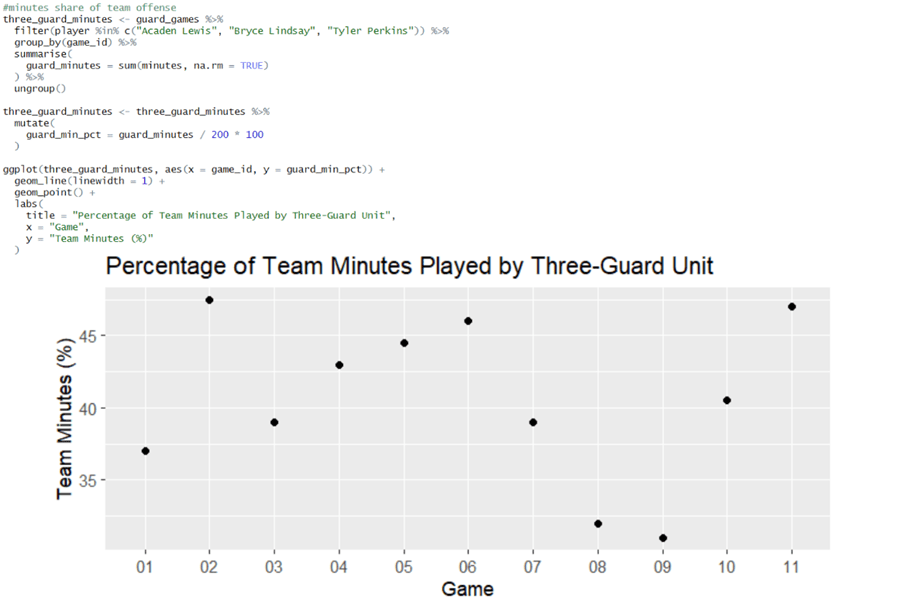
This trend shows that Lewis, Lindsay, and Perkins consistently account for a substantial share of Villanova’s available minutes across the non-conference slate, often exceeding forty percent of total team floor time. Peaks in the middle and late portions of the schedule suggest growing trust in the three-guard alignment, as Villanova settled into more consistent rotations that kept Lewis, Lindsay, and Perkins regularly involved. Even in games where their collective minutes are not as consistent, the guard unit has proven to be a central structural component of the offense. Overall, the pattern reinforces how heavily Villanova’s offensive identity is tied to this group as the team enters Big East play.
With Big East play now underway, Villanova’s early-season data offers a clear perspective of how the offense is going to function moving forward. The three-guard unit has shown an ability to share responsibility, maintain efficiency, and create consistent perimeter opportunities without forcing possessions. Rather than focusing on one guard, Villanova has leaned into a more balanced lineup and Lewis, Lindsay, and Perkins have embraced it. If the opening stretch is any indication, this trio is already making an impact and looks set to continue doing so as conference play moves forward.
StatCats: Comparing Villanova’s New Additions to a Decade of Wildcats
Isabella Chmil
November 9th, 2025

As the 2025-2026 college basketball season tips off, Villanova finds itself entering a new era. A new head coach and a wave of transfer portal additions have given the program somewhat of a new identity. Having grown up watching Villanova Basketball, I have seen the program evolve through different eras of players, leadership, and team identity. Still, I do not believe any offseason has brought as much change as this one.
This uncertainty inspired this project. I wanted to move beyond the reports and preseason speculation I have been seeing on social media to gain a better understanding of who these new players are, statistically and historically. By analyzing player performance data and comparing this season’s roster to Villanova player seasons from the past decade, I aimed to identify which past players the new team most resembles.
To build the StatCats similarity model, I used 15 different performance metrics considering both efficiency and volume including points, rebounds, assists, steals, blocks, turnovers, and efficiency rates such as field goal percentage, three-point percentage, free-throw percentage, assist-to-turnover ratio, points per minute, and rebounds per minute. Each metric was standardized to eliminate scale bias, and players were compared across these dimensions to quantify their overall statistical similarity. The result is a data-driven perspective on how Villanova’s newest roster additions connect to the program’s identity built over the last decade. Rather than relying on social media speculation, this analysis uses numbers to show which previous players some of these new players are most aligned with.
Before diving into the individual player models, it is important to outline how these comparisons were constructed. A select group of seven of Villanova’s newest additions were analyzed, using their most recent collegiate season (or in the case of one, his past two high school seasons) as the statistical basis. Each of these players were compared to every Villanova player season from the past ten seasons, using the same set of standardized metrics. To ensure meaningful results, only players who averaged over five minutes per game were included in the analysis, filtering out limited samples. All data for both the transfer players and past Villanova teams was sourced from Sports-Reference. From there, each player’s statistics were transformed into z-scores and evaluated through similarity modeling to identify where their playing styles align within a decade of Villanova Basketball history.
Having established the StatCats model, we can now turn to the statistical player comparisons.
Duke Brennan

The Villanova player seasons that the StatCat model identified as the closest statistical comparisons to Duke Brennan’s recent campaign at Grand Canyon University are Dhamir Cosby-Roundtree (18-19), Enoch Boakye (24–25), Darryl Reynolds (16–17 and 15-16), and Daniel Ochefu (15-16).

The model shows moderate statistical alignment between Brennan and these five player seasons, though none fully demonstrate low-usage efficiency and interior focus like his past season at Grand Canyon. The five closest historical comparisons exhibit similar rebounding and efficiency metrics, with the highest Comp Score being 68.04 showing partial but not perfect alignment.
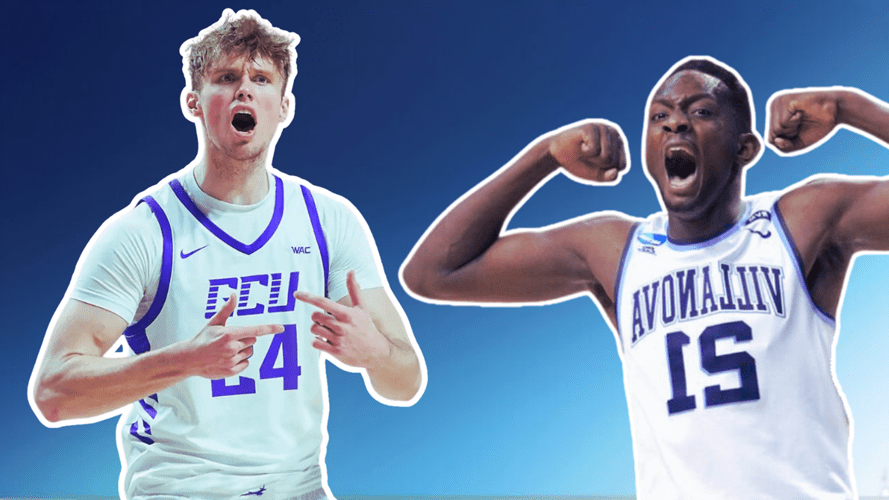
Closest match: Dhamir Cosby-Roundtree (2018–19): Distance = 3.31, Comp Score = 68.04.
Cosby-Roundtree aligns with Brennan in several core areas: both post players show strong finishing efficiency (FG% Z Brennan = 1.93, Cosby-Roundtree = 1.95) and above-average rebounding (TRB Z Brennan = 2.69, Cosby-Roundtree = 1.07). Cosby-Roundtree also posts a positive steal z score and low three-point percentage which corresponds with that of Brennan (STL Z = 0.35, 3PT % Z = -2.81). While Cosby-Roundtree’s scoring volume z is negative compared with Brennan’s modest positive scoring z, the overall proximity makes his 2018-19 season the best blueprint for Brennan.
A telling feature across all five comparisons is the extremely low three-point z scores paired with remarkably high FG% z score values. This pattern highlights a shared profile of rim-oriented, low–three-point reliance players. In similar terms, they are all true interior contributors rather than perimeter shooters.
Despite these shared traits, the Comp Scores remain low. These low Comp Scores for Brennan reflect the statistical landscape of Villanova over the past decade and how it has been dominated by guard and perimeter-oriented production, making it difficult for the model to find perfect comparisons for a post like Brennan. The Villanova teams over the last decade have focused on spacing, guard creation, and perimeter shooting. Therefore, a low usage, high FG%, and a well above-average rebounding post like Brennan is comparatively rare. The model found the best available matches, but none reached the kind of 80+ Comp Score that would be equivalent to a high statistical comparison.
Bryce Lindsay

The Villanova player seasons that the StatCat model identified as the closest statistical comparisons to Bryce Lindsay’s most recent season at James Madison University include Kris Jenkins (2015–16), Phil Booth (2017–18), TJ Bamba (2023–24), Justin Moore (2022–23), and Jordan Longino (2024–25).

The model finds strong alignment between Lindsay and this group of past Villanova guards. High Comp Scores like the ones in the chart above indicate that Lindsay’s statistical profile closely fits the mold of Villanova guards over the past decade who are high volume and efficient shooters. These comparisons reflect Lindsay’s ability to balance offensive efficiency with composure and versatility with all top matches having a Comp Score of 80+.

Closest match: Kris Jenkins (2015–16): Distance = 1.48, Comp Score = 85.79.
Jenkins’s metrics align closely with Lindsay’s across key categories. Both show above-average scoring output (PTS Z Lindsay = 0.93, Jenkins = 0.97) and strong usage rates (FGA Z Lindsay = 0.94, Jenkins = 0.87). Lindsay and Jenkins also share strong assist metrics (AST Z = 0.57) and overall balanced field goal percentage (FG% Z Lindsay = 0.10, Jenkins = 0.14). However, Bryce Lindsay proves to be more efficient from three-point range (3P% Z Lindsay = 0.81, Jenkins = 0.61).
Across all five comparisons, the data clearly shows the archetype of a consistent guard. Lindsay’s metrics reflect a composed, efficient guard and a perimeter scorer who contributes without dominating possessions.
Unlike the low Comp Scores observed in frontcourt models like Brennan’s, Lindsay’s higher similarity scores reveal the opposite. His play style reflects Villanova’s established guard-centric tradition. Over the past decade, Villanova basketball has thrived on players who can space the floor, make sound decisions, and score efficiently within a structured offensive system. These are just some of the traits that Lindsay’s statistics reflected in the StatCat model. In summary, Lindsay’s metrics suggests he continues the lineage of versatile Villanova guards who drive success through balance, efficiency, and control.
Tafara Gapare
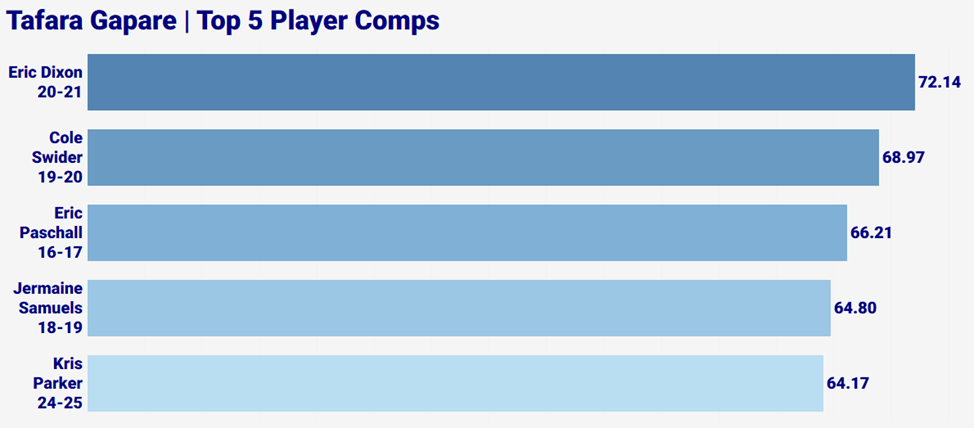
The Villanova player seasons that the StatCat model identified as the closest statistical comparisons to Tafara Gapare’s most recent season at the University of Maryland include Eric Dixon (2020–21), Cole Swider (2019–20), Eric Paschall (2016–17), Jermaine Samuels (2018–19), and Kris Parker (2024–25).

The model shows moderate statistical alignment between Gapare and these five player seasons, reflecting Villanova’s history with long, versatile forwards. The model suggests that Gapare’s statistical profile reflects that of a developing forward. That is, one who brings defensive versatility but is still refining his offensive efficiency and scoring consistency. The five closest historical comparisons exhibit similar usage rates, with the highest Comp Score being 72.14 showing partial alignment.
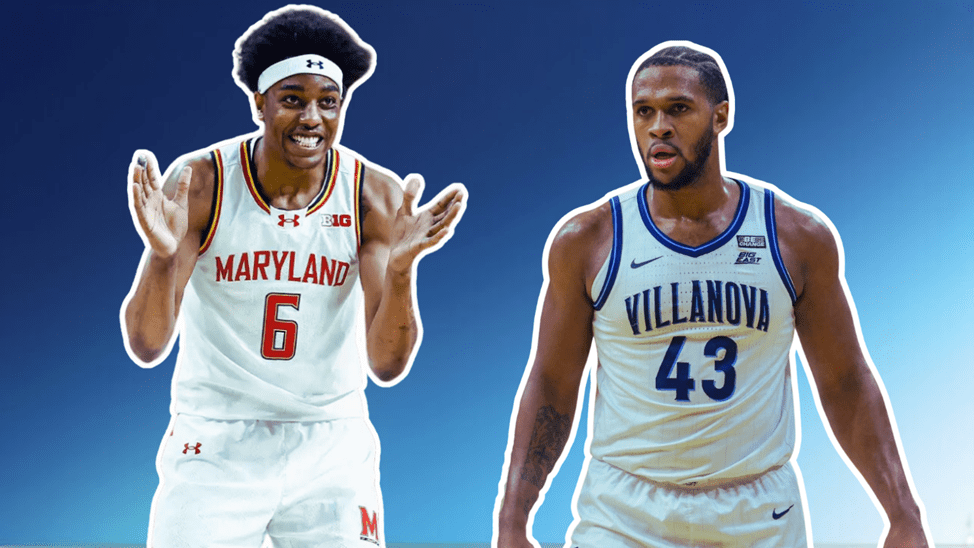
Closest match: Eric Dixon (2020–21): Distance = 2.15, Comp Score = 72.14.
This match is particularly interesting, and it is important to note that this is not the version of Dixon who was the nation’s leading scorer last season. The 2020–21 Dixon was a young rotational forward, learning Villanova’s system while contributing primarily through defense and rebounding. Both players share similar efficiency (FG% Z Gapare = 0.25, Dixon = 0.22) and low usage levels (FGA Z Gapare = -0.89, Dixon = -1.01). Their defensive impact metrics, like rebounding for instance (TRB Z Gapare = -0.79, Dixon = -0.93), also line up, highlighting their comparable physical presence in the frontcourt. However, Gapare’s strong shot-blocking z-score suggests a bit more rim protection than Dixon.
Gapare’s other close matches reinforce the idea of him as a stretch forward still building consistency. Other players ranked within the model also display similar patterns of athletic, multipositional play that rely more on defensive contribution and effort than volume scoring.
In broader context, Gapare’s comparisons tell a story of potential and projection. His numbers fit within the mold of Villanova’s long-term developmental forwards who initially contributed as defensive specialists before expanding their offensive impact. Gapare’s moderate Comp Scores compared to a guard like Bryce Lindsay harp on the fact that Villanova has a large history of being guard-centered, while the program’s forwards often develop over time rather than emerge as immediate offensive focal points. Now as a senior, Gapare has the experience and opportunity to pull it all together. This season could be the one where he expands his offensive game and becomes a more complete contributor on both ends of the floor.
Devin Askew

The Villanova player seasons that the StatCat model identified as the closest statistical comparisons to Devin Askew’s most recent season at Long Beach State University include Phil Booth (2018–19), Collin Gillespie (2019–20 and 2021–22), Josh Hart (2016–17), and Donte DiVincenzo (2017–18).

The model finds moderate to strong alignment between Askew and this group of tough, ball-dominant, multi-level scoring guards. These five comparisons represent a classic Villanova guard archetype. Askew’s statistical profile aligns with that mold with his metrics demonstrating high usage, above-average scoring volume, and strong playmaking. His Comp Scores being 70+ show moderate similarity to those guard-heavy seasons, though none are a perfect fit.
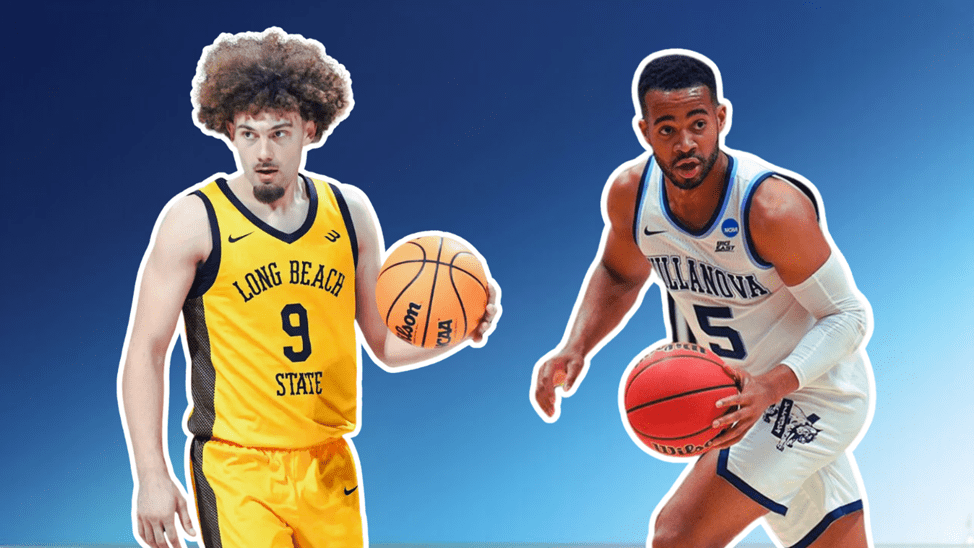
Closest match: Phil Booth (2018–19): Distance = 3.10, Comp Score = 76.17
Booth’s senior season was one of high responsibility leading a post National Championship roster, carrying heavy on-ball creation and offensive volume. Statistically, Askew shows strong parallels. Both players posted high assists (AST Z Askew = 2.46, Booth 1.87), similar point z-scores (Askew 1.89, Booth 1.84), and comparable shot volume indicators (Askew 2.13, Booth = 1.84). Both player seasons also show modest rebounding (TRB Z Askew = 0.54, Booth = 0.19) and similar shooting distributions.
However, it is crucial to contextualize these comparisons within Askew’s expected role at Villanova in his final collegiate season. At Long Beach State, Askew was initiating, scoring, and creating every possession. At Villanova, surrounded by more balanced roster and under a new coach who wants to play games with an 11–12-man rotation, he will not hold that same level of usage or control. The model connects him statistically to Villanova’s greats because of his high-activity offensive profile, but realistically, his contributions will not exceed these in season for Villanova.
While Askew’s statistical makeup mirrors Villanova’s extensive line of lead guards, his context does not. The model suggests that he has the scoring ability and playmaking aggression just like these leading guards, but Villanova’s depth and offensive balance will limit the scale of his role. While flashes of that kind of assertive guard play would certainly be exciting, it is more probable that Askew settles into a complementary backcourt presence. One that fits Villanova’s guard DNA but operates in a more reserved role.
Zion Stanford
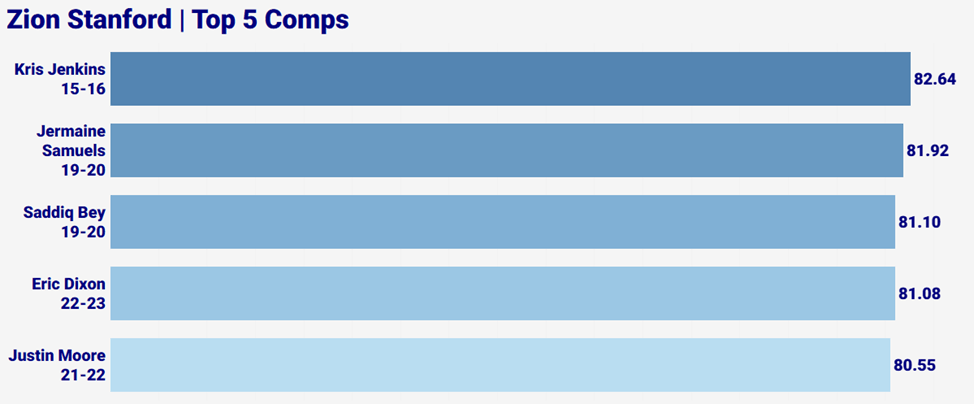
The Villanova player seasons that the StatCat model identified as the closest statistical comparisons to Zion Stanford’s most recent season at Temple University include Kris Jenkins (2015–16), Jermaine Samuels (2019–20), Saddiq Bey (2019–20), Eric Dixon (2022–23), and Justin Moore (2021–22).

This group of comparisons represents a mix of versatile forwards who blend scoring, physical defense, and positional flexibility, traits that are central to Villanova’s modern system. Stanford’s statistical profile shows balanced contributions across both offense and defense, reflecting his two-way style of play. His Comp Scores being 80+ indicate a tight statistical resemblance across several archetypes of past Nova wings and forwards.

Closest match: Kris Jenkins (2015–16): Distance = 1.70, Comp Score = 82.64.
Jenkins’ 2015–16 season, while defined by efficient scoring and high-volume three-point shooting, offers the strongest statistical parallel to Stanford. Both demonstrate a well-rounded offensive skill set and consistent production across categories like points and assists. Jenkins posted strong offensive metrics aligning closely with Stanford’s z-scores in those same categories. However, some of the key differences lie in three-point proficiency (Stanford 3P% Z = 0.27, Jenkins = 0.62), rebounding (TRB Z Stanford = 0.49, Jenkins = 0.19), and blocking (BLK Z Stanford = 1.28, Jenkins = 0.32) suggesting that while their roles may mirror each other, Stanford’s perimeter threat is less developed and that he contributes more on defense.
Stanford’s metrics reinforce the idea of a balanced, versatile wing still developing his offensive identity. His statistical makeup points to a player who contributes through efficiency, effort, and defensive versatility rather than high-volume scoring. His blend of physicality and control reflects a player focused on steady, two-way production while continuing to refine areas like perimeter consistency.
Overall, the model suggests Stanford fits the Villanova archetype of a balanced, switchable wing, capable of contributing efficiently without commanding high usage. If he develops a more dependable outside jumper and maintains consistent defensive rebounding, Stanford could evolve into a player with the multidimensional impact that defined Nova’s best hybrid forwards of the Jay Wright era.
Malachi Palmer

The Villanova player seasons that the StatCat model identified as the closest statistical comparisons to Malachi Palmer’s most recent season at the University of Maryland include Chris Arcidiacono (2020–21), Jermaine Samuels (2017–18), Brandon Slater (2019–20), Jahvon Quinerly (2018–19), and Cole Swider (2018–19).

The model finds only moderate alignment between Palmer and this group, and that’s entirely a reflection of his low-usage role during his freshman season. His metrics show low volume across nearly every category whether that be minutes, points, rebounds, or assists, making it extremely difficult for the model to identify a close match based on real Malachi’s actual tendencies as a player. He had too limited a role last season for any of these comparisons to truly capture the player he is or is expected to become.

Closest match: Chris Arcidiacono (2020–21): Distance = 1.71, Comp Score = 82.33
Arcidiacono’s season aligns the most with Palmer’s because of their limited usage but efficient system play within a controlled role. Both players recorded extremely low scoring volume (PTS Z Palmer = -1.18, Arcidiacono = -1.30), low turnover metrics (TOV Z Palmer = -1.58, Arcidiacono = -1.26), and modest efficiency numbers across the board. However, that similarity is not based on their similar playing styles but rather on the structured role they played on their respective teams. The similar metrics reflect being low-minute rotation pieces and not actually having comparable play styles.
Overall, this comparison undersells Palmer’s actual talent. The data represents a snapshot of a freshman who rarely saw the floor, not the dynamic wing Villanova is expecting this season. With a significantly larger role on a new team with a familiar staff, Palmer’s numbers shift dramatically.
While the model links him to end-of-rotation role players, that is a reflection on opportunity and not ability. The reality is that Palmer’s comparison set tells us more about his limited Maryland minutes than his potential impact at Villanova. Expect his metrics for this season to reflect a player finally stepping into the role and rhythm his previous stats cannot show.
Acaden Lewis
Although this project is focused on Villanova’s transfer portal additions, it is impossible to talk about this new roster without mentioning Acaden Lewis. Unlike the other new additions to Villanova’s roster, Lewis enters as a true freshman. To still include him in this analysis, I used data from his final two seasons at Sidwell Friends, sourced through MaxPreps. Through this, I was able to access many of his metrics but had some limitations. I did not have access to certain stats like minutes per game and certain possession-based stats. As a result, his comparison model was built on a smaller metric set than the other players in this project.

The Villanova player seasons that the StatCat model identified as the closest statistical comparisons to Acaden Lewis’s final two seasons at Sidwell Friends School include Donte DiVincenzo (2017–18), Collin Gillespie (2019–20), Josh Hart (2016–17), Phil Booth (2018–19), and Caleb Daniels (2022–23).

The model finds moderate to strong alignment between Lewis and this group of versatile, two-way guards who blend scoring, playmaking, and defensive intensity. Even with the limited scope of available data from his high school career, Lewis’s statistical profile fits the mold of the well-rounded Villanova guard archetype, which being his capability of impacting multiple phases of the game. His Comp Scores being 75+ demonstrate a solid stylistic resemblance to that tradition, pointing less to what he is now and more to the kind of player he could develop into within a Willard-coached Villanova system.
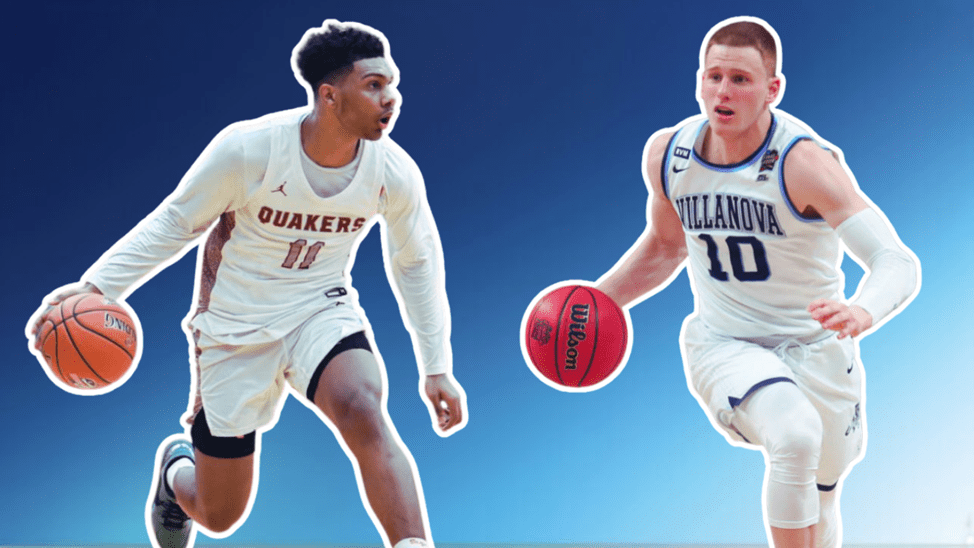
Closest match: Donte DiVincenzo (2017–18): Distance = 1.98, Comp Score = 81.48
DiVincenzo’s 2017–18 season aligns closest with Lewis due to their shared two-way activity and athletic guard profiles. Both players showed a balanced mix of scoring (Lewis PTS Z = 1.11, DiVincenzo = 0.99), rebounding (Lewis TRB Z = 0.93, DiVincenzo = 0.63), and playmaking (Lewis AST Z =2.22, DiVincenzo = 1.63) paired with strong defensive instincts (Lewis STL Z = 2.09, DiVincenzo = 1.07). The similarity between the two lies not just in numbers but in how they generate impact by scoring efficiently, facilitating, and defending with intensity. While Lewis’s context as a high school player makes these comparisons broad, his statistical resemblance to DiVincenzo suggests him as a high-energy, two-way guard who has the ability to take on a major role within Villanova’s system.
Lewis’s metrics reinforce the idea of a poised, energetic guard with a strong foundation for two-way impact. His profile suggests a player who contributes through activity, composure, and playmaking instincts outside of pure scoring output. As he transitions to the college level, Lewis has the potential to be a dynamic, well-rounded player that can make an immediate impact in this new era of Villanova basketball.
Ultimately, this analysis provides an early statistical glimpse at what Villanova could have in Acaden Lewis. If Lewis develops within Villanova’s structure, it would be exciting to see him evolve into the kind of well-rounded, high-energy guard that these statistical comparisons represent. And, if he chooses to stay beyond his freshman year rather than immediately pursuing the NBA, Lewis has the potential to grow into a Villanova a guard who becomes talked about for years to come, much like the program’s most iconic backcourt players over the past decade.
This project set out to use data and historical context to better understand how Villanova’s newest additions might fit into the program’s long-standing identity. Through statistical modeling and player comparisons, we were able to connect the profiles of Villanova’s newest additions to some of the most memorable seasons in Villanova basketball history. From high-usage guards to stretch forwards still finding their offensive rhythm, the results highlight how each of these players might evolve within the structure and culture that defines Villanova Basketball. Even when the comparisons do not perfectly align, they offer valuable perspective on what traits, skills, and tendencies Villanova fans might find familiar.
Ultimately, this analysis brings to light the excitement of a new era of Villanova Basketball. Each player carries a unique path, yet all share the opportunity to contribute to something bigger than themselves. While we will not be seeing these past players reborn in this roster, we will be watching a group capable of building its own legacy. It is going to be exciting to see what is in store for this season and how these new additions work together to create the next chapter of Villanova Basketball.
From College Park to the Main Line: Kevin Willard’s Next Chapter
Anthony Loh
March 31st, 2025

In the ever-evolving college basketball world, coaching changes can send shockwaves through the sport. Kevin Willard’s move from Maryland to Villanova is one such move that has reshaped the landscape. Here, I talk about the timeline of events leading up to Willard’s departure and why he left.
The Saga Unfolds: A Timeline of Events
- March 15, 2025: Willard emerged as a candidate for the Villanova head coaching position.
- March 16, 2025: CBS reporter Jon Rothstein revealed that Willard and Maryland were negotiating a contract extension to make him one of the top 10 highest-paid coaches in college basketball. During his Selection Sunday press conference, Willard aligned himself with Maryland Athletic Director Damon Evans, stating, “Me and Damon are on the same page … his focus and my focus are the same.”
- March 20, 2025: Pete Thamel reported that Evans was the leading candidate for SMU’s Athletic Director position, casting doubt on Maryland’s administrative stability. In a press conference in Seattle, Willard—commented, “Evans is ‘probably’ going to SMU … I need to see ‘fundamental changes,’” highlighting the challenges of his future amid uncertainty.
- March 21, 2025: Maryland defeated Grand Canyon in the Round of 64. Postgame, Willard dismissed any controversy, saying there was “no situation” and expressing enthusiasm for his role while advocating for changes. Later that day, Colleen Sorem was appointed interim Athletic Director.
- March 23, 2025: Maryland secured a victory over Colorado State on a buzzer beater in the Round of 32, sending Willard to his first Sweet 16 as a head coach.
- March 25, 2025: In a radio appearance, Willard affirmed, “As of now, I’m staying in Maryland,” but added he’d “absolutely” stay only if his conditions were met.
- March 26, 2025: In a pre-Florida game press conference, he sidestepped rumor-related questions, hinting at unresolved tensions.
- March 27, 2025: Before Maryland’s NCAA Tournament game against Florida, which ended in an 87-71 loss, Kevin Willard faced a wave of boos from Maryland fans as his final appearance as head coach. In his last press conference with the Terrapins, Willard appeared uncertain about his future, sharing with the media, “I don’t know what I’m doing… I haven’t talked to my agent. I haven’t talked to my wife… I have an agent; I’m sure he’s talking to people because that’s what agents like to do, but I don’t know.” When asked about the possibility of returning to College Park, Willard responded “I love College Park. I love Maryland. But this is going to be a family decision.” Shortly after, Willard told at least one person “I’m out of here”.
- March 30, 2025: At 12:57 AM, Terrapins beat reporter Jeff Ermann announced that Kevin Willard and Villanova had finalized an agreement, officially naming him the next head coach of the Wildcats and bringing the saga to a close. He informed his team of his plans on Zoom.
Willard’s Departure
Willard’s exit from Maryland was driven by his push for “fundamental changes.” He had issues with the Big 10’s schedule and travel which got worse when former PAC-12 teams joined the conference. At Maryland, football was set to dominate the upcoming $20.5 million House settlement funds, leaving basketball underfunded. Even despite making a Sweet 16, Maryland spent about $3 million in NIL for this year’s roster which would put it in the middle of the Big 10. To put into context, star F Eric Dixon on the Villanova alone made approximately 1.7 million through NIL. The departure of AD Damon Evans for SMU exacerbated Willard’s concerns about leadership stability.
Villanova, after three seasons under Kyle Neptune without an NCAA Tournament appearance, saw Willard as the solution. With a 335-249 career record and seven NCAA Tournament berths—including a 2016 Big East title win over Villanova—Willard brings experience in the conference. His 12 years at Seton Hall and Sweet 16 run made him the pick by AD Eric Roedl.
The lack of an FBS football program provides a financial edge in the new era of college basketball. With the House settlement distributing significant funds to athletes, Big East schools like Villanova can allocate a larger share to basketball. Unlike Power 4 programs—where football often claims the majority of funds—Villanova’s basketball program stands to benefit disproportionately. This, combined with an elite alumni donor network and NIL budget, equips Willard with the resources to attract top talent.
The Future
Willard’s departure leaves Maryland at a crossroads, with candidates like Buzz Williams rumored to replace him. His move to the Main Line reflects the shifting dynamics of college basketball with how much funds are leveraged. This could inspire other basketball-focused schools to invest heavily, challenging the dominance of football-driven Power 4 conferences. Ultimately, these changes signal a new era of NIL and a reconfiguration of competitive balance, making the sport more unpredictable.
Predicting the Rest of the Regionals
Anthony Loh
March 25th, 2025

This year’s tournament has rewritten the record books before the Sweet 16 even tips off. The SEC has stormed in with an unprecedented seven teams—the most from any conference in a single Sweet 16 in NCAA history. This year’s second weekend is a gauntlet with only four conferences—SEC, Big Ten, Big 12, and ACC—represented, smashing the previous low of seven. No double-digit seeds survived past the first weekend, a first since 2007. This sets the stage for what promises to be the most competitive clash in recent memory. Every Sweet 16 team has ranked in the Bart Torvik top 30 since February 1st. With the stage set for a battle of the best, here are my predictions for how this Sweet 16 and Elite 8 will play out.
Sweet 16
Michigan (5S) vs. Auburn (1S)
Auburn comes in just 109 miles from campus, bringing a home edge in the heart of Atlanta. Many ties connect this matchup: Michigan assistant coach K.T. Harrell played under Bruce Pearl at Auburn, PG Tre Donaldson suited up for Auburn last season, G Namari Burnett played at Bama, and F/C Danny Wolf played at Yale last year in an upset over the Tigers. Michigan boasts a stout defense, ranking 13th nationally in two-point field goal defense (30.9%) with their double seven-footer lineup—meaning Auburn’s Johni Broome will face a tougher battle in the paint. Auburn’s guards will need to step up from beyond the arc, where the Tigers shine, sitting 44th in three-point shooting at 36.6%. Michigan counters with a strong 34th-ranked three-point defense (30.9%). Offensively, the Wolverines struggle, ranking only 44th in adjusted offensive efficiency and faltering from deep. Their true weakness stands out: turnovers. Torvik has them at a shaky 19.6% turnover rate—among the nation’s sloppiest—placing Michigan at 321st nationally. Auburn will exploit this, forcing turnovers and turning them into a fast-break clinic. The Tigers advance with a statement win.
Ole Miss (6S) vs. Michigan State (2S)
Michigan State rides Tom Izzo’s March magic. He now has 27 appearances in March Madness and the 4th most wins in the tournament at 58. In a historical contrast, Ole Miss hasn’t reached the Sweet 16 since 2001—until now. The Rebels also just hit 24 wins for the first time since 2010. Chris Beard defies the odds of the Rebels basketball program. Over the past decade, he’s guided Little Rock to its first tourney win in 30 years, led Texas Tech to the national title game, and had Texas atop the rankings. Ole Miss disrupts Michigan State’s flow, excelling at avoiding turnovers (3rd-lowest nationally) and causing them (32nd), against MSU’s 150th-ranked turnover rate. Mississippi also outshoots the Spartans from three—34.8% (120th) to Michigan State’s 31.0% (318th). With the statistical fact that unranked AP teams earning a 1 or 2 seed have never made the Final Four along with the strong Ole Miss alumni network who will be in attendance in Atlanta, Ole Miss pulls off an upset, continuing the SEC dominance.
Maryland (4W) vs. Florida (1W)
The West Region’s top half held chalk, with Florida and Maryland advancing after tight scares. Kevin Willard’s Maryland lineup gets a breather—crucial for a squad thin on depth—leaning on their “Crab 5,” who scored 70 of 72 points and took 59 of 62 shots in a buzzer-beater win over Colorado State. They face Florida, ranked top five in adjusted offensive efficiency and top 15 defensively. Maryland, a top-10 team themselves, brings an elite defense and a solid offense. The Terps force more turnovers and shoot better from deep, while Florida dominates inside, excels at offensive rebounding, and has faced a tougher slate. This matchup will ultimately provide more output outside of the starting lineups and this is where the Gators’ deeper bench proves the difference—Maryland’s ranks outside the top 100 in bench minutes. Florida advances to the Elite Eight for the first time since 2017.
Arkansas (10W) vs. Texas Tech (3W)
Unlike the top half, the bottom half of the West Region delivered the tournament’s biggest upset so far, with Arkansas stunning St. John’s in Providence. The Razorbacks are red-hot, having toppled Hall of Fame coaches Bill Self and Rick Pitino. John Calipari’s turnaround of a team that started 0-5 in SEC play into a legitimate March contender is nothing short of remarkable—despite losing five-star recruit Boogie Fland for the regular season. The Razorbacks will likely see the return of leading scorer Adou Thiero from a hamstring injury, a massive recoup for a shorthanded 8-man rotation. Texas Tech, despite recent wins, has struggled, shooting a dismal 25% from three in the tournament and are still without starting G Chance McMillan. Now they face Arkansas’s 18th-ranked Torvik adjusted defense—a significant step up from Drake and UNC Wilmington. Something special is brewing in Fayetteville, and as the last double-digit seed, Arkansas continues to wield its magic and lock down opponents. With Calipari’s impressive 12-3 Sweet 16 record and 4-1 mark as an underdog, the Hogs keep their momentum rolling to San Francisco.
Arizona (4E) vs. Duke (1E)
Two top-11 Bart Torvik teams collide in Newark, rematching an earlier game held in Tucson, Arizona on November 22nd where Duke won 69-55. The Wildcats face a cross-country trek, a clear disadvantage, while the Blue Devils enjoy a near-home edge anywhere on the East Coast. Arizona’s strategy—avoiding threes and daring opponents to shoot them—falters against Duke, a top-20 team in both making and stopping three-pointers. Tommy Lloyd’s squad struggles to force turnovers and often loses possession, while Duke boasts one of the lowest turnover rates. Inside, the Blue Devils rank top-five in two-point shooting and defense; Arizona is solid but only barely top-50. Jon Scheyer’s crew cruises to a blowout.
BYU (6E) vs. Alabama (2E)
Two of the nation’s fastest offenses collide, with a projected total soaring past 174 points. Nate Oats boasts the country’s quickest attack—the fastest since Washington in 2016—ranking Alabama fifth on Torvik offensively, just ahead of BYU at sixth. Neither team’s defense stands out, but Alabama’s has been particularly shaky lately, surrendering 80+ points in seven games and 90+ in four. The Tide’s defense languishes at 350th nationally in forcing turnovers, disrupting only 13.5% of possessions—the weakest rate in the SEC. Wisconsin failed to rattle BYU’s ball handlers, allowing Egor Demin and the Cougars to slice through their defense with ease. Alabama will encounter the same problem if they can’t pressure Kevin Young’s squad. BYU’s late-season surge—reminiscent of their 1981 Elite Eight run—propels them past the Crimson Tide in a thrilling upset.
Purdue (4MW) vs. Houston (1MW)
Two slow-paced offenses square off in the Midwest semifinal in Indianapolis. For Purdue, this marks Matt Painter’s sixth Sweet 16 appearance in eight years; for Houston, Kelvin Sampson has reached this stage every year since 2019—the longest active streak, cemented by snapping Gonzaga’s near-decade run in the previous round. Purdue benefits from a near-home crowd at Gainbridge Fieldhouse, a mere 65 miles from campus, while Houston treks 1015.2 miles. Houston sits atop Torvik’s rankings, outpacing every team in the field. Yet, Sampson’s No. 1 seeds have a history of faltering: Duke knocked them out in the 2024 Sweet 16, Miami did the same in 2023, and back in 2003 at Oklahoma, Syracuse halted them in the Elite Eight. Purdue’s rowdy fans—fueled by proximity and led by Braden Smith, the nation’s top point guard—capitalize on Houston’s recurring March curse, sending the tournament’s first No. 1 seed home.
Kentucky (3MW) vs. Tennessee (2MW)
SEC vs. SEC. One of college basketball’s most toxic rivalries descends on Indianapolis, with both teams vying for an Elite Eight spot. Kentucky swept Tennessee this season—winning 78-73 in Knoxville on January 28th and cruising 75-64 in Lexington on February 11th. The Wildcats sank 12-of-24 threes in both games, while Tennessee faltered, managing just 11-of-45 in the first and a meager 3-of-18 in the second. The Vols couldn’t take advantage of Kentucky’s 280th-ranked two-point defense—despite a top-25 three-point defense—settling for excessive perimeter shots in the opener and getting outscored 27-9 from deep in the rematch, even with a 20-for-36 showing inside. Both contests dragged at Tennessee’s preferred slow pace—67 and 64 possessions—yet they couldn’t find their footing. Tennessee’s defense, which restricts opponents to 28.3% from three, unraveled as Kentucky shot 50% in each matchup. With a healthy Lamont Butler—who logged only 22 minutes combined earlier in the first two games—and a storied 34-11 Sweet 16 record against Tennessee’s 2-10, Kentucky moves on to the regional final.
Elite 8
Ole Miss (6S) vs. Auburn (1S)
This Elite 8 clash marks the third SEC showdown of the season between Ole Miss and Auburn. The Tigers previously topped the Rebels 92-82 in Oxford on February 1st and edged them out 62-57 in a tighter SEC Tournament rematch on March 14th, thanks to a late bucket from Johni Broome. Auburn holds a decisive advantage, ranking 21 spots higher offensively and 17 spots higher defensively. The Tigers shoot an impressive 55.6% effective field goal percentage (24th nationally), outclassing Ole Miss’s 51.6% (131st). On defense, Auburn limits opponents to a stingy 46.2% effective field goal percentage (15th), while the Rebels lag at 50.3% (147th). Ole Miss shines with a low turnover rate and a pesky smaller lineup that forces a 20.3% opposing turnover rate (32nd), but their rebounding struggles could be their undoing. With a dismal 25.3% offensive rebounding rate (313th) and a 30.7% defensive rebounding rate, the Rebels are primed to get outmuscled on the boards. Despite these strengths, their rebounding issues will likely be their downfall against Auburn’s physicality. Add in strong crowd support in Atlanta—given its proximity to Auburn—and the Tigers should dominate this matchup.
South Region Prediction: Auburn
Arkansas (10W) vs. Florida (1W)
This all-SEC Elite 8 battle revisits a January 11th clash in Fayetteville, where Florida handled Arkansas 71-63 with ease. The Gators have since solidified their dominance, ranking in the top 4 per Torvik’s metrics. Boasting one of the tallest frontcourts in the tournament, Florida crashes the offensive glass at a 38.7% rebound rate, overwhelming smaller foes. Arkansas’s guards excel in transition, but their shaky 32.4% three-point shooting (246th) faces a tough test against the Gators’ elite 29.3% three-point defense (5th). Florida’s smothering defense, ranked 5th in effective field goal percentage allowed at 45.4%, should stifle the Razorbacks’ offense both inside and beyond the arc. Arkansas’ open-floor style won’t find enough room to breathe against the Gators’ length. With their dominant offense and stifling defense, Florida is poised to disrupt Calipari’s attack plan and secure a trip to San Antonio.
West Region Prediction: Florida
BYU (6E) vs. Duke (1E)
BYU and Duke set the stage for an Elite 8 shootout, pitting two of the nation’s most dynamic offenses against each other. The Blue Devils rank 3rd in effective field goal percentage and lead the nation in effective field goal defense, holding opponents to just 44.1%. BYU’s analytically driven offense launches 47.8% of its shots from deep, hitting 37.3% (27th), but Duke’s perimeter defense—allowing a mere 30.5% from three, one of the country’s best marks—could shut that down. The Cougars rely on crisp ball screens and off-ball cuts to free shooters, but Duke’s switchable defenders and quick closeouts should force contested low-percentage shots. Inside, BYU’s defense allows 49.1% shooting within the arc, a weakness the Blue Devils’ skilled bigs can exploit with their 58.5% two-point shooting (5th nationally). Duke’s superior rebounding on both ends of the glass, will provide more possessions, sealing their commanding march to the Final Four.
East Region Prediction: Duke
Purdue (4MW) vs. Kentucky (3MW)
Purdue takes on Kentucky in Indianapolis, just 65 miles from West Lafayette, giving the Boilermakers a near-home edge. Their offense ranked 8th nationally in efficiency, revolves around a crafty point guard averaging 8.5 assists per game (2nd nationally) and a 20.3 PPG scorer in Trey Kaufman-Renn. Kentucky counters with the 12th-best offense and a tidy 14.9% turnover rate (35th), fueled by a fast-paced style at 70.9 AdjTempo (25th). However, the Wildcats face a hurdle: Purdue’s deliberate pace, ranked 298th in tempo, could frustrate their fast-break rhythm. The Boilermakers’ half-court attack thrives on patience, while Kentucky struggles to force turnovers (337th nationally), leaving them vulnerable to Purdue’s composed sets. By dictating a slower game and leveraging their home-like crowd, the team from West Lafayette should capitalize on this tempo mismatch to secure a back-to-back trip to the Final Four.
Midwest Region Prediction: Purdue
The Quest for the Next Villanova Head Basketball Coach
Anthony Loh
March 15th, 2025
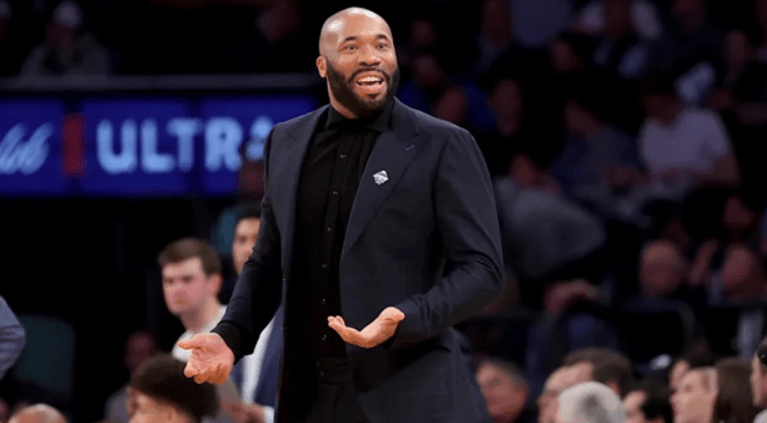
Kyle Neptune had been relieved of his coaching duties after three seasons, during which he failed to guide the Wildcats to the NCAA Tournament—despite vast NIL resources. Succeeding Jay Wright—who delivered two national championships, four Final Fours, and 16 NCAA Tournament appearances—the bar was set extraordinarily high. Neptune’s inconsistent performance—punctuated by surprising losses to smaller programs—fell far short of expectations. The Villanova job remains one of the most attractive—given its rich history and that Big East schools, lacking high-level college football programs, funnel a larger share of revenue into their basketball programs. With the search for Neptune’s replacement underway, here are potential candidates—split into realistic and unrealistic tiers.
Realistic Tier
Chris Collins (Northwestern)
Collins brings a Philadelphia connection through his father, Doug Collins, a former 76ers player and coach from 2010 to 2013. Since taking the helm at Northwestern in 2013, Chris has transformed a historically difficult program, securing its first-ever NCAA Tournament berth in 2017 and adding two more appearances (2023, 2024). His teams have cracked the AP Top 25 multiple times during his tenure—a testament to his ability to succeed in a challenging environment. Collins’ academic focus, honed at Duke as a player and assistant, aligns seamlessly with Villanova’s values, making him a compelling candidate.
Ryan Odom (VCU)
Odom’s name has surfaced for multiple openings this cycle, including Virginia NC State, and now Villanova. In his second season at VCU, he captured the Atlantic 10 regular-season title in the 2024-25 season, building on prior success at Utah State, where he reached the NCAA Tournament in 2023. His signature achievement remains the 2018 upset of No. 1 Virginia—as a 16-seed with UMBC—the first of its kind in men’s tournament history. Whispers of his interest in Villanova suggest he’s a serious contender.
Richard Pitino (New Mexico)
Pitino has revitalized his career at New Mexico, leading the Lobos to the Mountain West tournament title in 2023 and the regular-season championship in 2024—despite losing his three best players: JT Toppin, Jamal Mashburn Jr., and Jaelan House. A move to Villanova would set up a captivating Big East rivalry with his father, Rick Pitino, at St. John’s. After being let go from Minnesota in 2020, Richard has established himself in Albuquerque, showcasing resilience and coaching prowess that could translate to the Main Line.
Porter Moser (Oklahoma)
Having steered Loyola Chicago to two trips to at least the second weekend, including a 2021 Sweet 16 berth and a 2018 Final Four—a run that included four NCAA Tournament wins—Moser offers a resume with his 6 tournament wins. He had a staggering 99-36 record in his last four seasons with the Ramblers, which landed him the head coaching spot at Oklahoma in the Big 12 (now SEC). Although his time with the Sooners has not been the strongest—it presents a potential “buy-low” opportunity based on his previous track record. Moser’s experience in high-pressure settings and his knack for program elevation make him a strong fit for Villanova’s aspirations.
Mike Nardi (Villanova Interim)
Mike Nardi played under Jay Wright at Villanova from 2003 to 2007, contributing to three tournament appearances, including the 2005 Sweet Sixteen and 2006 Elite Eight teams. After his playing career, he gained coaching experience as an assistant at St. Joseph’s and Manhattan, along with player development roles. His deep connection to the Villanova program—understanding its culture and values—combined with his coaching background, makes him a somewhat realistic candidate—even if a sentimental one.
Unrealistic Tier
Grant McCasland (Texas Tech)
McCasland has elevated Texas Tech into a top-10 team on the 3 seed line in the 2025 season after leading North Texas to a 2021 NCAA Tournament upset over Purdue. His 48-19 record over two seasons with the Red Raiders and his program-building ability make him a compelling candidate. However, his deep ties in the state of Texas—a Baylor alum who coached at Abilene Christian—make a move to Villanova improbable.
TJ Otzelberger (Iowa State)
Otzelberger has swiftly turned Iowa State around, posting a 94-43 record over three seasons, successfully making the tournament every year and reaching the Sweet 16 in both 2022 and 2024. His Midwest roots—he’s a Wisconsin native who coached at South Dakota State before Iowa State—and the Cyclones’ upward trajectory, in addition to his wife being an ISU alum, suggests he’s unlikely to depart Ames for Villanova.
Scott Drew (Baylor)
At Baylor, Drew’s 21-year tenure has yielded 12 tournament appearances with a staggering 20 wins in the NCAA Tournament, including a 2021 national championship and a 464-257 record, cementing his status as one of the best coaches ever in the sport. With roots in Indiana and a legacy entrenched in Waco, Drew appears rooted at Baylor—rendering a jump to Villanova a long shot despite his elite credentials.
Buzz Williams (Texas A&M)
Buzz Williams has built a successful program at Texas A&M, leading them to two NCAA Tournament appearances so far in five years. His contract, extended through the 2025-26 season, includes a high buyout clause—which would make it expensive for Villanova to hire him. Additionally, Williams has expressed commitment to Texas A&M, where he’s thriving in the SEC, further reducing the likelihood of a move. His prior Big East experience at Marquette doesn’t outweigh these financial and personal factors.
Billy Donovan (Chicago Bulls)
With two national championships at Florida, Billy Donovan is one of the greatest coaches ever in the sport. Currently the head coach of the Chicago Bulls, his return to college basketball seems far-fetched, in addition to his lengthy NBA experience. The leap from a somewhat stable professional position to Villanova—despite his Big East familiarity from playing at Providence—is unlikely given the lifestyle and salary differences.
The SEC’s Transformation into the Best Men’s Basketball Conference of All Time
Anthony Loh
March 10, 2025

Over the past four months, the Southeastern Conference (SEC) has not only solidified its status as this season’s dominant league but also staked a claim as the strongest conference in college basketball history. Once known primarily for football—the SEC has surged into 2025 as a juggernaut, fueled by elite coaching, financial prowess, and jaw-dropping metrics. How did a league once dismissed as a basketball afterthought transform into an unstoppable force? Here’s the story of the SEC’s ascent to greatness.
The SEC in 2024-25: A Historic Snapshot
Forget football for a moment—men’s basketball in the SEC is rewriting the narrative. As of this article, the league’s non-conference record is 185-23. Their mastery in non-conference Quad 1 games? Unmatched—a 29-19 mark that towers over the ACC (12-53), Big East (11-31), Big Ten (21-40), and Big 12 (15-36). Fourteen unique SEC teams have earned AP Top 25 rankings this season, a testament to the conference’s depth. According to Joe Lunardi’s latest bracketology, 12 of the 16 SEC teams are projected to make the NCAA Tournament—a total that would already surpass the Big East’s 2011 record of 11 bids. That number could grow even larger, with Oklahoma and Texas lingering on the bubble.
The analytics paint an even bolder picture. Ken Pomeroy’s ratings rank all 16 SEC teams in the top 80 of adjusted-efficiency rankings, with 12 in the top 45—led by Auburn (No. 1, +35.89), Florida (No. 4, +34.55), Tennessee (No. 5, +30.85), and Alabama (No. 6, +29.80). Per KenPom, the SEC’s dominance this season is unrivaled—no conference in history has ever performed at a higher level.
How It Happened: From Minnows to Sharks
Historically, the SEC wasn’t a basketball powerhouse—often overshadowed by its football dominance. Rewind to 2015: the SEC was dominated by Kentucky and Florida, with little else to offer. The conference had a losing record against major leagues, ranked at the bottom of the Power 6 (now Power 5), and was a three-bid league desperate for relevance. In one of his final calls as commissioner, Mike Slive sought advice from coaching legends Billy Donovan and John Calipari in which Donovan stressed the need for investment, top-tier coaching, and stronger scheduling while Calipari pushed for the promotion of the league in basketball.
When Donovan left for the NBA in 2015—and the SEC remained at rock bottom in 2016—new commissioner Greg Sankey had seen enough. Acknowledging that the league was not meeting expectations, he brought in consultants who delivered a simple message—success required investment. Through savvier scheduling, elite coaching hires, and leveraging football’s financial might for facilities, transfers, and NIL deals, the SEC turned a corner—mediocrity no longer had a place to hide.
The results are undeniable. Enter Bruce Pearl at Auburn—a hire that became a catalyst. Pre-Pearl, Auburn hadn’t made the NCAA Tournament since 2003; in his first 10 years, he delivered a Final Four, two regular-season titles, and two tournament titles—doubling the program’s modern-era totals in both. This season, the Tigers are 27-4, boasting the most efficient offense in the history of the sport (130.0 ORtg, KP). Pearl’s system, combined with Johni Broome’s dominance (18.6 PPG, 10.6 RPG, 3.2 stocks), has made Auburn the SEC’s poster child. Neville Arena has evolved into a fortress, with fans creating one of the sport’s best atmospheres.
Pearl wasn’t alone. Alabama—led by analytics-minded Nate Oats—runs the fastest offense in college basketball history (78.7 possessions per game), propelling the Crimson Tide to a 24-7 record despite facing the hardest strength of schedule in KenPom history at 18.92 ADJ EM—a mark that shatters the former record (14.71 ADJ EM, 2023-24) also held by Alabama by four points. Fresh off their first Final Four last season, they’re title contenders again (+1000), alongside Auburn (+380) and two other SEC teams in the top six of championship odds. Florida—guided by Todd Golden—boasts a 27-4 record with the third-best offense (127.3 ORtg, KP) and the tenth-best defense (92.6 DRtg, KP)—earning them the third-best title odds (+700). The last of the 4, Tennessee—anchored by the nation’s top defense (88.4 DRtg, KP)—sees Rick Barnes steering the Vols to a 25-6 record with +1600 odds. Other coaching hires—Buzz Williams at Texas A&M, Mark Pope at Kentucky, Chris Beard at Ole Miss, and John Calipari at Arkansas—have added immense coaching talent to the conference.
A driver of this transformation is football revenue—which has indirectly fueled basketball success. The SEC’s financial might, amplified by NIL collectives, has attracted top talent and funded investments in facilities and coaching staff—creating a cycle of competitiveness. The advent of NIL and the transfer portal turned recruiting into a bidding war, with SEC schools using their financial edge to lure elite high schoolers and transfers. Veterans like Mark Sears, John Broome, Zakai Zeigler, and Wade Taylor IV—last year’s first-team All-SEC—returned, and it attracted stars like Chaz Lanier, along with a flood of transfers—boosting roster experience. KenPom ranks Ole Miss, Kentucky, and Texas A&M in the top 10 nationally for Division I experience, with Auburn and Tennessee in the top 25.
The Legacy Test: From Contenders to Champions
The SEC’s rise wasn’t instantaneous. The SEC Tournament and NCAA March Madness loom as the final proving ground. Last year, five of eight SEC teams crashed out in the Round of 64—a heavy disappointment. Now, with roughly a dozen teams tournament-bound, the league aims to end a 13-year national title drought. Thanks to a data-driven revolution and an NIL war chest, the SEC has transformed into a basketball behemoth—and it’s here to stay.
Predicting the 2024-25 Men’s Power 5 Conference Player of the Year Winners
Anthony Loh
March 3, 2025
Throughout four months, the top performers from the Power 5 conferences have strengthened their argument for being recognized as the standout players in their respective leagues. In some instances, the races remain staggeringly close, while in others, one player has dominated for weeks. As the regular season draws to a close with only a few games until conference tournaments and ahead of next week’s official announcements, I offer a take on who I believe could—and should—win Player of the Year in every conference.
ACC
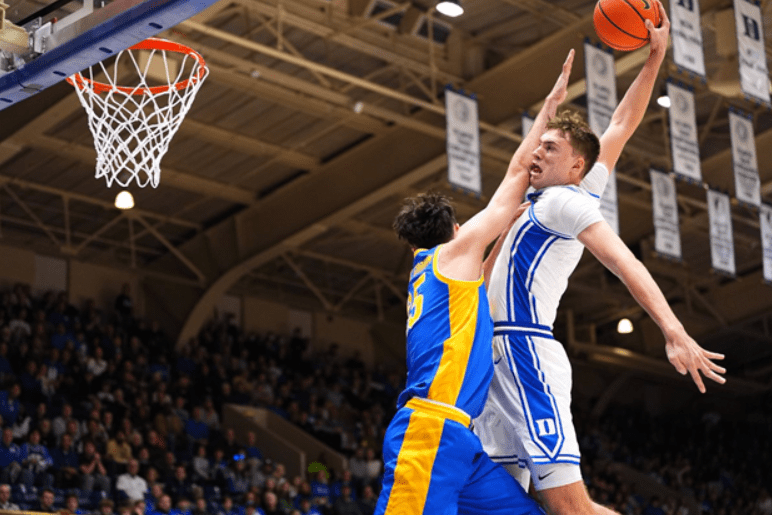
Who I think predict to win: Cooper Flagg, G-F, Duke
Stats: 19.3 PPG, 7.5 RPG, 4.1 APG, 2.7 stocks (49.2% FG, 37.5% 3PT)
Cooper Flagg has redefined what it means to be an 18 year old freshman, stepping onto Duke’s campus and immediately transforming the team back into a powerhouse. He has guided his team to an incredible ranking—the second-best in KenPom history—with a net of +39.09. Flagg excels on both ends of the court, with his unique versatility and defensive impact and his ability to guard the one to the five. Offensively, he’s a catalyst, creating opportunities with his vision while finishing plays with authority. Widely regarded as a certainty for the ACC Player of the Year, Flagg is also poised to secure an impressive array of accolades: ACC and National Freshman of the Year, ACC Defensive Player of the Year, and the frontrunner for the prestigious Wooden Award, with odds presently favoring him at -130.
Honorable Mention: Chucky Hepburn, G, Louisville
Stats: 16.3 PPG, 3.3 RPG, 6.0 APG, 2.5 stocks (45.2% FG, 36.0% 3PT)
Big East
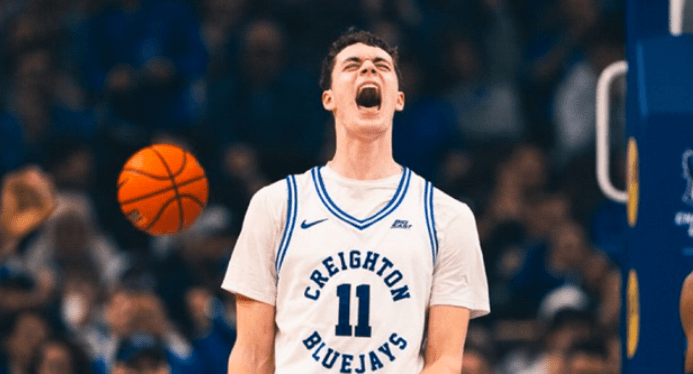
Who I think predict to win: Ryan Kalkbrenner, C, Creighton
Stats: 19.1 PPG, 8.8 RPG, 1.5 APG, 3.3 stocks (65.6% FG, 37.8% 3PT)
Ryan Kalkbrenner has lived up to his preseason billing, anchoring Creighton to a high finish—at least fourth place—in the conference. What makes this season so special from “Kalk” is that his statistical preeminence is unparalleled, ranking among the top-5 ranking among Big East players in PPG, RPG, BPG, FG%, eFG%, TS%, PER, win shares, and oRTG. As a 7 ‘1 presence, Kalkbrenner excels as both a dominant rim protector and a highly efficient scorer, underpinning Creighton’s formidable campaign. However, this is not a one-horse race. RJ Luis Jr., a native of South Florida and a standout for St. John’s University, has engineered a renaissance for the Red Storm, securing their first outright Big East title in over 40 years and reinvigorating basketball in New York. Despite Luis Jr. ‘s impressive season, Kalkbrenner’s consistent excellence on offense and defense along with being the anchor of Creighton’s success in the Big East gives him the advantage in this close race.
Honorable Mention: RJ Luis Jr., G, St. John’s
Stats: 17.8 PPG, 6.9 RPG, 2.3 APG, 2.1 stocks (44.3% FG, 30.0% 3PT)
Big 12
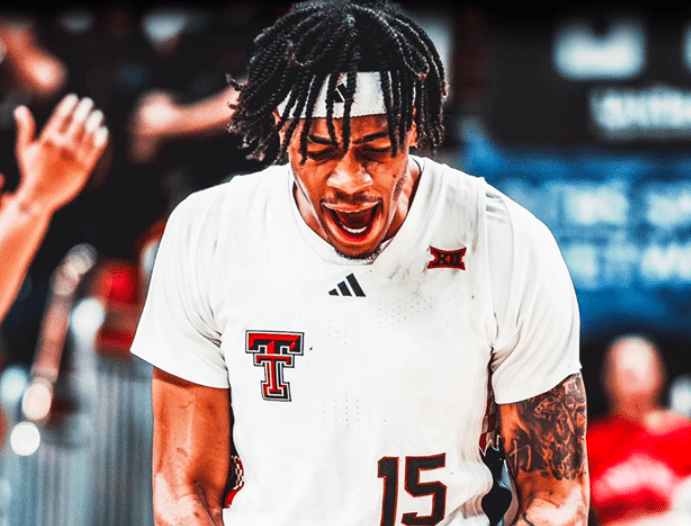
Who I think predict to win: JT Toppin, F, Texas Tech
Stats: 17.3 PPG, 9.0 RPG, 1.0 APG, 2.1 stocks (55.9% FG, 30.8% 3PT)
JT Toppin has ascended to the forefront of the Big 12 Conference, establishing himself as one of the top forwards in the country. Transferring from the University of New Mexico to Texas Tech University, he has propelled the Red Raiders toward the potential of a deep run in March. His remarkable season stats include 11 games with 20 or more points and 12 double-doubles, putting him on NBA draft boards. Notably, his 41-point outburst against Arizona State University on February 12, 2025—the Big 12’s highest-scoring performance this season—solidifying his reputation as an offensive juggernaut. As the frontrunner for Big 12 Player of the Year—and a strong candidate for All-American honors—Toppin has transformed Texas Tech into a formidable force and set the stage for a memorable postseason run.
Honorable Mention: Richie Saunders, F, BYU
Stats: 15.8 PPG, 4.3 RPG, 1.5 APG, 1.6 stocks (52.1% FG, 44.0% 3PT)
Big Ten

Who I think predict to win: Braden Smith, G, Purdue
Stats: 16.0 PPG, 4.5 RPG, 8.7 APG, 2.6 stocks (44.6% FG, 39.5% 3PT)
Braden Smith has taken his play to a different level this year—already breaking Purdue’s all-time leader in assists despite not being past his junior season. He leads the Big Ten in assists per game by a wide gap of 1.7 and tops the conference in steals per game (SPG). His assist average this season is the highest ever in Big Ten history. Still, the competition is close—John Tonje, a transfer guard at the University of Wisconsin, has propelled the Badgers to heights unseen in over a decade, positioning them among the NCAA Tournament’s 2-4 seed lines through his scoring. While both players are near-certainties for All-American distinction—Smith’s superior playmaking gives him a slight edge for Big Ten Player of the Year.
Honorable Mention: John Tonje, G, Wisconsin
Stats: 19.5 PPG, 4.9 RPG, 1.8 APG, 0.9 stocks (48.0% FG, 38.9% 3PT)
SEC

Who I think predict to win: Johni Broome, F-C, Auburn
Stats: 18.4 PPG, 10.8 RPG, 3.3 APG, 3.2 stocks (50.5% FG, 29% 3PT)
Johni Broome has asserted his preeminence within the Southeastern Conference (SEC), emerging as a household name while steering Auburn University to an unprecedented tally of Quad 1 wins. The Tigers currently hold a top-five KenPom rating in collegiate history and wield the most efficient offense ever documented, flourishing within what is widely acknowledged as the nation’s most formidable conference ever recorded. Broome’s centrality to this success is undeniable, evidenced by his 15 outings of at least 20 points and 10 rebounds, a record of consistency and indispensability. As the linchpin of the country’s top-ranked team, he trails only Cooper Flagg in Wooden Award odds at +100. Broome’s versatility—through his shot creation—complemented by his rebounding, undermines his invaluable contribution to Auburn’s historic season.
Honorable Mention: Mark Sears, G, Alabama
Stats: 19.1 PPG, 3.0 RPG, 5.0 APG, 1.1 stocks (41.2% FG, 36.1% 3PT)
Men’s College Basketball Week 1 Top 25
Blake Pearson
November 11, 2024
The opening week of college basketball, filled with mid-major matchups and lopsided spreads, saw a shortage of big games between tournament teams. While most of these games may not contribute to résumé-building wins, they give fans an early glimpse of each team’s current form and potential. With college hoops officially shifting from paper to the court, expect these rankings to continue to fluctuate in the early weeks.
1. Kansas Jayhawks (2-0)
Last week: 1
In one of only four ranked matchups in the first week, Kansas took care of business at home, knocking off North Carolina 92-89. It was closer than the Jayhawks probably would have liked, considering it was in Allen Fieldhouse, but no team is going to drop in the rankings after a top ten victory. Hunter Dickinson has looked great, as has South Dakota State transfer Zeke Mayo. Mayo has led the team in scoring in both games, the other a 30-point win over Howard, and he is looking like a significant addition for Self’s squad. One thing to monitor over the coming weeks is the play of AJ Storr, who has had a slow start in reserve minutes—a bit surprising for the consensus top five transfer out of Wisconsin.
2. Alabama Crimson Tide (2-0)
Last week: 2
Alabama opened their season by dominating a mediocre UNC Asheville team, winning 110-54, with seven players scoring in double digits—a testament to the depth of this Crimson Tide squad. Alabama followed their victory up with a closer win at home against a solid Arkansas State team, one expected to be in strong contention for an automatic tournament bid from the Sun Belt. Mark Sears has been playing like his usual self, and Grant Nelson has been impressive off the bench. The upside of this team lies in their freshman class, as starters
Derrion Reid and Labaron Philon have looked strong in their first two games at the collegiate level. Keep an eye on Cliff Omoruyi’s usage, as Nate Oats has opted to keep him off the floor in late-game situations.
3. Auburn Tigers (2-0)
Last week: 7
The big winners of the week were the Auburn Tigers, who pulled off a thrilling victory against Houston in just their second game of the season. This enormous victory came only a day after the team plane was forced to make an emergency landing due to a physical altercation between two players. The players involved did not make the trip to Houston, and the rest of the team managed to put the incident behind them, securing what may be the biggest non-conference win in program history. Johni Broome has been as good as advertised, and freshman Tahaad Pettiford took over the Houston game down the stretch in an impressive performance. Auburn will look to leave the controversy in the past and continue this hot streak.
4. Gonzaga Bulldogs (2-0)
Last week: 6
Gonzaga opened their season with the most impressive win of the week, stomping all over Baylor in a 101-63 victory. The Zags used an eight-man rotation, and all eight players made significant box-score contributions, proving their depth to be a scary sight for opposing teams. Gonzaga also defeated Arizona State later in the week, another quality win, though not in as dominant of fashion. Ryan Nembhard has been the offensive catalyst so far, registering 11 assists in each game. The transfer class has also impressed, with Pepperdine’s Michael Ayayi and Arkansas’s Khalif Battle both putting up big numbers. Everyone anticipated that Gonzaga would be a top team, but they have somehow exceeded even those lofty expectations up to this point.
5. UConn Huskies (2-0)
Last week: 4
UConn breezed through their first week of games, defeating Sacred Heart and New Hampshire by an average of 37.5 points. The Huskies do drop in the rankings due to impressive victories
by Gonzaga and Auburn, but there’s not much more UConn could have done in this opening week. Alex Karaban looks comfortable being the go-to superstar, and freshman Liam McNeeley has impressed with back-to-back double-doubles to start his college career. While Aidan Mahaney has gotten off to a slow start, Solo Ball has been a pleasant surprise in his sophomore year, surpassing 14 points in both games. UConn will be great this season, but they may continue to slide slightly as they do not play an important game for another two weeks.
6. Houston Cougars (1-1)
Last week: 3
In what had the feel of a potential Final Four matchup, Houston lost a heartbreaker to Auburn, 74-69. They drop in the rankings, and understandably so, but losing a nail-biter to an elite team on a neutral court is not cause for concern. The defense was a bit shaky in the second half, but Auburn hit some tough shots and grabbed some timely offensive rebounds. The offense, which was the main question mark heading into the season, looked more than capable of winning big games, with LJ Cryer and Emanuel Sharp forming a formidable backcourt duo. The Cougars will shake this one off, tip their hat to Auburn, and almost assuredly return to the top five at some point this season.
7. Iowa State Cyclones (1-0)
Last week: 5
The only team in the rankings with just a single game played, Iowa State took care of business in an 83-44 win over Mississippi Valley State. The Cyclones looked dominant on both sides of the ball, as expected, and only dropped in the rankings by default. Keshon Gilbert and Tamin Lipsey led the team in scoring and will continue to be their top two scorers. The question marks on the inside might have been answered after solid play from Charlotte transfer Dishon Jackson and St. Mary’s transfer Joshua Jefferson. A one-game sample size is nearly impossible to judge, but Iowa State looked as good as possible in their blowout win.
8. Duke Blue Devils (2-0)
Last week: 8
Duke has yet to be tested through two games, both resulting in big wins over Maine and Army. It was unclear how big of a role the freshmen would play for the Blue Devils, but the upperclassmen seem to have taken a backseat early on. This team will go as far as Cooper Flagg and Kon Knueppel will take them, and that should be a long way. Flagg looks NBA-ready at just 17 years old, and Knueppel already appears to be one of the best pure scorers in the country. As long as Duke’s depth players stick to their roles and leave the ball in the hands of their two young superstars, the Blue Devils should be an ACC powerhouse once again.
9. North Carolina Tar Heels (1-1)
Last week: 10
It is rare to lose a game this early in the season and rise in the rankings, but North Carolina got the best loss possible—a three-point defeat at the number one ranked Kansas Jayhawks. The Tar Heels’ frontcourt looks thin, as expected, but they have arguably the best trio of guards in the nation in RJ Davis, Seth Trimble, and Elliot Cadeau. Trimble and Cadeau appear to have made massive leaps since last season, easing some of the weight that will be on Davis’s shoulders all year. If Jae’Lyn Withers and Jalen Washington can be slightly more than just serviceable on the interior, this team will be on Duke’s heels all season atop the ACC standings.
10. Arizona Wildcats (2-0)
Last week: 11
Arizona had a light schedule to open their season, defeating Canisius and Old Dominion with relative ease. The schedule toughens up next week with Wisconsin and then Duke, but the Wildcats have the personnel to be prepared for it. Their three returning guards—Caleb Love, Jaden Bradley, and KJ Lewis—stack up against any backcourt in the country, with Love being a Player of the Year candidate in the Big 12. The transfer class has also looked great, with Tennessee transfer Tobe Awaka putting up 18 points and 15 rebounds against ODU. The conference schedule will be much tougher this year outside of the Pac-12, but Arizona looks geared up to compete for a regular-season title.
11. Tennessee Volunteers (2-0)
Last week: 13
Tennessee opened their season with two straight wins, headlined by a 22-point rout on the road against Louisville. That win should age well as the season progresses, as the Cardinals have a lot of new, talented pieces that need time to build a rapport together. Tennessee lost several key players from last year, but North Florida transfer Chaz Lanier is looking like the perfect superstar replacement for Dalton Knecht. The rest of the backcourt is full of talent, led by senior Zakai Zeigler. The frontcourt is a little shaky, but Ohio State transfer Felix Okpara has been serviceable thus far. As long as Rick Barnes is at the helm, Tennessee will be atop the SEC standings.
12. Creighton Bluejays (2-0)
Last week: 12
The story of Creighton’s season thus far has been the play of star big man Ryan Kalkbrenner, who dropped 49 points on 20-for-22 shooting in an opening win over UT Rio Grande Valley. While a great season was expected from Kalkbrenner, these video game numbers will put him in strong contention for First Team All-American honors. Steven Ashworth has also had a terrific start, averaging 20 points through two games. The question marks for this team, just like in years past, will be depth. If two of Mason Miller, Isaac Traudt, and Jamiya Neal can be relied upon for consistent scoring, Creighton will challenge UConn for the Big East title.
13. Baylor Bears (1-1)
Last week: 9
Absolutely nothing was clicking for Baylor in their season opener, as they were walloped by Gonzaga 101-63 on the road. However, Baylor seemed to figure it out in their second game, defeating a solid Arkansas team on a neutral court. It is hard to overlook the disaster that was the Gonzaga game, but the Arkansas win is enough to keep Baylor’s ranking afloat, for now. The offense was much more balanced and efficient, with five players scoring in double figures against the Razorbacks. Freshman VJ Edgecombe looked more comfortable than in his debut, although he still shot the ball at a horrendous rate. Norchad Omier looked more like his Miami self, which was huge in the victory. The first game was definitely worrying, but Baylor will be fine.
14. Texas Tech Red Raiders (2-0)
Last week: 20
Texas Tech is one of the biggest risers in this week’s rankings, despite unimportant wins over Bethune-Cookman and Northwestern State. This ranking is based largely on the eye test, and Grant McCasland does not get nearly enough credit for the work he has done to revive this program. The Red Raiders can defend at an elite level, as per usual, but the scoring abilities of this squad far exceed those of previous years. JT Toppin, a New Mexico transfer, might be the most underrated player in the country, and he is surrounded by guards who can do it all in Kerwin Walton, Chance McMillian, and Kevin Overton. This team is balanced and can compete with any team in the Big 12.
15. Cincinnati Bearcats (2-0)
Last week: 21
Cincinnati had a very similar week to Texas Tech, winning two easy games in blowout fashion and looking very impressive in the process. Cincinnati lacks a true star, but they are another balanced team with strong guard play and solid bigs. The returning backcourt trio of Dan Skillings Jr., Jizzle James, and Simas Lukosius is as consistent as any. Aziz Bandaogo and Texas transfer Dillon Mitchell offer a tremendous amount of upside in the frontcourt. Look for Cincinnati to wear teams out with their depth and physicality in what will be one of the better Bearcat teams in recent memory.
16. Indiana Hoosiers (2-0)
Last week: 15
Despite a slow start from Stanford transfer Kanaan Carlyle through two games, Indiana’s talent has been on full display after two blowout wins. Mackenzie Mgbako looks like one of the best players in the country after dropping 31 points in a win over SIU Edwardsville, while Malik Reneau and Oumar Ballo round out a deadly frontcourt. Consistent guard play might be an issue, but Carlyle should pick it up, and Washington State transfer Myles Rice has looked solid. If Indiana sticks to their strengths and forces the ball inside consistently, they will dominate a weak Big Ten conference.
17. Kentucky Wildcats (2-0)
Last week: 17
Kentucky was a difficult team to rank in the preseason with a completely reloaded roster and coaching staff, but the offense is firing on all cylinders early, eclipsing triple digits in both victories. Dayton transfer Kobe Brea, who led the nation in three-point field goal percentage last season, is shooting the lights out once again, and Drexel transfer Amari Williams is a beast on the interior. Oklahoma’s Otega Oweh has also looked great on both ends of the floor. They have yet to play a notable team, but Mark Pope’s squad is looking dangerous in his first year in the SEC.
18. Xavier Musketeers (2-0)
Last week: 18
Xavier came out of the gates slow, facing a halftime deficit against Texas Southern, but picked up the intensity in the second half en route to back-to-back wins. Dayvion McKnight and Indiana State transfer Ryan Conwell form an impressive one-two punch in the backcourt, and forward Zach Freemantle picked up right where he left off in his first game back in over a year. The Musketeers will take time to build chemistry due to all their moving parts in the offseason, but if things are clicking for them by Big East play, UConn may not coast to another regular season championship this year.
19. Texas A&M Aggies (1-1)
Last week: 14
This ranking would look quite different for the Aggies if they had just held on to their 11-point lead late in the game at UCF. Texas A&M went cold from the field at the worst time, and they dropped the matchup 64-61. Road games are never easy in college basketball, especially against a formidable opponent in UCF, so it is best not to overreact. The Aggies bounced back in their next game on the back of Zhuric Phelps’s scoring punch. Wade Taylor IV is still the guy for this Texas A&M squad, though, and with a solid supporting cast around him, this team could get hot and make some noise despite their early loss.
20. Purdue Boilermakers (2-0)
Last week: 24
Purdue had many question marks heading into this season surrounding life post-Zach Edey, but they appeared to find a replacement quickly. 7’4” freshman center Daniel Jacobsen looked great in the season opener, a win over Texas A&M-Corpus Christi, notching 13 points and 7 rebounds. Unfortunately for the Boilermakers, Jacobsen suffered a broken tibia in their second game and will likely redshirt, ending his season. A crushing blow, the depth behind Braden Smith, Fletcher Loyer, and Trey Kaufman-Renn is now extremely slim. This trio will be enough to be competitive in every game they play in a weak Big Ten conference, but Jacobsen was the X-factor.
21. Marquette Golden Eagles (2-0)
Last week: 23
Marquette has won three of their four halves so far by over 18 points, with the lone outlier resulting in a halftime deficit against George Mason. They bounced back and won handily, however, and the offense looks better than expected following Tyler Kolek’s departure. Kam Jones will threaten to lead the nation in scoring, and David Joplin and Chase Ross have taken the next step to become more than complementary pieces. Interior defense might be a problem, especially in a conference full of talented bigs, but the Golden Eagles can score with anyone.
22. Texas Longhorns (1-1)
Last week: 16
Another team out of Texas that dropped their opening game of the season, the Longhorns fell 80-72 to Ohio State at a neutral site. Ohio State looked better than anticipated, and Arkansas transfer Tramon Mark was out with an ankle injury, so an overreaction is unnecessary. Rodney Terry said postgame that Mark will be out indefinitely, however, so his absence may need to be factored into the ranking eventually. On the bright side, freshman Tre Johnson looks like a budding superstar after following up a 29-point performance with 28 points against Houston Baptist. If Johnson keeps this up and Mark returns soon, this loss will be quickly forgotten.
23. St. John’s Red Storm (2-0)
Last week: 25
Rick Pitino’s second season with St. John’s is already looking far more promising after two dominant offensive performances to start the campaign. Of the few players returning from last year, RJ Luis Jr., Simeon Wilcher, and Brady Dunlap all seem to have taken massive leaps in their play. Utah transfer Deivon Smith is also looking like the perfect fit as a pass-first point guard in Pitino’s system. The most encouraging sign has been the scoring output despite the slow start from highly touted Seton Hall transfer Kadary Richmond. It is early, but the Johnnies might be back.
24. Arkansas Razorbacks (1-1)
Last week: 19
Arkansas was a difficult team to rank before the season began, and they might be even tougher now after the first week of play. The Razorbacks did not dominate Lipscomb by any means in their home opener, and then dropped a game to a questionable Baylor team. Arkansas has an undeniable amount of talent, but Coach Cal’s squad seems to be lacking an identity early. Kentucky transfer Adou Thiero’s offensive game looks vastly improved from last year, and freshman Boogie Fland is a scoring threat at all three levels. Two players to watch for the Razorbacks as the season goes on are Trevon Brazile, who missed all of last season due to injury, and Tennessee transfer Jonas Aidoo, whose lack of playing time so far is very surprising.
25. Illinois Fighting Illini (2-0)
Last week: Unranked
Another team that only played two buy games this week, Illinois looked fantastic, scoring 112 in their opener against Eastern Illinois, and pouring in 90 more against SIU Edwardsville. The Eastern Illinois matchup was obviously a one-sided affair, but the freshman class that Brad Underwood put together this offseason was more than impressive. Will Riley dropped 31 points in his first collegiate game, Tomislav Ivisic had a double-double, and Kasparas Jakucionis looked comfortable running the offense. If this young squad can continue to mesh as a group, I would not hesitate to call them the best team in the Big Ten.
Check out the full rankings here: https://blakey-brackets-2024.netlify.app
Memorable Start: Villanova Basketball Week 1 Review
Anthony Loh
November 10, 2024
The beginning of the 2024-25 Villanova Wildcats campaign has brought a very large mixed bag of emotions. Let’s recap.
Disappointment
Let’s start with the rock bottom. At the beginning of the week, Villanova entered the season with a Kenpom ranking of 20th. They have since fallen down 29 spots to 49th. Despite having the 294th-ranked strength of schedule in the country so far, they are only 2-1.
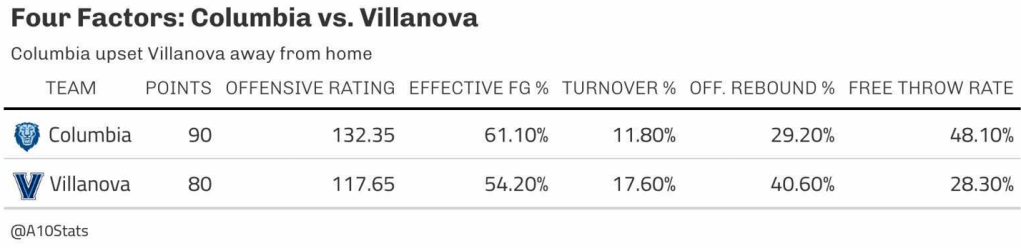
Wednesday’s game against the Lions was one of the most disappointing performances in program history. In a year where the team was expected to improve off a lackluster 23-24 season with a whole new rotation except Eric Dixon and Jordan Longino, the team looked already vulnerable. Despite putting up 80 points, roughly 10 more than their average last season, the defense gave up a staggering 90 points. Columbia had a Kenpom ranking of 217th entering the night and shot 53.7% from the field. Off 12 Wildcat turnovers, Columbia had 21 points, and on the night had 27 fastbreak points compared to 9 from the home team. The defense immensely struggled, and the offense did not negate it either. Out of those 80 points, the bench only had 11 of them, however, it gets even deeper. Until Josiah Moseley’s jumper with 5:30 remaining in the game, Villanova had 0 bench points. To add on to the struggles of the team, the Cats outside of Dixon and Wooga Poplar shot 10 for 30 (33%) from the field and 4 for 17 (23.5%) from 3.
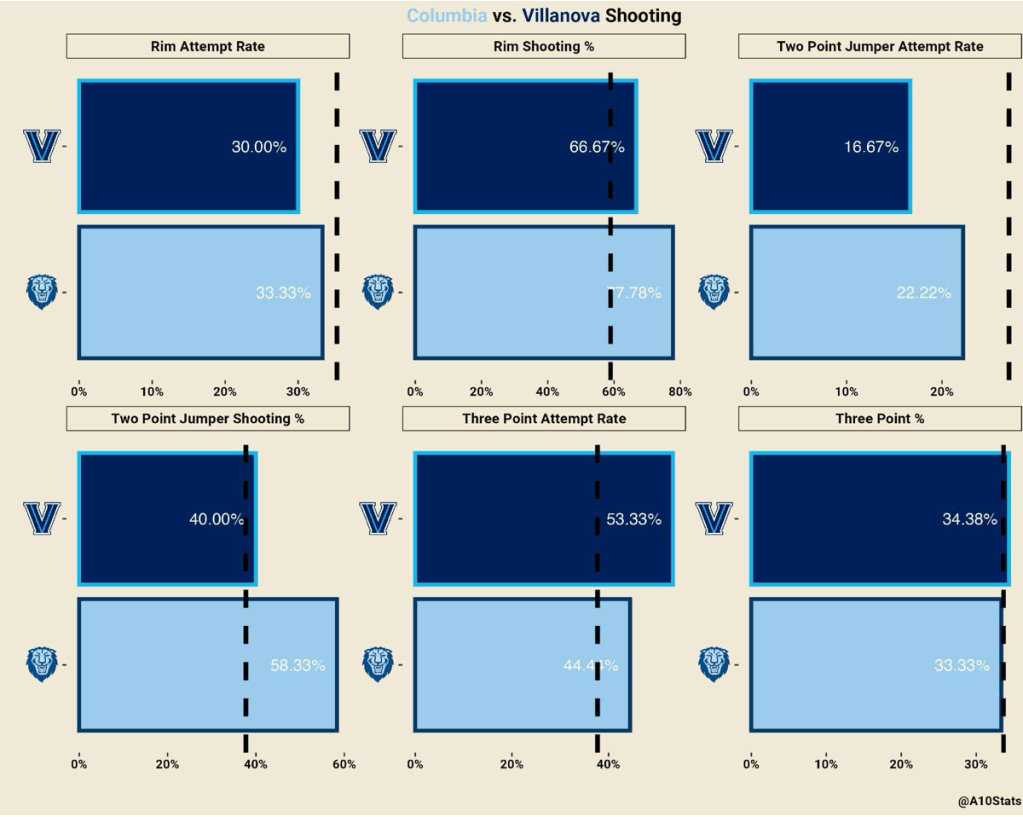
On a night that was supposed to be special with Eric’s debut game, it turned into a bunch of frowned faces in the fanbase and a silent crowd that ended the night. Diving deeper into the total team, the expected 3rd contributor, Jordan Longino, has only averaged 9.3/3.0/3.7 with 28.1/23.5/66.7 splits and a 39.4 TS%. Very disappointing for the PA native who finally had a healthy offseason to improve. Off the court, it hasn’t been any better either, as freshman top 75 and 4-star recruit Matthew Hodge’s initial eligibility waiver for the season was denied. A second appeal was filed and sent to the Committee and a decision will be made on 11/13 on whether he can play this year or not.
Positives
Despite the brutal loss this week, there are still positives to take from this week. On Monday’s game without star Eric Dixon, the Wildcats still ended up winning 75-63. Wooga Poplar, a hometown native and transfer from the University of Miami showed the potential that he could be a very good 2nd option with a quality 20-point and 10-rebound performance on 61.5/66.6/100 splits with a 72 TS% game. On Friday in a game against NJIT, the Kyle Neptune era had its biggest margin of a victory of 37 of a scoreline that was 91-54. In this same game, the Wildcats only had 5 turnovers, down from 12 against Columbia and 17 against Lafayette. Focusing more on this team’s performance, the team had a 57.1% FG and a 47.8 3PT%, both of the best in the Neptune era. Kris Parker also had a career-high of 11 points on 57.1/50.0 splits, and hopefully, this can result in more minutes. In addition, top-75 recruit freshman Josiah Moseley also gave a quality defensive performance with 2 blocks off the bench. Nnanna Njoku also had 2 blocks and his record when he played in the first half improved to 12-0 in the last 2 years, potentially showing he should be a mainstay in the rotation.
Closing
Hopefully, the win on Friday provided some much-needed momentum as the team heads down the Main Line to Saint Joseph’s for the Holy War, a team that beat the Wildcats 78-65 at the Pavillion last year. 3 days after, they head down south to Baltimore where they will play a crucial non-conference game against the most likely 2-0 Virginia team who recently lost their coach Tony Bennett to retirement last month. As always, Go Cats!
Men’s College Basketball Preseason Top 25
Blake Pearson
October 22, 2024
With the start of the college basketball season just a couple of weeks away, it’s time to dive into the landscape of Division I hoops through a preview of the best teams in the country. An offseason that included a loaded rookie class, a chaotic transfer portal, and significant departures via graduations and NBA hopefuls has set the stage for what promises to be a magical year of college basketball. Let’s take a look at the teams that are projected for success in the 2024-25 season and looking to position themselves for deep runs come March.
1. Kansas Jayhawks
It is no secret that last year was a major disappointment for the Jayhawks. After a consensus number one ranking in last year’s preseason AP Poll, the goal for this team was national championship or bust, and what a bust it was as the issues just piled up as the season went on. Texas transfer Arterio Morris was dismissed from the team before even appearing in a game. All-American Michigan transfer Hunter Dickinson got off to a rocky start, and the team appeared to lack chemistry early. Then, as the games got bigger down the stretch, their best player, wing Kevin McCullar Jr., suffered an injury and missed the rest of the season. This led to a disappointing four seed in the tournament, and a quick second round exit at the hands of Gonzaga. The team then had major question marks heading into this year, with lone bright spot, freshman Johnny Furphy, declaring for the NBA draft, and Hunter Dickinson considering going pro.
That being said, I have no issue comfortably naming them the best team in the country to begin 2024. Depth was a big issue last season, and this year it will be a major strength of this squad. Bill Self reloaded the roster with a blend of high impact transfers, talented freshmen, and multiple pieces returning to the school, none bigger than their star center Dickinson gearing up for year two in Lawrence. Pass-first point guard Dajuan Harris Jr. and forward KJ Adams Jr. are back as well and will presumably be in the starting lineup once again. Self also landed Wisconsin’s do-it-all guard AJ Storr, one of the top names in the portal, along with Zeke Mayo of South Dakota State, who averaged an impressive 18.8 points per game, albeit in a weak conference. The bench, a weakness from a season ago, was also bolstered by the additions of Alabama’s Rylan Griffen, Mississippi State’s Shakeel Moore, and the 14th-ranked freshman recruit according to 247 Sports, Flory Bidunga. This team is experienced, deep, and well-coached, a perfect combination for success in March. They will almost certainly be ranked as a top ten team all season long.
2. Alabama Crimson Tide
Alabama was expected to be a fringe top 25 team last season, and they exceeded these expectations all year. Mark Sears was a National Player of the Year candidate, and North Dakota State transfer Grant Nelson was the perfect complementary piece to their superstar. The Tide got out of the gates hot and ended the year even hotter thanks to a surprise Final Four run highlighted by a gritty win over one seed North Carolina. Alabama eventually fell to the juggernaut that is UConn, but it was a successful season, nonetheless. Heading into this season, Alabama’s fate rested in the hands of Mark Sears’ decision; test the waters of the NBA draft or return to school and try for glory once more.
Luckily for the Crimson Tide, Sears chose the latter, and he will threaten to lead the nation in scoring now that Zach Edey’s 25+ points per game at Purdue is gone. Nelson is back as well, along with three-point specialist Latrell Wrightsell Jr. The loss of shifty guard Aaron Estrada will sting, but his production is replaceable. The biggest issue with last year’s squad was size and defense, as they had one of the worst defensive ratings and rebounding rates in the SEC. Enter Clifford Omoruyi. Alabama landed the Big Ten Defensive Player of the Year finalist from Rutgers, and they will feel an immediate impact from his 8.3 rebounds and a whopping 2.9 blocks per game. While not a naturally gifted scorer, Omoruyi’s size will make him a key lob threat in the pick-and-roll with Sears. His addition will also allow Nelson to play more on the wing where he is at his best. Nate Oats did not stop there with his portal additions, though. Alabama also added Aden Holloway from Auburn, Chris Youngblood from USF, and Houston Mallette from Pepperdine, all of which can score in bunches. Combine them with a top three freshman recruiting class highlighted by Derrion Reid, Aiden Sherell, and Labaron Philon, and this shapes up to be one of the best rosters in the country. Alabama is not guaranteed to make as deep of a run this year as they did last, but they will certainly be in strong contention to make noise in March.
3. Houston Cougars
Death, taxes, and Kelvin Sampson’s teams shutting opponents down. Last year might have been the most complete team Houston has had under Sampson, and they silenced all doubters by getting a number one seed in the NCAA tournament in their first year in the Big 12. The Cougars dominated all season long on both sides of the floor and were ranked number one in the country for much of the year, led by one of the best two-way guards in Jamal Shead. The defense behind him was also lock-down, led by J’Wan Roberts and Ja’Vier Francis, and on the other end, L.J. Cryer was a much-needed bucket getter. After a narrow win over Texas A&M in the second round of the tournament, Houston got bounced by Duke in the Sweet Sixteen. They led for much of the first half though, until an ankle injury to Shead derailed any hopes of a deep run. The injury was devastating for a team that looked best suited to give UConn a potentially competitive game, a rare sight in March as of late.
While Shead’s departure to the NBA is going to hurt, returning four starters from a number one seed team is usually a recipe for success. The team is not flashy on paper, but it wasn’t last year either and that does not seem to matter under Kelvin Sampson-coached teams. Roberts, Francis, and Cryer are all back, as well as Emanuel Sharp who will continue to give them an offensive spark. The once highly touted freshman Terrance Arceneaux is back for his junior season too, and the Cougars hope that his potential can finally be unlocked. If any team could afford a quiet offseason, it’s Houston, and that’s exactly what they had. The Cougars’ only major addition came when they snagged Oklahoma’s Milos Uzan out of the portal to replace Shead’s starting spot, and he will fit into the team’s scheme perfectly as an on-ball defender and facilitator. Mercy Miller and Chase McCarty will look to get minutes off the bench in their first season of college basketball, but they will take time getting up to speed. Houston may not have the firepower of some other teams, but it is best not to bet against the Cougars, especially in the regular season when they seem to always be in contention for the top tournament seed overall.
4. UConn Huskies
Is this ranking too low? Maybe, maybe not. Everyone underestimated UConn last season even after their dominant championship run, and this offseason is shaping up very similarly after losing a lot of players to the NBA Draft once again. Lead guard Tristen Newton graduated and got drafted, along with their Swiss Army knife in Cam Spencer. High-flying freshman Stephon Castle was a lottery pick, as was seven-footer Donovan Clingan. Noticing a trend? UConn did not just lose key pieces; they lost four superstars. There is no denying that last year was a magical run, as the Huskies became the first team since 2006-2007 Florida to repeat as national champion, but the roster will look extremely different this year, so Dan Hurley is going to have to get creative and have his new roster gel quickly if they want to have a chance to three-peat.
Despite the big shoes to fill, the Huskies feel confident in who they will have on the floor. With a roster as strong as UConn’s last season, not every good player can get the necessary minutes to make an impact, and Hurley is hoping that he has some studs that were buried in last year’s depth chart. Jaylin Stewart and Solo Ball, freshmen that showed flashes last season in limited minutes, are both back and looking to play a big part in UConn’s title run. Some other key pieces will be returning as well in Hassan Diarra and Samson Johnson, who will be thrust into bigger roles this year. No returning player will have a bigger impact than Alex Karaban, who is the lone starter back after averaging 13.3 points per game on solid shooting percentages. Hurley also hit the transfer portal to replace their losses by nabbing St. Mary’s guard Aidan Mahaney and Michigan’s Tarris Reed Jr., both of whom will probably be in the starting lineup on opening night. The grand prize from this offseason though is Liam McNeeley, and the 10th-ranked freshman is hoping to be the Huskies’ next March legend. Despite all of the moving parts, the important constant is Hurley, widely regarded as the best coach in the nation after the last two years. He turned down the Los Angeles Lakers job for a reason, and that is because he hopes something special is brewing in Storrs once again.
5. Iowa State Cyclones
Few young minds on the defensive end of the floor are better than Iowa State coach TJ Otzelberger, and he proved it last year as Iowa State was the most surprising team in the country. The Cyclones received zero, yes zero, votes in the preseason poll, yet wound up winning the Big 12 tournament, in what is the toughest conference in college basketball, earning a well-deserved two seed in March Madness. Their great season came to an end in the Sweet Sixteen for the second time in three seasons after a loss to Illinois, but it was one of the greatest Iowa State basketball seasons in recent memory, and they are well-positioned for similar success this season.
While Otzelberger may be one of the best defensive coaches in all of college basketball, even the best schemes are only as good as their personnel. Iowa State has arguably the most talented defensive backcourt, more than capable of locking down any guard in the country. The Cyclones have a two-headed monster in Tamin Lipsey and Keshon Gilbert, both of whom averaged over 2 steals per game. Lipsey was also named a finalist for National Defensive Player of the Year. They are no slouches on the offensive end either, as they were both top two in points and assists per game on last year’s team. Curtis Jones rounds out the returning starting guards, and Milan Momcilovic is also back for his sophomore season, aiming to build on his double-digit scoring average. Iowa State also hit the transfer portal to replace the bigs they lost, adding Joshua Jefferson from St. Mary’s and Dishon Jackson from Charlotte to provide much-needed size. Northern Iowa’s Nate Heise, who can provide some timely scoring off the bench, rounds out their class of transfers. Given the Cyclones’ defensive prowess, no one will want to face them in March. If the offense improves even slightly, this team could be very dangerous.
6. Gonzaga Bulldogs
A five seed in last year’s tournament was uncharacteristic for Gonzaga in recent years, capped by a defeat in the WCC championship game. The Bulldogs struggled to find their identity early in the season, and at their lowest point, they had a shocking 11-6 record after losing a tight game to Santa Clara. The Zags peaked at the right time though and looked dominant in March, but Zach Edey’s size proved too much in a Sweet Sixteen loss to Purdue. Mark Few had assembled a balanced roster around Wyoming transfer center Graham Ike, surrounding him with strong passers, shooters, and defenders. It was somewhat surprising that Few’s formula was not a successful one early, but the Zags found their stride down the stretch and will look to build on this momentum going into next year.
The best way to build on momentum is continuity, and Few was able to bring back almost the entirety of last year’s roster, plus some. The only significant loss is Anton Watson, whose defensive versatility and reliable scoring will be missed. Ike returns, however, alongside one of the best passers in the country, Ryan Nembhard, and their top shooter, Nolan Hickman. Role players Ben Gregg and Braden Huff will aim to fill Watson’s void, with Huff especially showing flashes last year. The Bulldogs will also look to unlock Dusty Stromer’s potential as another returning piece. In total, Gonzaga returns seven of their top eight players from last year’s team, including Steele Venters, who missed all of last season due to injury. As if running back basically the entire roster weren’t enough, Few also snagged two proven veteran scorers in the transfer portal: Michael Ajayi from Pepperdine and Khalif Battle from Arkansas, who averaged 17.2 and 14.8 points per game, respectively. With another balanced, deep, and talented roster, Gonzaga is well-positioned to significantly improve on their performance from a year ago.
7. Auburn Tigers
This ranking may be higher than the consensus, but last year’s first round exit to Yale seems to cloud judgment for most. People forget that Auburn looked like the best team in the country toward the end of last season, dominating SEC play on their way to winning the conference tournament with relative ease. With this run, Auburn seemed poised for a top three seed entering the tournament, but the committee disagreed, underseeding them as a four. To make matters worse, they drew a tough matchup against a 13 seed Yale team that was likely underseeded as well after earning a bid in a strong Ivy League. It was the perfect trap game for Auburn, whose hopes of a deep run were quickly shattered. They will look to shake off this heart-breaking end to last season in what should be another strong roster for Bruce Pearl.
The Tigers’ biggest offseason news was the return of their best player on both ends of the floor, forward Johni Broome, who might be the most underrated and underappreciated superstar in the country. Auburn also brought back two more starters and two key bench players from a roster that went ten-deep a season ago. Sharpshooting guards Chad Baker-Mazara and Denver Jones return, both a year removed from shooting 41.8% from three-point range. Bench bigs Chaney Johnson and Dylan Cardwell will look to expand their roles and make a bigger impact. This alone would warrant a season with high expectations, but Auburn filled the remaining gaps in the rotation through key transfer portal additions. Furman’s JP Pegues and Georgia Tech’s Miles Kelly will provide an offensive boost to the starting lineup and shine alongside Broome. Cardwell’s development will be crucial for Pearl’s squad, as they lack a dominant center. However, Auburn’s strong defense will keep analytics on their side all season, and those numbers should translate to on-court success
8. Duke Blue Devils
Aside from a 2012 Kentucky team that coasted to a national title, freshman-heavy teams rarely make deep runs in March. If any team is capable of proving that experience doesn’t matter, it’s this Duke squad. The Blue Devils are coming off a strong Elite Eight run, though it ended in disappointing fashion against in-state rival NC State. Duke dropped back-to-back games early, suffering bad losses to Arkansas and Georgia Tech, but then went on a tear, led by second-team All-American Kyle Filipowski and freshman phenom Jared McCain, both of whom are now in the NBA. The only returning contributors are guards Tyrese Proctor and Caleb Foster, but they will be important veteran presences among the new faces. The roster turnover was inevitable, but no one was more prepared for their personnel losses than Jon Sheyer.
In typical Duke fashion, Scheyer brought in the nation’s top recruiting class, headlined by Cooper Flagg. The top-ranked recruit, Flagg, is all but guaranteed to go first overall in next year’s draft, and for good reason. Flagg is a unique blend of size and skill, with exceptional shooting and playmaking abilities for a 6’9” forward. The class does not end with him though, as Duke also brought in Khaman Muluach (4th-ranked freshman), Isaiah Evans (13th), Kon Knueppel (18th), Patrick Ngongba II (21st), and Darren Harris (40th). Muluach is expected to play the second-largest freshman role behind Flagg, following an impressive summer with the South Sudan Olympic team. Sheyer also reloaded via the transfer portal, adding experience to his young squad. Tulane’s Sion James, Syracuse’s Maliq Brown, and Purdue’s Mason Gillis may be overshadowed by the first-year firepower, but they will bring a crucial level of experience and maturity that every great team needs. Duke is difficult to rank given the unknowns, but their talent is undeniable, and talent usually prevails.
9. Baylor Bears
The Baylor Bears are coming off of a below average season by their standards, getting bounced in the second round of the NCAA tournament by a talented Clemson team that made a surprise Elite Eight run. The Bears had an impressive regular season, though, coming out of the gates hot with nine straight wins in the non-conference and performing well enough in Big 12 play to earn a three seed in March. They were one of the most well-rounded teams last season, featuring six players who scored in double figures. Baylor’s strong backcourt was led by two newcomers, freshman Ja’Kobe Walter and Toledo transfer RayJ Dennis, both now in the NBA. Their top interior players, Jalen Bridges and Yves Missi, have moved on as well. Scott Drew desperately needed to replace this production, so he turned to the transfer portal and the incoming freshman class for some new faces.
Baylor added two of the top names from the transfer portal this offseason to help offset their losses. Norchad Omier averaged 17 points per game last year for a largely disappointing Miami team, though Omier wasn’t to blame. He is a versatile wing that has the touch to score inside as well as the guard skills to stretch the floor. Jeremy Roach averaged 14 points per game at Duke last year, solidifying what should be a strong 1-2 scoring punch. Roach is also a fantastic facilitator of the basketball and should create opportunities for his teammates, and luckily, he will be surrounded by multiple scoring threats. Despite their departures, the Bears return two key guards, Langston Love and Jayden Nunn, both of whom can score in bunches. Big man Josh Ojianwuna is also back and will look to expand his role as the new starting center. The final piece of the puzzle is 5th-ranked freshman V.J. Edgecombe, an athletic guard and arguably the best shooter in this year’s class. Edgecombe will likely move on to the pros next year, but Drew hopes that Baylor can bring another championship to Waco in his lone season.
10. North Carolina Tar Heels
After a dominant 26-6 regular season, the Tar Heels earned themselves a number one seed in March Madness, albeit the lowest ranked one, with high hopes for a deep tournament run just a year removed from missing the tournament altogether. North Carolina appeared to be set up nicely, boasting the most talented roster in a relatively weak region. They featured first-team All-American guard RJ Davis, dominant big man Armando Bacot, and two high-impact transfers, wings Harrison Ingram and Cormac Ryan. On paper, they looked like clear Final Four favorites, but anything can happen in March, and they ended up losing in heart-breaking fashion to Alabama. North Carolina was one of the oldest teams in the country due to these four stars: a blessing last season, but potentially a curse this year.
The Tar Heels expected to lose their top four players to graduation and the pros, but in a somewhat surprising move, Davis decided to give it one more go at the college level. His presence as a National Player of the Year candidate alone is enough to justify this top ten ranking. Seth Trimble and Elliot Cadeau also returned to school, both hoping for breakout seasons as Hubert Davis will undoubtedly rely on them more. Cadeau’s development as a shooter, a glaring weakness last season, will be crucial to the team’s success. The Tar Heels also added some big-name transfers, Belmont’s Cade Tyson and Vanderbilt’s Ven-Allen Lubin, who aim to provide complementary scoring like Ingram and Ryan did last year. The team’s upside ultimately lies in its freshman class, with Ian Jackson (8th ranked freshman) and Drake Powell (11th) having the potential to form one of the most dangerous underclassmen duos in the country. The team lacks a true big man but will lean on Jae’Lyn Withers to try to fill that role. Rebounding and interior defense may plague them all year long, but betting on RJ Davis to carry this team in March is a safe one.
Best of the Rest
11. Arizona Wildcats
12. Creighton Bluejays
13. Tennessee Volunteers
14. Texas A&M Aggies
15. Indiana Hoosiers
16. Texas Longhorns
17. Kentucky Wildcats
18. Xavier Musketeers
19. Arkansas Razorbacks
20. Texas Tech Red Raiders
21. Cincinnati Bearcats
22. UCLA Bruins
23. Marquette Golden Eagles
24. Purdue Boilermakers
25. St. John’s Red Storm
Check out the full rankings here: https://blakey-brackets-2024.netlify.app
NBA All-Star Game Reserve Players Prediction
Jonathan Hunn
January 30, 2024
Last week, the NBA announced the starters for this year’s All-Star Game set to take place in Indianapolis on February 18th.
In the Eastern Conference, Damian Lillard of the Bucks (8th selection) and Tyrese Haliburton of the Pacers (2nd selection) will be the starting guards, with team captain Giannis Antetokounmpo of the Bucks (8th selection), Joel Embiid of the 76ers (7th selection), and Jayson Tatum of the Celtics (5th selection) rounding out the Eastern Conference forwards.
In the Western Conference, Shai Gilgeous-Alexander of the Thunder (2nd selection), and Luka Doncic of the Mavericks (5th selection) are starting at the guard spots, with team captain LeBron James of the Lakers (20th selection), Kevin Durant of the Suns (14th selection), and Nikola Jokic of the Nuggets (6th selection) concluding the West frontcourt.
With the reserves set to be revealed this Thursday 2/1 on NBA on TNT’s pregame show, here are my predictions of the players the coaches will select to round out the rosters for this year’s edition of the NBA All-Star Game.
Eastern Conference Guards
Tyrese Maxey – Philadelphia 76ers
While Maxey’s torrid start was getting some potential starter buzz amongst NBA media and fans alike, his efficiency slightly tapered off and that hype was mostly drowned out. Despite that, he has maintained excellent numbers fit for an NBA All-Star, placing top 15 in the league in scoring (25.7 points a night), and assists (6.6 assists a night). Maxey’s prominent role on the team with the East’s third-best record earns him a spot on the squad.
Jalen Brunson – New York Knicks
Jalen Brunson’s breakout season last year with the Knicks catapulted him into the full-on star conversation and his play this season as the de facto leader of the Knicks has only elevated that discourse. With career-high averages of 26.7 points, 3.9 rebounds, 6.5 assists, and a career-high 42.4% percentage from deep, Brunson is an indisputable All-Star.
Eastern Conference Forwards
Scottie Barnes – Toronto Raptors
While some Raptor fans seemed to be frustrated with Scottie Barnes’s development stalling in his second season, Barnes’ third season has affirmed the patience of those fans as he has rewarded them with a stellar campaign thus far. With face-of-the-franchise Pascal Siakam shipped to Indianapolis, Barnes has slid into the role of leader of the young Raptors, with career highs across the board in points (20.3), rebounds (8.3), and assists (5.7), as well as a sizeable jump in 3PT% (up to a career-high 36.3% from 28.1% from last year). Those numbers, his defensive production, and seamless switch ability on that end make Barnes a worthy team member this year.
Bam Adebayo – Miami Heat
The anchor of Miami’s defense and a valuable connector and self-creator on offense, Bam Adebayo has once again played himself into All-Star consideration. With averages of 21.0 points, 10.5 rebounds, and 4.2 assists, Bam’s counting numbers are All-Star worthy. His case is even more solid when coupled with his constant defensive activity and deserves a spot on the East reserves.
Kristaps Porzingis – Boston Celtics
When the Boston Celtics traded Marcus Smart away to acquire Kristaps Porzingis from Washington, they were making a sizeable gamble, especially for a team that had found plenty of success with Smart starting and Al Horford playing a sizeable chunk of the starting center minutes. Porzingis has rewarded the gamble with an excellent season of 19.5 points, 6.7 rebounds, and 1.8 blocks a night. He has done an admirable job anchoring top-seeded Boston’s defense in the process.
Western Conference Guards
Devin Booker – Phoenix Suns
Booker has missed several games this season, but when he has been healthy, he has no doubt been one of the best guards in the league, averaging 28.4 points, 4.9 rebounds, and 7.3 assists per night. He even had a 62-point game the other week and is flirting with a 50/40/90 season, truly remarkable efficiency for a volume scorer like himself.
Anthony Edwards – Minnesota Timberwolves
The Minnesota Timberwolves have had something of a resurgence to start this year, rocketing to the top of the Western Conference behind a top-tier defense. While Rudy Gobert is the anchor of that defense, Edwards has turned himself into one of the key cogs defending the perimeter. When paired with his standout counting numbers (25.9 points, 5.2 rebounds, and 5.3 assists per night), Edwards should be a lock for the ASG.
Western Conference Forwards
Kawhi Leonard – Los Angeles Clippers
For the first time in quite a few years, Kawhi Leonard has had himself a consistent, healthy, and impactful regular season. After the Clippers’ initial slide following their acquisition of James Harden, the team has been on an absolute tear, with Leonard once again re-affirming his status as one of the premier players in the sport. His defense has rebounded nicely after a few down years, and he is averaging 23.8 points, 6.2 rebounds, and 1.7 steals per game. His efficiency has been staggering as well, as he is very close to reaching the 50/40/90 club.
Anthony Davis – Los Angeles Lakers
Anthony Davis is currently working his way through his healthiest season since 2019-20 and his numbers have reflected his dominant presence on both ends of the court, with averages of 24.9 points, 12.1 rebounds, and 2.3 blocks per game. His play has not exactly translated into team success, as the Lakers have been hovering around Play-In Tournament territory, but it is not exactly for his lack of effort.
Lauri Markkanen – Utah Jazz
Markkanen’s emergence into an All-Star last season surprised many, but his play this year has made it clear that it was no fluke. Even as the Jazz have struggled, Markkanen has shone, showcasing his unique skill set as a seven-foot hybrid forward/wing. He is currently averaging 23.7 points, 8.8 rebounds, and 1.9 assists per game on nearly 50/40/90 shooting splits and has been a bright spot for Utah in an otherwise mediocre season for the team.
Eastern Conference Wild Cards
Donovan Mitchell – Cleveland Cavaliers
This season, Mitchell has continued the sort of play fans have come to expect from him with averages of 27.7 points, 5.5 rebounds, and 6.3 assists per game. However, what has been most impressive from Mitchell has been the role he has taken on to carry the Cavs following consecutive injuries to Darius Garland and Evan Mobley. When many expected the team to slide and look to sell off pieces at the trade deadline, Mitchell and the Cavs have soared, winning 9 of their last 10 games.
Julius Randle – New York Knicks
Randle has essentially taken a backseat to Jalen Brunson as the featured player for the Knicks but has done an admirable job as the number two, providing consistent scoring punch and physicality for the Knicks. His season averages of 24.0 points, 9.2 rebounds, and 5.0 assists land him squarely in all-star consideration.
Western Conference Wild Cards
Stephen Curry – Golden State Warriors
It might be surprising to see Stephen Curry in the wild cards for the conference, but his numbers are down across the board in an uneven season for Golden State filled with drama, suspensions, and injuries to key players. Even in a down year, Curry is averaging 27.3 points along with 4.2 rebounds and 5.0 assists a contest.
De’Aaron Fox – Sacramento Kings
Rounding out the Western Conference All-Stars is De’Aaron Fox, the co-leader of the Sacramento Kings alongside Domantas Sabonis, who just barely missed the cut. Fox has seen a large jump in both three-point efficiency and volume, seeing his attempts jump by almost three and his percentage increase by over 6%. While the Kings have not maintained all of the momentum from last year’s top 3 finish in the West, they have kept a solid playoff position and Fox has been one of the main reasons for that.
What We’ve Learned About Each Team by Christmas
Preston Powery
December 22, 2023
For many NBA fans, Christmas signifies the time to really start focusing in on the season. For teams, Christmas provides a temperature check one-third of the way through the regular season, as they evaluate their current standing and future outlook. While the NBA season is a marathon and teams will look different a few months from now, the period between the start of the season in late October to now can still be telling, especially for teams not performing to preseason expectations. Starting with the Eastern Conference, I’ll discuss one thing we’ve learned about each team, for better or for worse, through a thrilling first two months.
Eastern Conference
1. Boston Celtics: Best starting five in the NBA
When the Celtics traded for Kristaps Porzingis and Jrue Holiday this offseason, we knew they had arguably the best starting five on paper. To see these two mesh immediately with Jayson Tatum, Jaylen Brown, and Derrick White, however, has still been very impressive. The visual below displays the number of possessions and the net rating of every team’s starting lineup as of December 20. These five have played 532 possessions together, the fifth most in the NBA, and own the third highest net rating at +20.7, a number that seems sustainable given the seamless fit. They have been especially scary defensively, allowing only 101.1 points per 100 possessions, 14 points below league average. Boston is also 14-1 when all five play together, which is even more notable considering that they’ve faced the fourth toughest schedule according to Basketball Reference. Barring a significant injury to one of these five, the Celtics appear poised to grab the number one seed in the East and enter the playoffs as credible favorites.

2. Milwaukee Bucks: Defensive struggles are mildly concerning
Sitting at 21-7 with comfortably the third best record in the league should by no means signal a panic in Milwaukee, but history tells us that teams this poor defensively hardly ever win championships. The Bucks currently rank 20th in the league in defensive rating, and only one champion since 1980, the ’01 Lakers, had a defensive rating below 15th. Although the Bucks defense has slightly improved, they are still playing more similarly to teams like the Mavericks, Nets, and Hawks, who have been proficient offensively but struggled some defensively, than the best teams. As the visual below shows, the Bucks are lagging behind the top two-way teams like the Celtics, 76ers, Thunder, Clippers, and Nuggets, teams who uncoincidentally look like legitimate contenders right now. There is plenty of time for the Bucks to at least become average defensively to combine with their potent offense led by Giannis and Damian Lillard, but if they don’t, they’ll have a tough time beating the best in the playoffs.
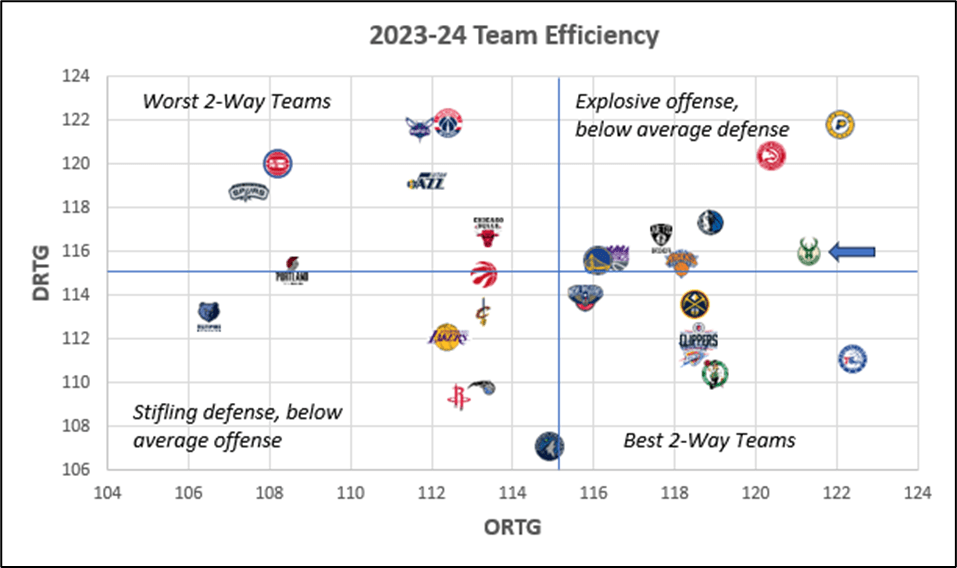
3. Philadelphia 76ers: Optimized without Harden
The Sixers are currently outscoring their opponents by 11.4 points per game, more than two points better than the second best differential, as they have dominated on both ends. Trading James Harden has increased the usages of Joel Embiid, Tyrese Maxey, Tobias Harris, and De’Anthony Melton, and those four, along with Nicolas Batum, have produced a whopping +33.3 net rating in 467 possessions. While this lineup won’t sustain this level of excellence all year, and they have benefited from the fourth easiest strength of schedule, it is clear that this team flows better without Harden. Nick Nurse has implemented a style allowing Embiid to operate more as a playmaking hub on offense while still leading the league in scoring and Maxey to exploit his slashing and elite transition game, and Philadelphia has looked as formidable as anyone because of it.
4. Orlando Magic: Should be a lock for the playoffs
Despite battling injuries to two starters, Markelle Fultz and Wendell Carter Jr., for most of the season, Orlando finds itself in 4th in the East leading up to Christmas. With their immense size and hard-nosed guards, the Magic have sustained a top five defense in the league. What is even more encouraging for Orlando is that they could be much improved offensively by the end of the season, with their two best players Paolo Banchero and Franz Wagner playing at similar levels to last year. Even if one of these young stars takes a leap offensively over the next four months, Orlando will be capable of competing with the league’s best every single night. They also have the 5th easiest remaining schedule going forward, so it is not inconceivable that Orlando will host a first round matchup in the playoffs this year.
5. New York Knicks: Proof that rebounding is about more than size
Although the Knicks are the 2nd shortest team in the league by average height (6’5.7), they are 1st in offensive rebounding percentage and 2nd in defensive rebounding percentage. This has allowed New York to have the 9th best offensive rating in the league, despite only having the 20th best effective field goal percentage. Unfortunately, the player most responsible for this impressive feat, Mitchell Robinson, will be sidelined for the next few months. Still, this team’s identity revolves around crashing the glass, so a steep drop-off in this category should not be expected. Once again, the Knicks appear to be on their way to a mid-upper 40-win season and should feel confident about avoiding the play-in.
6. Miami Heat: Fine without Dame
For all the preseason slander against Miami for missing out on Lillard, the Heat have proven their organizational stability through the first two months. Propelled by the biggest steal in the 2023 draft, Jaime Jaquez Jr., Miami’s depth has kept them afloat amidst only having Bam Adebayo and Tyler Herro for a combined 28 games. They also have provided excellent spacing around Butler and Bam, currently holding the highest three-point percentage in the league at 39%. As we approach the trade deadline over the next two months, Miami should be in a prime position to put together a compelling package for any star on the trade block. Even if they make no further moves, their unprecedented playoff run last year proves that as long as they stay in the top eight, which they will, they’ll be a force to be reckoned with in April and beyond.
7. Cleveland Cavaliers: “Big 4” experiment may end soon
Through the season’s first two months, Cleveland has underwhelmed. After having the 7th best offense and best defense a season ago, the Cavs are now 21st and 12th in those categories. Evan Mobley and Darius Garland have not improved as much as expected and will now miss several weeks due to injuries, and the team has struggled to find that fifth guy to consistently close games with. With Donovan Mitchell in the second to last year on his deal, there have been loud whispers about potential destinations for the star if Cleveland decides to retool around its youngest assets. If the Cavs don’t figure things out once Mobley and Garland return, this Mitchell-Cavs experiment could be very short-lived.
8. Indiana Pacers: Arguably best offense and worst defense
Watching Tyrese Haliburton and the Indiana Pacers flying up and down the court to the tune of 127 PPG is one of the most exhilarating experiences in the sport. Unfortunately, this team coughs up 126 PPG on the defensive end, completely erasing the advantage its elite offense creates. Indiana is not expected to contend this year and has a budding superstar in Haliburton, so there’s little pressure on them to improve their defense anytime soon. But, as their performances in the In-Season Tournament proved, they are ahead of schedule in terms of competing with the best teams in the conference, so it will be interesting to see how far their offense takes them.
9. Brooklyn Nets: Much better offensively than expected
Brooklyn has mostly lived up to preseason expectations record-wise, currently sitting around .500, but their offense has been a pleasant surprise. Their roster being filled with 3-and-D wings has led to great spacing and the second best three-point percentage (38.7%) on the 6th highest volume. However, the sum of their defense has been less than its parts, as a team with Mikal Bridges, Dorian Finney-Smith, Royce O’Neale, Cam Johnson, and Nicolas Claxton should not be 21st in defense, so the Nets will most likely just be a play-in team at best.
10. Atlanta Hawks: Better than record shows but still disappointing
Purely looking at their record, the Hawks have been one of the most underwhelming teams this season. However, according to Cleaning the Glass, the Hawks have been the second unluckiest team as their expected wins are higher than teams like Cleveland, Sacramento, Miami, and Indiana. Contributing to this lack of good fortune is the fact that Atlanta has really struggled in clutch scenarios. At 6-10 in clutch games so far, the Hawks are the 6th worst team in crunch time, which says more about their inability to stop teams in crucial moments than an inability to score. Looking ahead, Atlanta is a team that could see some movement by the trade deadline to try to build a better team around Trae Young, Dejounte Murray, and their intriguing young assets.
11. Chicago Bulls: Time to blow it up
Currently outside of the play-in picture in the East, it may be time for the Bulls to deal Zach Lavine, DeMar DeRozan, and Alex Caruso. All three players should fetch picks and/or intriguing young players for Chicago to hit the reset button. Although Coby White is in the midst of a breakout season, Chicago has a dearth of young assets to be excited about for the future, so the time is now to make major moves.
12. Toronto Raptors: Siakam and/or OG should be dealt this season
Toronto entered this season trying to compete for a playoff spot but currently sit a few games under .500. Despite having its starting five of Dennis Schroder, OG Anunoby, Scottie Barnes, Pascal Siakam, and Jakob Poeltl only miss a combined four games, it’s become clear that this team has a limited ceiling. In 697 possessions together, this starting lineup has a -4.7 net rating, putting them in the 29th percentile in this category. Given that Toronto has two of the most intriguing trade chips in impending free agents Siakam and OG, we’ll see if Masai Ujiri pulls the plug on this current iteration of the Raptors and builds around Barnes.
13. Charlotte Hornets: LaMelo-Miller-Williams trio is promising
The Hornets are not void of talent, but in a league ripe with talented teams, Charlotte has expectedly been one of the worst. On the bright side, LaMelo Ball looked like an All-Star before getting hurt, Brandon Miller has been one of the best rookies, and Mark Williams has proven himself to be a starting-caliber center in his second year. The Hornets currently have a -8.9 net rating, but in the two most used lineups with this 22-and-under trio, they are +10.1 and -4.2. Additionally, Charlotte could get a solid return if they decided to trade veterans Terry Rozier and Gordon Hayward to incorporate more young assets around LaMelo, Miller, and Williams.
14. Washington Wizards: Might finish with less than 15 wins
At nearly 20 games under .500, there have not been many positives for Washington this year. Jordan Poole has not been nearly as productive as expected, and Kyle Kuzma’s strong season will be overlooked unless they decide to move him. One potential positive has been the play of rookie Bilal Coulibaly, who may be Washington’s first hit on a lottery pick since Bradley Beal. If not for the Pistons, they would undoubtedly be the worst team in the East.
15. Detroit Pistons: Might finish with single digit wins
Detroit’s losing streak currently stands at 25 games, two short of breaking the single-season NBA record. The roster makes very little sense with several guards who struggle to shoot and several young bigs who do not complement each other. Ausar Thompson already looks like one of the best wing defenders in the league, and a future with him, Cade Cunningham, and Jalen Duren still sounds enticing, but right now they’re a mess.
Western Conference
1. Minnesota Timberwolves: Legitimate title contenders
A few days before Christmas, the T-Wolves comfortably hold the top spot in the West at 21-6. The Rudy Gobert deal looks much better than it did last season, as he, along with Jaden McDaniels, have spearheaded the league’s top defense. The offense also looks better than some advanced numbers would suggest, as the Edwards-Towns combo is closing out games better than ever before, with the duo shooting 60% and 54% in the clutch, respectively. Perhaps the most encouraging element about Minnesota’s legitimate title chances is their seemingly favorable matchup with the defending champs. Not many teams in the NBA can handle Denver’s size, but Minnesota can, having a better collection of defenders to throw at Jokic and Murray than any team. In their one regular season matchup this season, the T-Wolves dominated the Nuggets by 21, which could be a sign of things to come if these two meet in the playoffs.
2. Oklahoma City Thunder: Way ahead of schedule
Despite being the second youngest team in the NBA with an average age of 24.1 years old, the Thunder have already proven themselves to be a devastatingly good team. Led by 25-year-old superstar Shai Gilgeous-Alexander, 21-year-old rookie stud Chet Holmgren, and 22-year-old future star Jalen Williams, OKC owns a top eight offense and defense, which is a strong indicator of contender status. To display how rare OKC’s success has been, charted below are the wins and net ratings of all the teams over the past 10 years with an average age under 25. The average number of wins for such teams is 30.5 (OKC already has 18 one-third of the way through the season), and the average net rating is -3.7 (OKC’s is +8.5). If the Thunder keep up their current pace, this would be by far the best season from a team this young over the past decade. Additionally, only three teams younger than OKC have even made the playoffs over the past decade, but the Thunder should have their sights much higher than just a playoff berth. With their treasure trove of picks, they may be one move away from going all the way this year.

3. Denver Nuggets: Preseason depth concerns overblown
Coming into this season, there were doubts about the defending champs being able to repeat due to the losses of important role players Bruce Brown and Jeff Green. As we approach Christmas, these concerns should be quelled. Christian Braun has been solid stepping into the sixth man role, Reggie Jackson has been one of the most effective backups in the league, Peyton Watson provides impactful energy and athleticism, and offseason addition Justin Holiday fits like a glove. These guys have contributed to Denver’s smooth 19-10 start despite Murray missing half the season, making the losses of Brown and Green inconsequential. Even if the Nuggets’ reinforcements were not performing this well, they proved last year that having a cohesive starting five led by the best player in the world in Nikola Jokic and one or two reliable bench guys is all you need.
4. Sacramento Kings: Last season was no fluke
To a certain extent, Sacramento’s performance this year has gone under the radar in a stacked Western Conference. De’Aaron Fox has elevated to an MVP-caliber level, Domantas Sabonis continues to do Sabonis things offensively, sophomore Keegan Murray just dropped 47 with 12 threes, and Malik Monk is a serious sixth man of the year candidate. The typical issues still persist defensively, where Sacramento ranks 22nd and dead last in blocks, but this team is proving that last season’s 48 wins were not an anomaly. On pace for 50 wins, the Kings are in position to take a swing during trade season that could catapult them to the upper echelon of the NBA.
5. Los Angeles Clippers: Dangerous if they stay healthy
The Clippers have won 14 of 18 since losing their first six games post-Harden trade. Replacing Russell Westbrook with Terance Mann has drastically improved LA’s starting lineup net rating from -26.9 to +16.7, and they’ve clearly found synergy over the past month. But even more than Harden settling in, the Clippers’ recent success has been because of Kawhi Leonard’s resurgence. The superstar has played in all but one game and is back to his hyper-efficient self. If they maintain this stretch of good health all year, a big if considering Kawhi and Paul George’s injury history, the Clippers look as dangerous as anybody.
6. Dallas Mavericks: Thriving in crunch time
The Mavs have slowed down after a blazing start, but their ability to close games has been encouraging after struggling in this regard last year. After only winning 47% of their clutch games last year, they are currently 9-3 in such games, as the brilliance of Luka Doncic and Kyrie Irving has been on full display late in games. Like many teams in the West, Dallas has an elite offense that has buoyed an underwhelming defense, so they must improve defensively to be a serious contender. However, having the luxury of two of the best closers in the game could prove invaluable come playoff time.
7. New Orleans Pelicans: Struggling to find an identity
The Pelicans have been a pretty confusing team through the first third of the season. In many advanced stats on offense and defense, New Orleans has been roughly average. They’re one of only four teams to have not won a single game yet when trailing going into the fourth quarter, and they’ve blown double digit leads in 8 of their 12 losses. Unlike most teams, there’s also not a clear pecking order offensively with Brandon Ingram or Zion Williamson looking like the best player one game and uninvolved the next, leading to periods of clunky offense late in tight games. Even with these issues, in addition to injuries to C.J. McCollum, Trey Murphy, and Jose Alvarado, the Pels find themselves five games over .500, making them even more perplexing. They arguably have as much talent one through ten as anyone, potential to be scary defensively with their length and athleticism, are winning games at a 48-win pace, and it still feels like they have no clear identity.
8. Houston Rockets: Culture change paying off
The Rockets have arguably been the biggest surprise so far, jumping from the 29th ranked defense in 2023 to 2nd this year by bringing in head coach Ime Udoka, Fred VanVleet, and Dillon Brooks. This young roster has been held accountable in ways that they weren’t the last few years, resulting in Houston being in the thick of the playoff race at Christmas. There have still been some bumps in the road as the Rockets have struggled in clutch games, going 5-9 with the 6th worst net rating in these scenarios. Regardless, structure has been implemented after a few years of chaos, and Houston is back to being relevant.
9. Phoenix Suns: Need to see this team fully healthy
While the Suns’ play has been largely uninspiring thus far, we should be cautious in drawing definitive conclusions about a team whose big 3 have only played one full game together. Phoenix knew the risks of assembling an injury-prone, top-heavy roster, but they are still only a couple games out of a top six spot, thanks to Kevin Durant and Devin Booker’s brilliance and the ancillary pieces maximizing their abilities. They do have size issues that may be too much to overcome, but we still need to see them at full strength before counting them out.
10. Los Angeles Lakers: Lack of 3-point shooting holding them back
The In-Season Tournament champs may have a shooting problem. They are currently tied for the 3rd fewest three-point attempts per game and tied for the 6th worst percentage. LA is clearly the worst three-point shooting team of all the contenders, and this has contributed largely to the team’s subpar offense (ranked 22nd) despite LeBron and Anthony Davis performing at superstar levels. The Lakers may be built more for the playoffs, but addressing their lack of shooting by adding more floor-spacers around LeBron, AD, and Austin Reaves could be the difference between securing a top six spot and staying in the dreaded play-in.
11. Golden State Warriors: Dynasty is (probably) over
Draymond Green’s dirty plays and suspensions have served as a microcosm for the frustrations that Golden State has experienced in the season’s first two months. The visual below illustrates the steep drop-off in the effectiveness of the Warriors’ starting five (Steph Curry, Klay Thompson, Andrew Wiggins, Draymond Green, and Kevon Looney) since they won it all in 2022. Simply put, Klay, Draymond, and especially Wiggins have noticeably regressed while the rest of the league has caught up to, and even surpassed, them. In a loaded West, there is no guarantee that the Warriors will even make the play-in at this point. However, the situation in the Bay Area is not completely bleak, as Steph is still playing like one of the best players on the planet, and the bench is much improved from last year, largely thanks to Chris Paul’s stability.

12. Utah Jazz: Offense has fallen off a cliff
When the Jazz surprised everyone last year by hovering around .500 for most of the season, it was mostly due to their prolific offense. In fact, the Jazz have been below league average on offense just one time in the previous 17 seasons, but they rank 26th this year. Outside of Lauri Markkanen, Utah struggles to create good looks, and it’s fair to say they’ll finish with far fewer wins than last season’s total of 37.
13. Memphis Grizzlies: Missing more than Ja
Ja Morant’s debut against the Pelicans a couple nights ago reminded the NBA how electric the young guard is and how competitive Memphis could be the rest of the season. However, the deep hole Memphis has dug itself into cannot only be attributed to Ja but also to its seemingly boundless injuries to Steven Adams, Brandon Clarke, Marcus Smart, and Luke Kennard. Trading Tyus Jones and losing Dillon Brooks in free agency has also severely hurt the Grizzlies. The return of Ja can make up for a lot of their absences, but in a conference with 11 other genuinely good teams, Memphis’ chances of making the playoffs are slim to none.
14. Portland Trail Blazers: Grant & Brogdon have high trade value
Early season injuries have deprived us of seeing much of the tantalizing potential of Scoot Henderson, Anfernee Simons, and Shaedon Sharpe together. These injuries have shone light on Portland’s intriguing veterans, namely Jerami Grant and Malcolm Brogdon, who have had very strong seasons. Unless the Blazers desire to keep Brogdon around as a mentor to Scoot, trading these two could fetch a couple first round picks and more young assets to build around the aforementioned trio and Deandre Ayton.
15. San Antonio Spurs: Sochan at PG experiment not working
Victor Wembanyama has shown clear flashes of the two-way generational talent that he is hyped to be, but it can be argued that San Antonio has restricted him this year by not starting a true point guard. In 1,026 possessions with Wembanyama and Jeremy Sochan sharing the floor, the Spurs have a net rating of -14.8 and are the least efficient offense in the league. In 549 possessions with Wembanyama and Tre Jones sharing the floor, San Antonio is +2.2, has an above average efficiency, and turns the ball over much less frequently. Because of Wemby’s immediate impact, every decision the Spurs make should be with the intent of putting him in the most optimal situation, and this includes less Sochan and more Jones at point guard.
CBB Thanksgiving Takeaways to Feast On
Andrew Marino
November 29th, 2023

Thanksgiving Week, dubbed “Feast Week” in the world of NCAA Basketball, is known to be one of the most entertaining weeks of the regular season. This is mainly due to the barrage of Multi-Team Events (MTEs) throughout the week, headlined by the Maui Invitational and the Battle 4 Atlantis. The Maui Invitational took the cake this season for the most intriguing tournament, consisting of 5 teams from the AP top 11 (as of last week). However, that should not take away from the rest of the action around the league. This week provided several key takeaways that will be useful come March. Let’s dive into a few.
Crown Them
Let’s address the elephant in the room. The Maui Invitational consisted of the most talent out of all of the MTEs, hosting #1 Kansas, #2 Purdue, #4 Marquette, #7 Tennessee, and #11 Gonzaga. It was clear that whichever team won this tournament would leave the Aloha State with the strongest resume in the country.
The first shocker of the tournament occurred late Tuesday night, seeing Marquette dominate the top ranked team in the country from start to finish. After a strong 11-0 stretch by Marquette in the first half, the Golden Eagles never let the Jayhawks close the deficit to within 5, spending a majority of the second half leading by double digits. In a way, justice was served after Kansas’s Kevin McCullar’s taunts sparking a squabble between Coach Self and Coach Smart. When asked about the disagreement in a press conference, Shaka Smart shrugged it off, while Bill Self said, “I guarantee you [Smart’s comment] wasn’t accurate,” without even knowing what Shaka was saying. If I had to guess, things between these coaches aren’t fully healed yet.
The second semifinal matchup consisted of an eyesore between Tennessee and Purdue. The eyesore wasn’t so much due to the players themselves, but more so because of the combined 78 free throws attempted– 30 for the Volunteers and 48 for the Boilermakers. Surprisingly, neither of these teams are known for their ability to get to the line. Purdue, this season, only gets to the line just over 24 times per game, with the Vols averaging just over 20 attempts per game. Luckily, in case you were wondering, this was nowhere near the record for most free throw attempts in a game. That belongs to a matchup between Arizona and Northern Arizona, back in 1953. I’m not one to blame free throws for a game’s outcome, so what helped Purdue edge out Tennessee was not their disparity in free throws; it was a career night from Fletcher Loyer with 27 points that earned the Boilermakers a win to set them up against Marquette in the championship.
The Maui Invitational’s championship game was set to crown one team as the best in the nation. Whoever won would have the definitive best resume in the country and deserved the #1 ranking. On top of that, Marquette had a chance to make history–be the first team in sixty years to beat the top 2 ranked teams on back-to-back days. In fact, no team has even played the #1 and #2 ranked teams on consecutive days since Loyola Chicago in 1972. Unfortunately, this feat was one too steep for the Golden Eagles, as even after a late 13-4 run to cut the deficit to one point, Marquette ran out of gas and fell to the Boilermakers 75-78. With this win, Purdue undoubtedly deserved the top ranking in the country, which was reinforced by their 60 first place votes in this week’s AP poll. The team was led by Maui Invitational MVP, and 2022-23 Player of the Year, Zach Edey, who averaged 25.3 points and 13 rebounds through the tournament. Of course, this was expected of Matt Painter’s squad in the regular season; Purdue’s big question mark is still what happens when March comes around.
Bouncing Back in a Big Way
The second-best MTE of the week was likely the Battle 4 Atlantis (but may vary depending on who you ask). This Bahamas tourney consisted of two ranked teams–#14 North Carolina and #20 Arkansas–with Memphis, Michigan, Texas Tech, and Villanova in a tier directly below them. Most bets on the champion were on either ranked team. Memphis and Texas Tech were both undefeated underdogs, while Michigan and ‘Nova were strong teams trying to bounce off ugly losses. However, only one of those teams would be successful.
Little did we know, the team that fell to the Quakers of UPenn just one week prior would be the fieriest team in the field. Villanova being upset in the Palestra served as one of the most effective wake-up calls I have seen in College Basketball. The game directly after the loss to Penn, the Wildcats hosted Maryland, holding the Terrapins to just 40 points, with 12 of those points scored in the last 3 minutes. That defensive clinic should have been a sign of things to come, as history repeated itself against Memphis in the Battle 4 Atlantis championship. The Tigers scored a whopping 16 points in the first half against Villanova. Hey, if it’s any consolation, that’s more points than Maryland scored in the first half. With a 28-point halftime lead extending to 35 points early in the second half, the Wildcats created a buffer that was too steep for Memphis to surmount. Even after a 21-0 run.
Of course, Memphis wasn’t the only team Villanova had to cross in the Bahamas. The other two actually provided much tougher battles. The first round saw Villanova taking on Texas Tech, where a 12-0 run in the first half put the Wildcats in the lead, which they would never surrender. The toughest test of the week was a rematch of the 2016 NCAA championship, versus North Carolina. These two teams had not met since the historic Kris Jenkins buzzer beater. It was clear North Carolina, with Marcus Paige as an assistant coach, would take this game to heart. After shooting 46% from three against Northern Iowa, it felt as if UNC had all the momentum. Several points in this game as well, felt as if they were going to pull away–specifically two separate 9-point leads. However, each lead did not last long, with the Wildcats clawing their ways back into the game. Villanova never seemed in control, but that didn’t matter once they got the game to overtime. With a tough bucket from sophomore Mark Armstrong, Villanova was able to put the game away and win their second straight game against the Tar Heels.
In hindsight, this could have been predicted. Villanova, prior to this year, was 6-0 in Battle 4 Atlantis games, with 2 championships: 2013 and 2017. 2023 added on 3 more wins, to improve to a 9-0 record in Atlantis with 3 titles. That is dominance unlike any other. 2013’s MVP was James Bell, 2017’s was Jalen Brunson. The newest Wildcat to be named Battle 4 Atlantis MVP is Eric Dixon. After putting the Cats on his back against North Carolina, with a career high 34 points and 10 rebounds, Dixon averaged over 21 points and 8 boards in the Bahamas. Sounds like Paradise Island for him.
According to barttorvic.com, beginning from the day after the loss to Penn, Villanova has statistically been the best team in the country, averaging 76 points per game and allowing 63.25 against three power conference teams (and Memphis who’s better than most power conference teams). The game against Penn feels so far away and seemed to be quite the wake-up call for the Wildcats.
Owls Back On Track
What ranked team suffered a worse loss than Villanova did in the Palestra? FAU did. At home. Against Bryant. And just like Villanova, this loss was a wakeup call for the Owls. The Bulldogs led the game for the final 16 minutes, and that’s with March Madness Legend Doug Edert recording a 0/0/0 stat-line off the bench. Poor shooting is what troubled Dusty May’s squad in this game, highlighted by 26% from the field, and 17% from 3. I’m not sure if this was a Final Four hangover, but this was a worse loss than any loss FAU suffered last season.
What’s important, like all teams, is how you respond. The Owls responded in a big way in Orlando, fighting through the ESPN Events Invitational. The difference between their offense against Butler and their offense against Bryant was night and day, despite both being against the Bulldogs. FAU against Butler practically shot twice as well as they did against Bryant. The hot shooting would carry over into the next game against #12 Texas A&M, shooting over 50% from the field AND from 3. Despite the Aggies rebounding and attempting more shots, the Owls’ blazing offense was too much for A&M to overcome, scoring 96 points. Just like with Villanova, the championship game was a breeze. A 19-0 run between the two halves put the game away, with FAU dismantling Virginia Tech, 84-50.
Alijah Martin was the ESPN Events Invitational’s MVP, averaging 18 points, almost 6 rebounds, and nearly 2 steals per game. He brought energy that was so vital to the team’s tournament run last season. He has led the Owls back into the conversation for a deep run in March, and this just goes to show that sometimes taking a hard loss early in the season can be beneficial in the long run.
Bottom of the Barrel
Every conference is bound to have its share of below average, dare I say bad teams. However, there are two teams that stand out among the rest. One of which is coming off of one of, if not their worst season in school history: The Louisville Cardinals (still under Kenny Payne).
Now don’t get me wrong, the Cards are showing some improvement from last season, but when the bar to cross is 4 wins, it’s hard to go anywhere but up. Payne’s squad is currently sitting at a 3-3 with a 1-point win over UMBC, a convincing win against Coppin State, and most recently, an overtime victory versus New Mexico State. Now, I don’t want to dive too deep into the situation at NMSU, but just know that they are experiencing massive amounts of roster turnover due to a controversial slew of felonies. This resulted in the suspension of the program in the 2022-23 season, criminal investigations, and the firing of the head coach. It was bad enough to take that team to overtime, but Louisville shot 49 free throws. Earlier I said I wasn’t one to blame free throws for results, but when you have an advantage of 32 free throws, I feel like a power conference team like Louisville should be able to win convincingly. This was enough free throws for SIX Aggies to foul out, meaning Louisville was playing 5 on 4. If it wasn’t for two missed free throws with one second left in regulation, Louisville would not have escaped with a win.
After all that, Louisville is somehow not the worst power conference team, as of right now. That award goes to the DePaul Blue Demons, currently sitting at 1-5. The Blue Demons seemed like they were finally on an uphill trajectory with Tony Stubblefield after last season, with a double-digit win season, ending a 20-game lose streak versus Villanova, and reaching the second round of the Big East tournament. Unfortunately, this season seems to be a regression, with DePaul’s sole win coming against South Dakota. They’ve lost against Fort Wayne, Long Beach State, South Carolina, San Francisco, and NIU. I haven’t seen a Big East team struggle this much since… Georgetown for the last two seasons.
A New Rivalry in the Making
Everyone loves college rivalries. Duke versus Carolina, Michigan versus Ohio State, Alabama versus Auburn. So, it’s always a joy when an unexpected rivalry arises, especially in basketball. That’s exactly what the Maui Invitational brought us. It didn’t get much coverage compared to other matchups, as it was the consolation championship, tipping off at midnight EST. This game was the battle of Gonzaga vs UCLA, their fourth time meeting in FOUR seasons.
This streak began in the Final Four back in 2021, when Jalen Suggs hit a half-court buzzer beater in overtime to lift undefeated Gonzaga over UCLA to advance to the championship game (that they ultimately lost). Not only did he keep their perfect season alive, but he avenged Gonzaga’s loss to the Bruins in the 2006 Sweet 16. Since that game, the Bulldogs and Bruins faced each other in the 2021-22 regular season, the 2023 Sweet 16, and now the Maui Invitational. While this seems like the perfect rivalry, all four of these most recent wins have resulted in a win for Mark Few’s Zags, by an average margin of 7.5 points. This margin is inflated by the 20-point victory in the second meeting. If you remove that game, these matchups are decided by just over 3 points. While the results themselves seem lopsided as of recent, it would be a shame to not see these teams going at each other over the next few seasons.
Unlikely X-Factor for the Wildcats?
Owen Fernandes
November 12th, 2023
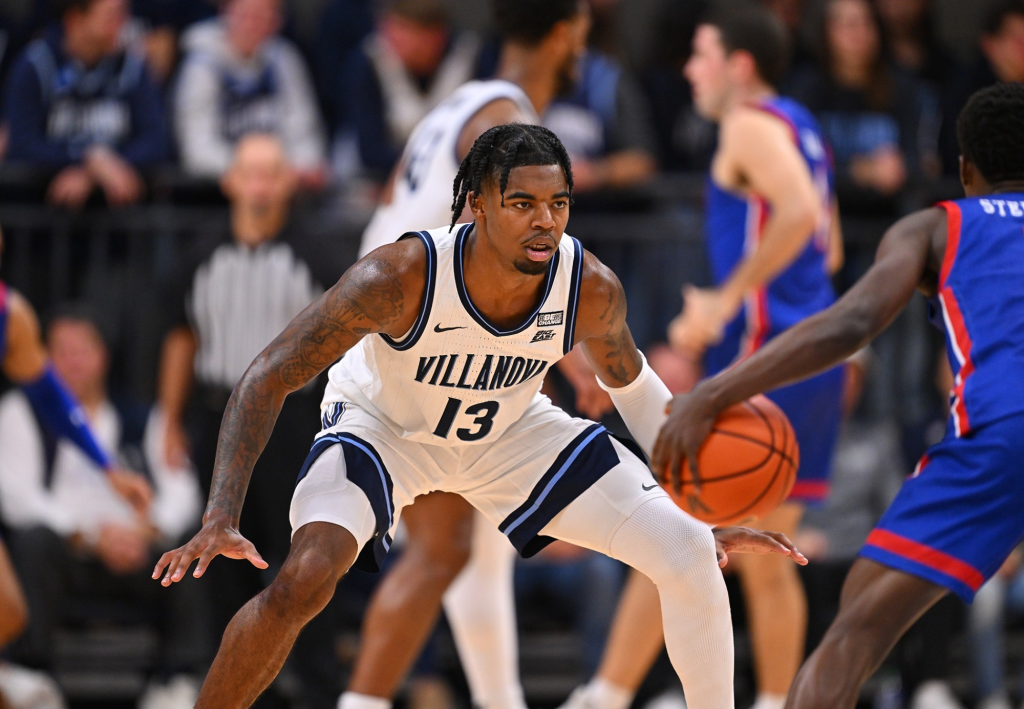
Villanova’s biggest x-factor this season might not be who you think. There is a lot of hype surrounding Villanova’s team this year, this is partially due to picking up four players from the transfer portal: TJ Bamba, Washington State University; Tyler Burton, University of Richmond; and Kevin Ware, University of Kentucky. The other transfer is Hakim Hart, who is a guard/wing that transferred for his fifth year of eligibility after spending his first four at the University of Maryland. Being that I was able to watch him play at Maryland, I feel like I can offer a unique perspective on a player who many people simply haven’t seen him play.
Hakim is the type of player every coach wants to have on their team. Someone who competes on both ends of the court and can step into any role on the floor and perform at a high level. He isn’t going to blow you away with just one part of his game but is able to do a lot of things at a high level. On the defensive end, he uses his length to his advantage by causing disruption in the passing lanes with deflections that lead to extra possessions. On offense, he doesn’t need the ball in his hands to be effective. He moves well off the ball and has a knack for finding himself in positions to score the ball with timely cuts and just being in the right place at the right time. This creates easy opportunities for his teammates to set him up to score the ball. This part of his game will be important to the Wildcat’s this year, as more times than not he will find himself off the ball due to the likes of players like Justin Moore and Eric Dixon. Both of whom have proven they can score the ball effectively with the ball in their hands. So, his ability to find openings in the defense will be a major benefit to their offense this year. But, maybe the most effective part of his offensive game is his playmaking ability. He makes excellent decisions with the ball in his hands, whether it be in the pick and roll or with his back to the basket. He is very crafty in his ability to finish around the basket with a combination of excellent footwork and his size advantage. He is also able to shoot the ball well from the outside but can be streaky at times. However, with a plethora of shot-makers around him, it should take the pressure off him and leave him with plenty of open shots.
His offensive game proved to be a vital part of Maryland’s success last season. This is evident when looking at their record where he scored 10 or more points, which was 17-4. This goes to show that when he was engaged offensively, it led to tremendous success for the entire team. Showing that Maryland’s success was mirrored by Hakim’s. In their Round of 64 matchup against West Virginia, his performance on offense was one of the main reasons they were able to advance to the next round. He used his playmaking ability to set up Don Carey for multiple open three-point shots and putting Julian Reese in positions to score around the basket. He also created opportunities for himself off the ball by coming off screens and again just a knack for being in the right place at the right time. He also proved decisive in making decisions when to attack the basket. He seemed to be all over the court and make every right decision. This game goes to show the impact he can have on a team’s success when he is engaged on both ends of the floor.
During an event where members of our club got the opportunity to talk with Joe Lunardi, I asked him about what he thought about Maryland’s team and how they would fare this year in the Big Ten. He answered by talking about Kevin Willard and how he is the right man for the job but that there are limitations for their expectations in the Big Ten because of how competitive the conference has become. He ended his answer by saying, “Their biggest problem is that their best player is in the Davis Center right now,” talking about Hakim Hart. This answer came before the season started but showed how his importance to Maryland’s success last year was apparent to those who pay attention to college basketball.
After watching Villanova’s first two games, it is clear Hakim is still adjusting to the play style and role within the system of this Villanova team. But there have been flashes where his playmaking and basketball IQ have been on display. Which leads to belief that if he can figure it out and make the necessary adjustments, he will be a major x-factor for this Wildcat’s team come conference play and deep into March where the Wildcat’s hope to return to their expectation of postseason success.
College Basketball 2023-24 Top 25
Andrew Marino
November 5th, 2023

- Kansas Jayhawks
It was difficult to find a team to reasonably place above Bill Self’s Jayhawks in the rankings. No matter how hard I tried (and trust me, I did). This team simply has all the pieces you need for a successful run. A historically victorious coach, returning pieces in Dajuan Harris, Kevin McCullar, and K.J. Adams, a fantastic recruiting class, and a dominant center in Michigan transfer, Hunter Dickinson. There’s no way around it; this is the most well-rounded team in the country, in a school with a winning culture.
2. Duke Blue Devils
This isn’t your father’s Duke basketball team. They aren’t relying on a starting 5 of top recruits to carry them through the season. Coach Scheyer has a team returning the top 4 scorers of last season’s team, which advanced to the Sweet 16 as a 5 seed. If the last few years have taught us anything about the tournament, it’s that experience may just be the most important trait a team can have. The ACC, once again, isn’t very near the most competitive conference, so the Blue Devils should have a clear path to a strong seeding come March.
3. Michigan State Spartans
I can’t explain why, but I’ve always been a fan of Tom Izzo’s Spartans. In recent years, they have not been as dominant as their history shows, but Izzo is always able to turn this team around when it matters most, headlined by their 2023 run to the Sweet 16. The Spartans return five of their top six scorers from last season, they bring in two five-star recruits–Xavier Booker and Jeremy Fears–and are led by one of the top coaches in the sport.
4. UConn Huskies
One of the main reasons I have UConn all the way in the top 4 is out of respect (gross), but I have a little doubt of the Huskies being around the top 10 for most of the season. While they won every single non-conference game (including in the NCAA tournament) by double digits, the Big East seemed to be the Huskies’ kryptonite, making up all eight of their losses. Hurley brings back Tristan Newton, Alex Karaban, and Donovan Clingan from last year’s championship team, but it raises the question of whether they are ready to step up and replace what they lost in Sanogo, Hawkins, and Jackson.
5. Purdue Boilermakers
Purdue is such a polarizing team. You can always rely on them to have an incredibly solid regular season, but once the tournament comes around, they can never seem to get over the hump. In the last three tournaments-2021, 2022, 2023-the Boilermakers lost to a 13 seed, a 15 seed, and a 16 seed, respectively. That is the basis of my concern, even with Zach Edey returning. However, in College Basketball, there’s always a chance; last time a team lost to a 16 seed, they won the tournament one year later.
6. Arizona Wildcats
I’m higher on this team than most, however, they have the same problem as Purdue. Under Tommy Lloyd, the Wildcats have a 61-11 record, yet only have two NCAA tournament wins to show for it. Most recently, the Wildcats fell to 15 seeded Princeton. However, Lloyd’s team brings back Oumar Ballo, who is ready to have a Pac-12 player of the year campaign, and brings in UNC transfer Caleb Love, who, whether you like it or not, led a team to the National Championship game. In my opinion, Arizona is in position to win the Pac-12 again, which makes it tough to have them outside of the top 6.
7. Marquette Golden Eagles
Shaka Smart’s second year in Milwaukee was met with success that I don’t think anybody predicted. The Golden Eagles won the crown of not only the Big East Regular Season, but the Big East tournament as well. They fell early in the NCAA tournament to Michigan State, but are now given a second chance with the same roster, only with the loss of Olivier-Maxence Prosper. Tyler Kolek returns as a top candidate for Big East Player of the Year, and I expect Smart and Kolek to have this team making a strong run this season.
8. USC Trojans
USC is another team that I have higher than most. All the way down at number 21 in the AP poll, a lot of the Trojan’s success will depend on the status of Bronny James. Boogie Ellis is leading the team as a fifth-year senior, and they also bring in number one prospect in the class of 2023, Isaiah Collier, but having Bronny James would push them over the edge. James was unfortunately a victim of cardiac arrest at practice over the summer, and his health should be placed at a priority over everything.
9. Creighton Bluejays
Creighton isn’t ever usually the flashiest team, but they are always able to get the job done. In fact, for this coming season, I see them as the most reliable team to count on when the tournament season comes around. The Bluejays are coming off of their most successful tournament run in program history, and return all but two players. I have no doubt that Greg McDermott can coach this team even deeper into the tournament, with the help of Ryan Kalkbrenner, Baylor Schierman, and Utah State’s Steven Ashworth. If the Bluejays didn’t lose Ryan Nembhard to the transfer portal, they would’ve been my clear favorites to win it all.
10. Houston Cougars
Revenge season incoming? Houston may have lost a lot in the off-season-specifically Marcus Sasser and Jarace Walker to the NBA draft-however, they’ve kept a majority of their pieces to such a strong defensive team, while also adding Baylor transfer LJ Cryer to fill some of the shoes left by the now NBA players. This team, despite its losses, is still the third ranked team according to Kenpom. A valid concern is that this will be Houston’s first year in the Big 12–but I think Kelvin Sampson and the Cougars are up for the challenge.
11. Texas Longhorns
Horns up? The Longhorns lost key pieces, but gained pieces as well. They have one of the most well rounded starting 5s in the country, headlined by a big 3 of Dylan Disu, Tyrese Hunter, and Oral Roberts transfer Max Abmas. After a historic tournament run from Abmas back in 2021, I don’t blame him for running it back with the Golden Eagles. However, at this point, I don’t blame him for leaving for a bigger school either. Rodney Terry, as a full-time head coach, is poised to have Texas as a top team in not only the Big 12, but the whole country.
12. Miami Hurricanes
After reaching the Elite 8 and the Final 4 in two consecutive seasons, Coach Larranaga still has an underrated squad going into next season. I completely understand why–losing Isaiah Wong is no easy fix. Nijel Pack is the next man up, and he’ll get help from Matthew Cleveland, a transfer from Florida State. The Hurricanes held a share of the ACC title, and I can see them challenging Duke for that title this season.
13. Arkansas Razorbacks
It’s about time we see a team from the SEC on the list. The SEC will be a good conference, but I just don’t see them having one super dominant team. Nonetheless, this is about the Razorbacks, not the SEC. I’ve learned over the years to not doubt coach Musselman, after two straight Elite 8s and eliminating defending champion Kansas last season. Like most successful teams, Arkansas will have a mix of returning talent and star freshmen. With no clear head of the SEC, I give the Razorbacks a good chance of winning the league.
14. FAU Owls
I’m not as high on FAU as others. I feel like we’re falling into the same trap that we’ve fallen into the past two seasons: Picking an underdog that made it to the Final 4 to have an extremely successful season following. It happened with UCLA, then UNC, and I’m afraid it’s going to happen with FAU. Luckily, all five starters from that Final 4 and 30+ win team are returning. The fact is, they are moving to the AAC and people are expecting them to have the kind of success that Houston had in the conference. I like the Owls to be a good team next season, definitely ranked, but I personally am keeping them outside of the top 10 due to recent patterns of Cinderella teams.
15. Tennessee Volunteers
I was shocked to see Tennessee in the AP top 10, but looking into it they deserve it. I just have them at number 15 for personal opinions. They return three of their stars–Santiago Vescovi, Zakai Zeigler, and Josiah-Jordan James–who helped them to a 4 seed in the NCAA tournament. The Vols reached the Sweet 16, and if it wasn’t for a Zakai Zeigler torn ACL, they probably could’ve gone farther. This team’s success truly depends on the ability of Zeigler, and whether or not he will be back to himself.
16. Baylor Bears
Time for the epitome of consistency in the 2020s. Baylor’s star from 2023, Keyonte George, is now in the NBA, but the additions of Ja’Kobe Walter and Toledo transfer RayJ Dennis should be able to help out with that. To be honest, I don’t have too much to say about the Bears; they return Jalen Bridges, Langston Love, and Jonathan Tchamwa-Tchatchoua from last year’s 3 seeded team. Above all else, they are still led by Scott Drew, who I put full faith in.
17. Villanova Wildcats
Here we go. Finally. As a Villanova fan, I’ve been waiting patiently to reach number 17 to write about the Wildcats. I’ll do my best to avoid any bias, but I think 17 is very reasonable for this team. Kyle Neptune obviously did not have a great start to his head coaching career at Villanova, missing the NCAA tournament and losing in the first round in the NIT. However, that season was coated with injuries to plague any chance of success. This team has two major traits that make them a threat in the Big East, and across the country: Experience and depth. The top 2 returning players, Justin Moore and Eric Dixon, as well as four transfers including Richmond’s Tyler Burton, WSU’s TJ Bamba, and Maryland’s Hakim Hart are all seniors or older. You can’t win without experience, and Villanova has a lot of it. Additionally, Chris Arcidiacono, who started for the Wildcats last season, is at the most their eighth best player, and there are still more players below him. The depth of this team is nearly unmatched, which is why I see Villanova having a major bounce back year. There are just two concerns: chemistry and coaching.
(I would elaborate on the concerns but I already wrote way too much for the Wildcats.)
18. Gonzaga Bulldogs
I’m giving Gonzaga the benefit of the doubt. I’m very nervous for the Bulldogs with the departure of Drew Timme. Last season, on the biggest stage, Timme got into foul trouble against UConn, and the Bulldogs could just not perform AT ALL without him on the floor, almost losing by 30. Luckily, they have Nolan Hickman still developing, the return of Anton Watson, and a slew of transfers, headlined by Creighton’s Ryan Nembhard, who I expect to be a major piece in this team’s success. Mark Few will definitely have his hands full this season, more so than usual.
19. Texas A&M Aggies
Last year’s Texas A&M team heated up in the second half of the season, finishing second in the SEC. They are on pace for a similar or even better finish this season, returning four starters-just losing Dexter Dennis who averaged 9.5 points per game. Buzz Williams has had this team in such a desirable position the past few seasons, yet they haven’t been able to get further than the first round of the NCAA tournament. This is the season that it should happen, and the Aggies could quite possibly win the SEC while they’re at it.
20. Maryland Terrapins
No, Maryland isn’t ranked to boost Villanova’s resume. Kevin Willard led this team to the second round in his first year coaching at Maryland, and he should be in position to have another successful position. The Terrapins are led by three veterans–Jahmir Young, Julian Reese, and Donta Scott–who I see leading Maryland to be the third best team in the Big 10. After being an average team in basketball for the past few seasons, this is the chance for the Terrapins to make a statement for the rest of the country.
21. Illinois Fighting Illini
The Fighting Illini have a lot of potential in a relatively weak Big 10 Conference. I currently have them as the fourth ranked team in the conference, but I wouldn’t be surprised if they have an even better season. I expect this team to be led by Terrence Shannon and Quincy Guerrier. Brad Underwood has created a consistent team in the past few seasons and I believe the only question is about who will be playing the point-guard. Beyond that, expect another solid season from Illinois.
22. St. John’s Red Storm
Oh, of course the Johnnies are already making me regret this. At the time of writing this, they just lost to Pace University (a DII school) a few days ago in an exhibition match. I’ll be a bit lenient simply because they were without their two clear best players. Nonetheless I’m hopeful because Rick Pitino has been able to create a brand new squad with NINE transfers, headlined by Jordan Dingle from UPenn. Joel Soriano, who I find to be one of the most underrated players in the Big East, is returning as well. I have no doubt in Rick Pitino’s coaching abilities, but with eleven new players, there will inevitably be some form of chemistry issues being needed to fix.
23. Kentucky Wildcats
There is a lot of pressure this year for Kentucky and specifically coach John Calipari. The Wildcats are bringing in the top-ranked recruiting class in the country, but that hasn’t seemed to matter as of recent. The most successful Kentucky team in the past three seasons got upset by the 15 seeded St. Peter’s Peacocks. With the loss of former Player of the Year, Oscar Tsciebwe, Calipari will need players to step up all around. Another average season could bring about some serious questions regarding Calipari’s future.
24. Colorado Buffaloes
No, this isn’t the Coach Prime effect. I liked the Buffaloes in the upcoming season long before the ‘Colorado Football Fiasco of 2023’. This is mainly due to underrated stud, Tristen Da Silva. He has potential to win Pac-12 Player of the Year in the conference’s last hoorah. Along with him, is the fourth-ranked player in last season’s recruiting class-Cody Williams. This may be one of the best veteran-freshman duos in the country, next to Boogie Ellis and Isaiah Collier at USC.
25. San Diego State Aztecs
Every few weeks, I need to remind myself that San Diego State just played in the National Championship game. The Aztecs return four of their top six scorers from last season’s team. One of which is Lamont Butler, who you may know for his wild buzzer beater over FAU. Expect a big jump from him, as well as Darrion Trammell, Jaedon LeDee, and Micah Parrish. San Diego State just seems to always be in position to win the Mountain West, and I see no difference this year.
Honorable Mentions
- Alabama Crimson Tide
- St. Mary’s Gaels
- UCLA Bruins
- North Carolina Tar Heels
- Northwestern Wildcats
Year of the Center?
May B. Wright
October 30th, 2023
The 2023-2024 college basketball season is just a week away and there is certainly so many exciting storylines to watch. The one that jumps of the page the most to me would be the impact that the center position will have on the college game this season. With four out of the five AP Preseason All-American listed at center, there is no doubt many of the best players in the country this season will be seven footers. We’ve seen the impact a versatile stretch center can have in the NBA with the reigning MVP Joel Embid, and arguably the best player in the world Nikola Jokic who’s accumulated two consecutive MVP’s. Winning the 2023 NBA Championing with the Denver Nuggets, Jokic average 30/14/7 and won Finals MVP. The ability to run your offense through a big opens up spacing, shooting, and driving lanes for all five players on the court and really challenges all defense schemes and systems.
So who are the best centers entering the 2023-2024 college basketball season?
Zach Edey (Purdue) – the reigning consensus player of the year last season, Edey is poised for another big season. After averaging 22 points and 12 rebounds, the 7’4” center will be surrounded by an older and more experienced supporting staff who certainly look to improve upon their shocking first round NCAA tournament upset to #16 seed FDU. In 2022 national player of the year Oscar Tshiebwe returned to Kentucky for his senior season and ultimately saw a slight drop in both rpg and ppg but lead Kentucky to a 22-12 record and NCAA second round appearance. I think Edey will be more dominant that Tshiebwe was in 22’ because of that talent surrounding Edey and sheer size mismatch he presents for nearly every team in the country.
Hunter Dickinson (Kansas) -the most highly sought after transfer in the country after three incredibly successful season at Michigan. Dickinson adds his name to the list of talented Kansas centers under Bill Self, and adds great height and offensive firepower to a Kansas team that is looking to go back to the final four, after winning it all in 2022. Dickinson has averaged 18 ppg each of the last two seasons while shooting 42% from three during the 22-23 season. With so much experience on this Kansas roster, look out for Timberlake and McCullar to be the perfect pair with Dickinson as no doubt Bill Self’s team on paper is the best team in the country entering the 2023-2024 season.
Kyle Filipowski (Duke) – a somewhat surprising decision that Filipowski returned to Duke for his sophomore season after being a projected first round pick in the 2023 NBA Draft. Jon Scheyer has built quite the roster in Durham, anchored by Filipowski, fellow sophomore guard Tyrese Proctor and the veteran senior point guard in Jeremy Roach. While Filipowski will play the four with sophomore Christian Reeves playing traditional five, but Filipowski is certainly the most talented player on this younger Duke team. Duke will need Filipowski to continue shoot the ball efficiently and play with toughness after the freshman struggled in Duke’s second round tournament loss last season to Tennessee. Duke will be tried and test with a great non-conference schedule before entering top heaving ACC conference play.
Armando Bacot (North Carolina) – back to back preseason all American team selections for Bacot after leading the tar heels to the 2022 National title game. Bacot had one of the most dominant performances in the 2022 tournament before leaving the national title game early due to injury, and was expected to dominate in 2023. The 2023 season was one to forget in Chapel Hill, as North Caroline became the first ever preseason #1 team to miss the NCAA tournament. A bit of an divorce at UNC as Caleb Love transferred to Arizona after relations fell apart between him, Bacot and Hubert Davis. Bacot has plenty of pieces around him to get back to the NCAA tournament and compete with Duke and Miami in the ACC. Bacot will need to remain healthy after dealing with high ankle sprains each of the last season, and must continue to improve upon his free throw shooting as Bacot is yet to shoot above 70% from the stripe in his college career.
Ryan Kalkbrenner (Creighton) – lot of excitement and chatter in Omaha, as the blue jay faithful believes Greg McDermott team may have the weapons to reach the programs first final four. The anchor and best player for this Creighton team is senior Ryan Kalkbrenner, averaging double figures in each of the last two years as well as all big east honors, Kalkbrenner is the key to this Creighton team’s success. Fresh off a heartbreaking loss to SDSU in the elite eight last season, Creighton returns three of their five starters and will rely on Kalkbrenner to lead their defense, after finishing 14th in adjusted defense per Kenpom. Kalkbrenner and Creighton will endure maybe the most talented Big East in the past decade but with an experienced group and plenty of spacing with shooters Steven Ashworth and Baylor Scheierman, Kalkbrenner and Creighton will be a tough out.
Donovan Clingan (UConn) – the reigning National Champions have reloaded after sophomore center Donovan Clingan passed on the NBA draft to return for another year in Storrs. Dan Hurley has built UConn back to a national powerhouse, returning starters Newton and Karaban look to add their names to the list of great UConn guards. UConn didn’t lose a game all season against non-conference opponents, but UConn will certainly look to compete for the Big East title and Clingan dominance will go a long way. Clingan was the back up for Adama Sanogo last season but at 7’2” his size and rim protection gives UConn a great advantage on both the offensive and defensively glass.
Great Guards win in March
With all this talk about centers having the biggest impact on college basketball this season I would be remiss not to mention some of the best guards in college basketball. There is no doubt that great experienced guards always find ways to lead their teams to deep tournament runs. Guys like Jordan Hawkins, Christian Braun, Kyle Guy and Jared Butler have all found ways to elevate their teams to great tournament success. Names who will look to add to that list this year would be Justin Moore, Tyler Kolek, Wade Taylor IV, Max Abmas Ryan Nembhard, LJ Cryer, Johnell Davis, Tyrese Proctor, Tyson Walker, and Dajuan Harris.
2022 NBA Mock Draft
Preston Powery
October 16th, 2022
Going into the 2022-23 NBA season, there appears to be more parity than in any season in recent memory. There is no obvious superteam, like the Miami Heat of the early 2010s or the Durant-led Warriors from 2017-19, where the outcome of the finals seems inevitable before the first regular season game. There is no longer only one or two teams in each conference with a realistic shot at winning it all. As the 22-23 NBA regular season nears its commencement, several teams in each conference reasonably believe they will be the ones standing with the Larry O’Brien Trophy in June. Additionally, the highly anticipated return of star players such as Kawhi Leonard, Zion Williamson, Jamal Murray, Ben Simmons, and more who missed all of last season not only elevates their teams’ ceiling significantly but also heightens the excitement of the new season as a whole. The rest of this article breaks down each team by tier, from the title contenders to the tankers, and whereas in past years the categorization of teams by tier would have been pretty clear, there is not nearly as much separation between teams going into this year. Thus, all NBA fans should be ecstatic about the upcoming season, perhaps more than any season in recent history.
Tier 1: Title Favorites
Golden State Warriors: The defending champs are primed to defend their throne in 22-23, led by one of the most influential players in NBA history in Stephen Curry. The reigning Finals MVP torched an elite defensive team in the Boston Celtics in the finals last season, averaging 31 PPG on 48/44/86 splits. With Steph continuing to play at such a high level, in addition to a healthier Klay Thompson, Draymond Green’s intangibles, a rejuvenated Andrew Wiggins, and a rapidly improving Jordan Poole, the Warriors should be one of the most feared teams in the NBA again this season. Elite defense is a recipe for winning championships, and Golden State has all the pieces in place to replicate their 106.9 Defensive Rating from a season ago, which led the league. They also proved in last year’s playoffs that they have enough offensive weapons to help lessen the burden on Steph, making them a dangerous team on both sides of the ball. Despite the departures of key rotational players like Gary Payton II and Otto Porter Jr., young guns Jonathan Kuminga, Moses Moody, and James Wiseman should have increased roles and be able to make up for those losses to stabilize this championship roster. As long as the Draymond-Poole altercation from early October does not completely blow up the team’s chemistry, the Warriors will be in the thick of the title race once again.
Boston Celtics: The defending Eastern Conference champs are loaded once again for 22-23. Although the latter part of the offseason was not kind to them, as Danilo Gallinari tore his ACL, Robert Williams underwent surgery that will keep him out for several weeks, and rising coach Ime Udoka got suspended for the entire year, Boston should still be elite. Despite only tying for the sixth best record in the NBA last season at 51 wins, the Celtics shared the league’s best Net Rating (+7.5) with the 64-win Suns. The graph below portrays the offensive and defensive ratings of every team last year, with the teams in the bottom right, including the Celtics, having the strongest offenses and defenses. Even after a poor first half, the Celtics finished as one of the best two-way teams in the regular season and improved even more in the postseason.
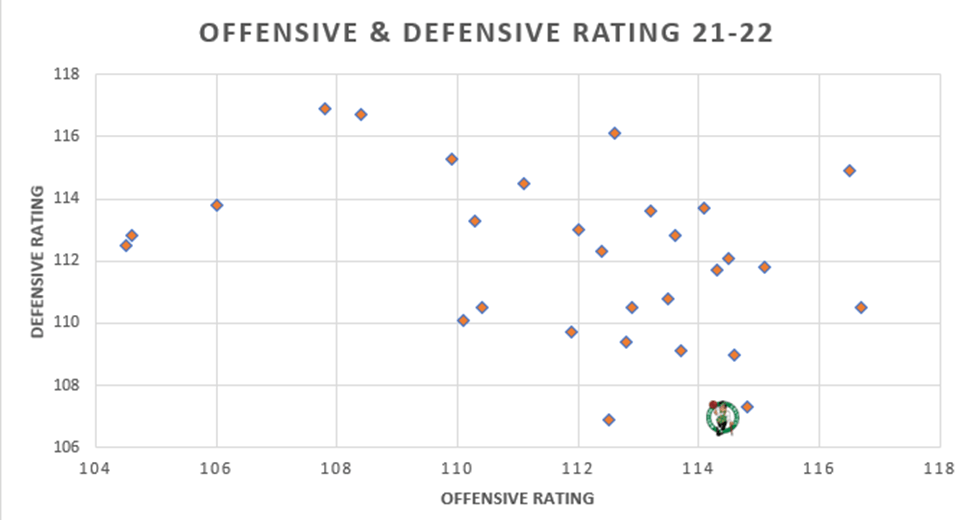
Of course, the ceiling for Boston depends on how far their All-NBA standout Jayson Tatum and All-Star Jaylen Brown will take them as they enter their primes. After making the finals last season, the pressure will be high on this team to win it all this year, with most of those lofty expectations being placed on the shoulders of Tatum and Brown. Expect these two young stars to take their game to yet another level and keep the Celtics squarely in the title conversation.
Milwaukee Bucks: Milwaukee’s case as one of the favorites to win it all this year is pretty simple. First, if Khris Middleton were healthy during last year’s playoffs, the Bucks feasibly could have repeated as back-to-back champs. Secondly, they have arguably the best and most dominant player in the world in Giannis Antetokounmpo. Giannis nearly single-handedly propelled the Bucks past the Celtics last season, as he proved that they will be perennial contenders as long as he stays healthy. With Middleton and borderline All-Star Jrue Holiday by Giannis’ side, they have as formidable of a trio as any team in the league, but the question for the Bucks will be, can they get enough consistency from everyone else? As long as players like Bobby Portis, Brook Lopez, Grayson Allen, and Pat Connaughton provide decent production to aid their big three, the Bucks will be as dangerous as anybody.
Los Angeles Clippers: Even though the Clippers only got 31 games from Paul George and 0 games from Kawhi Leonard last season, they still finished with a 42-40 record and reached the play-in. While having their two best players fully healthy will significantly improve an offense that had the seventh worst offensive rating, Los Angeles’ projection as one of the top teams in 22-23 is not solely because of them. The Clippers are the deepest team in the league, as they legitimately boast a lineup that can go 11-deep. With a plethora of versatile wings like Kawhi, PG, Marcus Morris, Robert Covington, Nicolas Batum, Norman Powell, and Terrance Mann, the defensive potential of this team should make them a nightmarish matchup in a best-of-seven series, and head coach Tyronn Lue has been heralded as one of the top in-game adjusters in the sport. Having the luxury of inserting a fully healthy top-15 player in George and borderline top-5 player in Kawhi to a team that was still competitive last season and is led by arguably the best coach in the league is scary for the rest of the NBA. This version of the Clippers is not only their most talented in franchise history, but they may have the highest ceiling of any team in the league as well.
Tier 2: Playoff Locks/Title Sleepers
Denver Nuggets: Nikola Jokic, fresh off of a season in which he had the highest player efficiency rating in NBA history (32.8), while leading a squad with Aaron Gordon as his running mate to 48 wins and a 6-seed, will get back much needed reinforcements for the 22-23 season. The two-time reigning MVP will gladly welcome the returns of Jamal Murray and Michael Porter Jr. who missed all and most of last season, respectively. The last time the Nuggets had those two healthy for the playoffs, they came back from two 3-1 deficits in the bubble and made the conference finals. Since then, Jokic has solidified himself as a bona fide superstar, and presumably, Murray and MPJ will also be much improved once the injury rust wears off. Because of these three, in addition to Gordon and solid role players such as Kentavious Caldwell-Pope, Bruce Brown, and Bones Hyland, Denver is a team that could have just as easily been placed in Tier 1. However, the Nuggets only produced a league average defensive rating last season, and while new additions KCP and Brown will help them on that end, the return of MPJ getting significant minutes will not move the needle much defensively. Denver will be elite offensively, but will they be able to defend at a high enough level to win it all?
Dallas Mavericks: While losing Jalen Brunson in free agency undoubtedly hurts the Mavericks, the notion that they got much worse this offseason is overblown. Acquiring Christian Wood gives superstar Luka Doncic a perfect big to complement his skillset, and their two-man game will create a plethora of opportunities for Dallas’ offense this season. Tim Hardaway Jr. will also return after missing last year’s playoffs and Spencer Dinwiddie should be even more of a factor without Brunson. If Dinwiddie can provide 80% of what Brunson contributed as a secondary scorer and playmaker, in addition to Wood being a seamless fit and Hardaway Jr. returning, then Dallas will be a serious threat to at least make the conference finals once again. The West may be loaded, but Luka’s LeBron-esque ability to carry any supporting cast makes up for the talent gap between Dallas and the other elite teams. The 23-year-old averages 32/9/8 for his playoff career, and as he showed against the Suns last year, he is more than capable of putting his squad on his back to beat superior teams when it matters most.
Phoenix Suns: After setting a franchise record with 64 wins last regular season, the Suns were the most disappointing team in the playoffs. Not only were they upset by the Mavericks in the conference semifinals as a huge favorite, turning the ball over 31 more times than Dallas, but they went back and forth with the 8-seeded, Zion-less Pelicans in the first round, surrendering 60 more rebounds and 54 more free throws to New Orleans. On top of that, DeAndre Ayton’s tension with the organization has not gone away, and father time is finally getting to Chris Paul, who looked lost in the Dallas series. However, Devin Booker is a legitimate top-20 player in the league and Mikal Bridges is the prototypical 3-and-D wing, so there is still a lot to like about the Suns’ core. Expect some regular season regression from Phoenix, but they should comfortably finish in the top six and are still a team to keep an eye on as a dark horse title contender.
Miami Heat: Following an impressive run in the playoffs last year, Miami may not have enough to be a serious threat to win the championship in 22-23. The Heat got marginally worse this offseason, losing P.J. Tucker and not replacing him with a power forward who can play a similar role. Kyle Lowry is quickly declining, Duncan Robinson is being paid a lot to sit on the bench in the playoffs, and Bam Adebayo, although a very good player, needs to become more consistent offensively for Miami to have a shot at a championship. That being said, they were only one or two possessions away from reaching the finals, largely because of Jimmy Butler’s playoff heroics. Butler, represented by the light blue dot on the far right in the graph below of the twenty players with the highest Box Plus Minus in the playoffs, had the highest BPM while only having the eighth highest usage rate. His ability to elevate his game on both sides of the ball in the playoffs makes him one of the top players any team would want to lead them in a series. Therefore, it would be foolish to completely disregard the Heat’s chances come playoff time.

Philadelphia 76ers: After adding P.J. Tucker, De’Anthony Melton, Montrezl Harrell, and Danuel House, the Sixers have depth that they have not had since Joel Embiid was drafted. Embiid has established himself as one of the most dominant two-way players in the world, Tyrese Maxey is one of the most promising young guards in the league, and Tobias Harris should have a better season as the clear fourth option. However, the success of the Sixers largely depends on which version of James Harden shows up this season. If Harden can rediscover some of the aggression he possessed in Houston to be as dangerous of a scoring threat as he is as a passer, then Philadelphia will be nearly unstoppable. Interestingly, the Sixers led the league by a significant margin in free throws per field goal attempt at .232 last season, and that percentage should rise even more if Harden draws fouls at the rate he did in Houston. Their propensity to get to the line should create easy opportunities to score, and while free throw attempts go down in the playoffs, they should finish as one of the top seeds in the East utilizing that strength. There are lofty expectations for the Sixers this year, and they have all the pieces in place to get past the second round for the first time in the Embiid era.
Brooklyn Nets: Brooklyn is one of the toughest teams to categorize because they are arguably the most talented team on paper, but they seriously lack leadership and accountability. Basketball aside, Kevin Durant requesting a trade and demanding Joe Tsai to choose between him or Sean Marks and Steve Nash is not something the best player and leader of a team does. Everyone knows how unreliable Kyrie Irving is off the court, and there are many question marks surrounding Ben Simmons’ desire to improve his game. On the court, the fit between these three should be impeccable, and the Nets have a slew of effective role players and floor spacers to make this team as potent as any. However, due to the unpredictability and perplexing nature of this squad, it is difficult to believe that they will remain drama-free and reach their incredibly high ceiling.
Memphis Grizzlies: Ja Morant and the Grizzlies broke out last season to the tune of 56 wins and the second seed in the West. Amazingly, Memphis went 20-5 without their star Morant and even annihilated the Warriors one game in the playoffs without him. That says a lot about Jaren Jackson Jr., Desmond Bane, and the rest of Morant’s supporting cast, as well as Taylor Jenkins’ coaching ability. Nevertheless, Memphis was seriously threatened by the Timberwolves in the first round last year and the West has only gotten better this offseason. As good as they are, the Grizzlies are not guaranteed another second round appearance in this year’s playoffs. Furthermore, Jackson Jr.’s injury and the loss of role players Kyle Anderson and De’Anthony Melton should certainly decrease their win total this year, and they may even fall to the play-in. On the other hand, if their rapid progression last year is any indication, it should not be a surprise if they take another leap and make a deep playoff run.
Minnesota Timberwolves: The Timberwolves made a win-now move by acquiring Rudy Gobert for five players and five first round picks/swaps. Although they gave up a noticeable haul to get the 3-time Defensive Player of the Year, they were able to keep their top four players: Karl-Anthony Towns, Anthony Edwards, D’Angelo Russell, and Jaden McDaniels. Minnesota was a relatively average defensive team last year, and while they were excellent at forcing turnovers, they struggled to grab defensive rebounds, which led to their opponents getting a lot of second chance points. The chart below illustrates how they fared relative to the rest of the league in forcing turnovers and getting defensive rebounds. Clearly, they were elite at forcing turnovers but had the fourth lowest defensive rebounding percentage. By inserting Gobert next to KAT in the frontcourt, defensive rebounds should no longer be an issue, and if they keep their identity as a pressuring defense that gets a lot of takeaways, they should be a borderline top-five defense in the NBA. Couple that with an explosive offense led by KAT, Edwards, and Russell, and anything short of a conference finals appearance will be disappointing for Minnesota.

Cleveland Cavaliers: Similar to Minnesota, the Cavaliers made a huge trade this offseason to not only bolster their young core but also to put them on the fringes of the title discussion as soon as this year. After acquiring Donovan Mitchell, Cleveland now has four All-Star caliber players who are 26 or younger—Mitchell at 26, Jarrett Allen at 24, Darius Garland at 22, and Evan Mobley at 21—which sets them up for the present and the future. The Cavs had the seventh best defensive rating last season at 109.7 and that number should only improve if Allen and Mobley stay fully healthy. Although there are some defensive concerns in the backcourt, Mitchell brings the Cavs much needed playmaking and shot-creation. Pairing him with Garland creates a lethal duo offensively, and they have enough defenders with Allen, Mobley, and Isaac Okoro to make up for their defensive issues. This team was tied for third place in the East heading into the All-Star break in 2022 before falling in the standings due to Allen’s injury. As long as they stay healthy, there is nothing stopping this squad from potentially eclipsing 50 wins and obtaining a top four seed in what could very well be a deep playoff run.
Tier 3: One Piece Away
Toronto Raptors: The Raptors are a sneaky good team that nobody would want to face in the postseason due to the abundance of two-way wings that they have. Although Toronto is not the most efficient offensive team, as they finished with the sixth worst field goal percentage and fourth worst true shooting percentage a year ago, they hang their hat on their defensive versatility. Having wings like Pascal Siakam, Scottie Barnes, OG Anunoby, Gary Trent Jr., and Otto Porter, in addition to Precious Achiuwa and Chris Boucher, makes Toronto extremely switchable and tough to create offense against. They led the league in opponent turnover percentage last season at 14.4%, and when you couple that with the fact that they had the second lowest turnover percentage on offense at 11%, the Raptors usually get more possessions than their opponents each game. This is a very intriguing and relatively young team that in any other year would be a lock for the playoffs, but because the East is so stacked, there is no guarantee that they make the playoffs this year. However, the chances that they do make the top eight are still pretty good and if they do, their flexibility will make them a tough out against anybody.
Atlanta Hawks: Atlanta made one of the biggest splashes this offseason by trading for Dejounte Murray after being dismantled by the Heat in the playoffs. On paper, the fit between Murray and Trae Young in the backcourt seems very promising, as the Hawks lacked another consistent shot-creator and perimeter defender that could mitigate the damage of Young’s atrocious defense. Similar to the Raptors, the Hawks took excellent care of the ball last year, leading the league in turnover percentage at 10.8%. Atlanta should have no issues being one of the better offensive teams in the league again, but Murray cannot solve all of their defensive issues as they will probably still be in the bottom half of the league on that end. They are also not as deep as they have been the last couple of years, and their depth was a significant reason why they were able to make the conference finals in 2021. The Hawks are a talented team that can beat anyone on any given night, but they are probably still another All-Star away from being serious title threats.
New Orleans Pelicans: The highly anticipated return of Zion Williamson makes the Pelicans one of the most intriguing teams of 22-23. After beginning last season with a 3-16 record, New Orleans finished 33-30 before pushing the 1-seed Suns to six games in the first round. Throwing Zion in the mix to join Brandon Ingram, C.J. McCollum, and Jonas Valanciunas, it is not hard to envision the tantalizing potential of this group, especially on offense. While those four players are mediocre to poor defenders, the Pelicans still have the assets to be a respectable defensive team. With strong individual defenders like Herbert Jones, Jose Alvarado, Larry Nance Jr., and presumably rookie Dyson Daniels, New Orleans is capable of impressing defensively, and if everyone else buys in, their team defense could be a pleasant surprise. While there is rightfully a ton of optimism about this team, and they have the talent to take a leap reminiscent of the Grizzlies last year, it will still be difficult for them to crack the upper echelon of a reloaded Western Conference. But even if they are a play-in team again who loses in the first round, New Orleans is clearly headed in the right direction and has a chance to contend for the title in a year or two.
Chicago Bulls: Despite winning 46 games a year ago and spending a majority of the season in first in the East before the injury bug hit, the Bulls are stuck in the middle of the league’s hierarchy. They went all-in by signing DeMar DeRozan, Lonzo Ball, and trading for Nikola Vucevic to be a good, but not great, team. This was evidenced by their putrid play against the East’s best last year, as they went 1-14 vs. Miami, Boston, Milwaukee, and Philadelphia. Moreover, according to Basketball Reference, their Pythagorean wins, based on their margin of victory and some advanced stats, was only 40, which was the fifth-lowest in the East. Shown in the graph below, their expected wins were less than non-playoff teams such as the Cavs, Knicks, and Spurs. Chicago does have some bright young players in Patrick Williams and Ayo Dosunmu to pair with All-Stars Zach Lavine and DeRozan, but the decline of Vucevic and health concerns of Ball limit this team’s ceiling to a second-round exit at best. As good as Lavine is and as well as DeRozan played last year, this team needs another star to win in the playoffs, which will be hard for them to achieve with very limited cap space over the next couple of years.

Los Angeles Lakers: One of the most disappointing teams in 21-22, the Lakers made no major changes this offseason in their quest to get back to NBA royalty. They kept Russell Westbrook and made marginal improvements to their bench, so it is understandable that most people are pessimistic about their outlook in 22-23. However, having LeBron James, who is still playing at a top five level as he enters his 20th season, and a motivated Anthony Davis, who is a borderline top-10 player when healthy, should be enough to at least make the playoffs regardless of the roster around them. Of course, the major caveat regarding this team’s potential is health, as LeBron and AD missed a combined 68 games last year. If those two miss less than half of that amount this year, and new head coach Darvin Ham finds a way to maximize Westbrook’s impact, then Los Angeles could be scary come playoff time. If those things do not happen, then the Lakers may very well miss the postseason again and waste another year of LeBron’s career.
Tier 4: Playoff Hopefuls
New York Knicks: Entering 22-23, the Knicks are mired in a state of mediocrity. They are not good enough to be a lock for the playoffs and contend for a title, and they are not bad enough to tank. After missing out on Donovan Mitchell, which is probably a blessing in disguise considering the assets they would have given up, and giving Jalen Brunson a 4 year, $104 million contract, the Knicks should be fighting for a play-in spot. Although there is intriguing young talent on this team, including RJ Barrett, Mitchell Robinson, Obi Toppin, Immanuel Quickley, and Quentin Grimes, Tom Thibodeau’s proclivity to give preferential treatment to the veterans could hurt New York this year and beyond. Additionally, it is hard to imagine that Julius Randle will accept his role as the third option most nights behind Barrett and Brunson, which could lead to a stagnant and inefficient offense once again. On the bright side, if some of the young guys get an opportunity to showcase their abilities and Barrett rises to an All-Star caliber level, then it is conceivable that playoff basketball could return to the Garden this year.
Portland Trail Blazers: Portland made some respectable moves to bolster their depth and build a solid team around Damian Lillard this offseason. Unfortunately, those moves would have made more sense for a team trying to rise from a playoff team to title contender, not a non-playoff team to borderline playoff team like the Blazers. In a very competitive West, the additions of Jerami Grant and Gary Payton II probably only puts them as a play-in team at best, even if Lillard returns to his usual self. Nevertheless, one reason to be optimistic about Portland’s future is the potential of their young guards Anfernee Simons, who took a huge leap in his fourth year, and mystery prospect Shaedon Sharpe, who was a steal at number seven in the draft and has potential superstar upside.
Sacramento Kings: Sacramento enters this season with by far the longest playoff drought (16 years) in the NBA. The good news for Kings fans is that this team should have the best shot of making the playoffs since De’Aaron Fox got drafted in 2017. They needed to acquire shooting to pair next to Fox and Domantas Sabonis, as they tied for the sixth worst three point percentage last year (34.4%) on relatively low volume, which they did through the additions of Kevin Huerter, Malik Monk, and drafting Keegan Murray. The real question mark will be their defense, as their 115.3 defensive rating was the fourth worst in 21-22, and they must improve on that end to seriously contend for a playoff spot. If Fox can continue the torrid stretch he was on post All-Star break, where he averaged 29 points, 7.5 assists, and 4 rebounds on 50/37 splits, and the new additions fit nicely, Sacramento will at the very least be in the conversation for a playoff spot.
Washington Wizards: The Wizards committed themselves to a future of mediocrity when they signed Bradley Beal to a 5-year $251 million contract. While they have decent talent on paper, there are too many issues with Washington to seriously consider them a playoff threat in the East. One of those major issues is their lack of shooting. The graph below shows that the Wizards made only 10.5 threes per game last year which was the fewest in the league, and all but four teams shot the three-ball at a higher clip. Their inability to take or make a lot of threes has been a trend over the last few years, as they consistently shoot at a below league average percentage on low volume. In a league where the three-pointer is so prevalent, Washington is not good enough to justify their lack of three-point shooting, both in volume and efficiency.
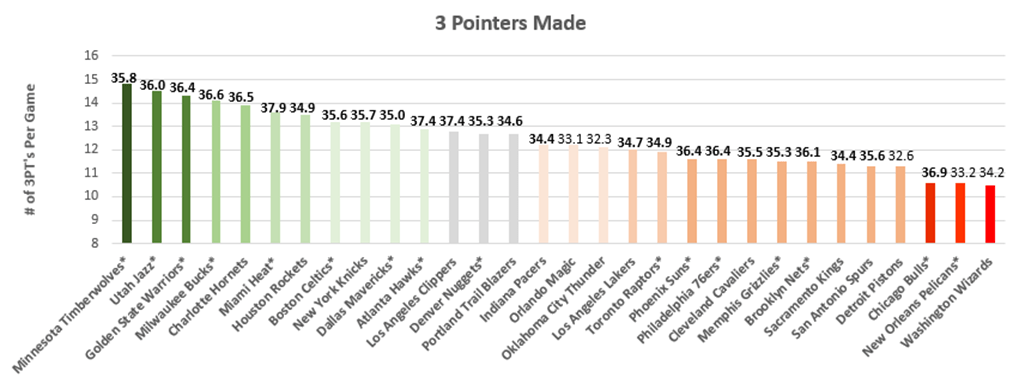
Charlotte Hornets: Led by LaMelo Ball, the Hornets hang their hat on sharing the ball and playing an up-tempo style. In 21-22, they led the league with 28.1 assists per game and were tied for fifth in pace with 100 possessions per game. However, without Miles Bridges, their offense should take a hit this year. Charlotte has also struggled to find a reliable big man to complement Ball, but they may have found one in Duke product Mark Williams, who they drafted in June. Still, the ceiling for this team in 22-23 is probably a third straight play-in appearance, barring breakout seasons from their plethora of young players coming off the bench.
Tier 5: Intriguing Rebuilders
Detroit Pistons: After a 23-59 finish in 21-22, the Pistons figure to be much better this season after additions to their promising young core. A backcourt of Cade Cunningham and Jaden Ivey could be electric, as Cade showed signs in the second half of last year of being a half-court virtuoso, and Ivey’s athleticism and speed should greatly improve Detroit’s effectiveness in transition. Their frontcourt is filled with intriguing young talent as well, with Isaiah Stewart, Marvin Bagley III, and 18-year-old Jalen Duren. On the wing, Saddiq Bey is another young player to keep an eye on, as his floor spacing and defensive potential fits nicely next to their young guards and bigs. Detroit also acquired veteran Bojan Bogdanovic who will not only inject juice into this team offensively but also provide them with important leadership. Led by Cade, it will not be surprising to see this team push for a play-in spot, but even if they do not make the play-in this year, there are not many teams with a brighter future than the Pistons.
Oklahoma City Thunder: OKC will have to wait until 23-24 to see prized prospect Chet Holmgren play, which dampens some of the excitement and expectations for the team this year. However, their backcourt of Shai Gilgeous-Alexander and Josh Giddey will be fun to watch, as SGA will look for his first All-Star appearance, and Giddey will look to add a more consistent jumper to an already advanced offensive game at 20 years old. The Thunder still have enough talent to potentially compete for a play-in spot, but if they are slow out of the gates, it will be interesting to see if they decide to fully tank and look towards next year with another high draft pick and the return of Chet.
Orlando Magic: Number one pick Paolo Banchero should make an immediate impact on what was arguably the most insipid offensive team in 21-22. In addition to having the lowest offensive rating in the NBA at 104.5, their efficiency and offensive rebounding were among the worst as well. The graph below shows that Orlando had the lowest offensive rebounding percentage and the third worst effective field goal percentage in the league. Paolo should help out in both areas, as he not only provides the team with a rebounding threat, but his playmaking and gravity will create easier looks for everyone which should increase their team efficiency. While Banchero may be the missing piece to get Orlando moving in the right direction again, he is not the only reason to be optimistic about the team’s future. Franz Wagner was a pleasant surprise last season and has All-Star potential, Wendell Carter Jr. is developing into one of the better young, two-way bigs in the league, and they have an abundance of young, talented guards. Similar to Detroit, the Magic will certainly improve this season and may even push for a play-in spot.
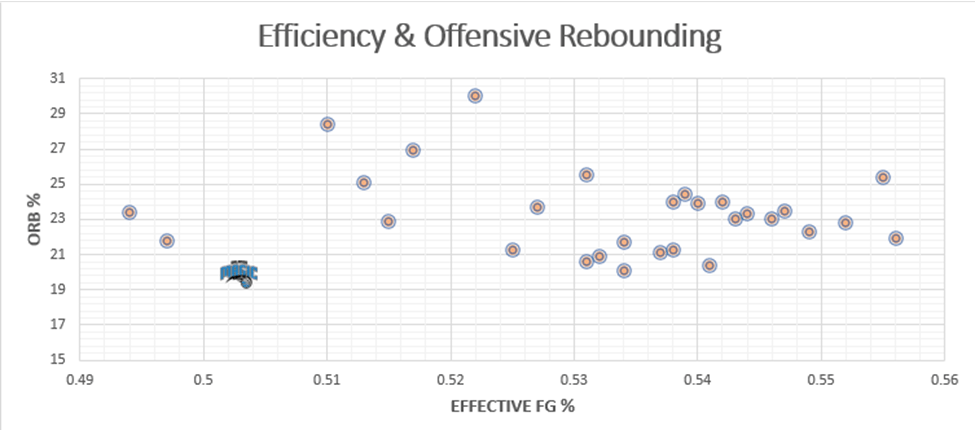
Houston Rockets: The Rockets were arguably the biggest winners of the 2022 NBA Draft, as they selected Jabari Smith number three overall, Tari Eason, and TyTy Washington. Adding these three, especially Smith, to a young core headlined by Jalen Green, Alperen Sengun, and Kevin Porter Jr. gives Houston something to be excited about for the future. While they are probably a year or two away from competing for a playoff spot, Rocket fans should be happy about how their rebuild is looking less than two years after trading away James Harden.
Indiana Pacers: After trading Domantas Sabonis and Malcolm Brogdon within the past year, Indiana is trending towards rebuilding mode. However, with Buddy Hield and Myles Turner still on the roster, their front-office probably still wants to be semi-competitive. Even though they only won 25 games last season, their expected wins according to Basketball Reference was 32, and they may not be much worse than that as currently constructed. The Pacers’ best move would be to trade Hield and Turner, which is likely considering the trade rumors surrounding them, and embracing the tank. A rebuild led by young star Tyrese Haliburton and the high-flying number six pick Bennedict Mathurin would be a good starting point for Indiana.
Tier 6: Wembanyama Sweepstakes (For Now)
To say that Victor Wembanyama is a special and franchise-changing prospect would be an understatement. Barring injury, the 7-foot-4-ish Wembanyama will be the number one pick in the 2023 NBA Draft. The league has never seen someone so fluid and versatile at his height, and it is not a stretch to think that he has the highest ceiling of any player ever entering the NBA. So, while there may only be two teams right now (Jazz & Spurs) who clearly have their sights set on him, there will be other teams such as the Pacers, Thunder, Rockets, and more who will be clamoring to position themselves at the top of the lottery if they start off slowly.
Utah Jazz: Danny Ainge and the Jazz front office received a boatload of young players and picks in the Donovan Mitchell and Rudy Gobert trades, giving themselves flexibility for the future. After being bounced in the first or second round the last five seasons, it seemed like the right time to trade their two stars and begin a rebuild. Veteran guards Mike Conley and Jordan Clarkson also may be moved this season for more young players and/or picks, as Utah turns its attention to Wembanyama and the rest of the 2023 draft class.
San Antonio Spurs: After trading their best player in Dejounte Murray, San Antonio will be competing with Utah for the best odds to get the number one pick in 2023. The Spurs helped their rebuilding efforts this past draft as they selected Jeremy Sochan, Malaki Branham, and Blake Wesley with their three first round picks. All three players have pretty high upside to add to a young core led by Keldon Johnson and Devin Vassell. While they are not completely devoid of talent, they are a safe bet to finish with the worst record in the NBA this year, which would be in accordance with their goal to draft Wembanyama.
Final Thoughts
In 22-23, both the Eastern and Western Conferences are as deep as they have been in a long time, and the talent level of the players is arguably greater than it has ever been in NBA history. The league is so loaded that at least one of the teams in Tier 2 will be in the play-in, despite being a legitimate title contender. There is also a high likelihood that at least two of the teams in Tier 3 will miss the playoffs, even though their aspirations are to make a deep run. Furthermore, almost every team in the league has a clear direction and bright present or future, which is not always the case heading into a season. Predicting which teams will make the finals in 22-23 is more difficult than ever due to the league’s parity and depth. As a result, playoff seeding will become more important as teams try to jockey for favorable matchups and to avoid the play-in, which should create a more intense and drama-filled regular season than in years past. Without a doubt, there will be fascinating storylines to follow, from the tipoff of the first regular season game on October 18 until the final whistle blows in June, and a champion is crowned.
2022 NBA Mock Draft
Andrew Johnson
June 23rd, 2022
1. Orlando Magic: Jabari Smith, PF, Auburn
The fit between Jabari Smith and the Orlando Magic makes too much sense not to happen. The Magic shot roughly 33% from three-point range as a team last year, and Smith has been viewed as a generational big man shooting prospect due to his 42.0% conversion rate on long balls last season at Auburn. While he struggles to finish at the rim and doesn’t have the isolation scoring or self-creation prowess of Paolo Banchero, Smith is a high-floor selection at No. 1 overall thanks to his elite-level three-and-D potential, strong character, and foundation for star-level ascension if he can continue to develop an off-the-dribble offensive package. Smith is a lock to become a highly valuable two-way player, something Orlando will appreciate considering their desire to start winning games in the short term. While he isn’t the home run swing teams typically covet at the start of the draft, the situational fit in Orlando and his extremely high floor make this an easy pick for John Hammond, and he should slide in next to Franz Wagner and Wendell Carter Jr. from Day 1.
Pro Comparison: 6’10’’ Klay Thompson
2. Oklahoma City Thunder: Chet Holmgren, C, Gonzaga This is the floor for Chet Holmgren, the player with the highest ceiling in the draft class. If he hits, we’re talking about a once-in-a-generation offensive hub who can push the ball in transition, stretch defenses from three-point range, and serve as a team’s defensive anchor thanks to his elite rim protection, defensive instincts, and foot quickness on the perimeter. While he was never the No. 1 option during his lone season at Gonzaga thanks to the presence of Drew Timme, Holmgren presents a tantalizing mix of bankable floor and All-NBA ceiling, as teams know they will be getting an impact shot-blocker from Day 1. Holmgren is also a much better finisher than Jabari Smith at the rim, making him an easy lob target for a Thunder team with a plethora of playmaking guards such as Shai Gilgeous-Alexander, Josh Giddey, and Tre Mann. While the concerns about his lanky frame are warranted and will ultimately push him to the No. 2 spot, his superstar potential is what teams dream of at the top of the draft. Sam Presti finally finds his franchise center after years of consolidating draft assets.
Pro Comparison: Supercharged Myles Turner
3. Houston Rockets: Paolo Banchero, PF, Duke
Banchero to the Rockets is my favorite player-team fit in the top 5. The Rockets tipped their hand by trading offensive-minded forward Christian Wood to the Mavericks,
signaling their desire to pair the 6’10’’ Banchero with electric guards Jalen Green and Kevin Porter Jr. Banchero, while not the defensive ace that Chet Holmgren is, is the best shot-creator in the entire draft. He’s a three-level scorer with a ready-to-go NBA frame at 250 lbs, and is an immediate mismatch for NBA forwards and centers given his advanced foot speed for a player his size. Banchero flashed an impressive arsenal of off-the-dribble offensive moves that make him an easy fit in Houston, a team lacking in frontcourt playmaking ability outside of 2021 draftee Alperen Sengun. If Banchero can become a league-average defender on the perimeter, he has a chance to be the best player in the draft given the value tied to a No. 1 option type of scoring big man. A core of Banchero, Green, KPJ, and Sengun should compete in the West in short order.
Pro Comparison: Blake Griffin
4. Sacramento Kings: Jaden Ivey, G, Purdue
While the fourth overall pick is Jaden Ivey’s perceived floor, I doubt the Kings will be making this selection come draft day. There is simply too much overlap in Ivey’s skillset with the Kings’ current backcourt of DeAaron Fox and Davion Mitchell – both players, like Ivey, rely on their quick-twitch athleticism to drive their offensive bag and struggle shooting the ball from outside. After trading Tyrese Haliburton to the Indiana Pacers in exchange for Domantas Sabonis, look for the Kings to prioritize win-now help and move this pick for an established veteran (Bradley Beal, anyone?). Ivey is the consensus top guard in this year’s class due to the offensive cornerstone potential tied to his explosive frame and 6’4’’ size, and he figures to be a nightmare for NBA defenses in transition and when attacking closeouts early in his career. If he can add a reliable perimeter jump shot and become a stronger defender like Ja Morant has, we could be talking about a franchise-changing player. Watch out for teams like the Wizards, Knicks, Spurs, Pistons, and Pacers to trade up and secure Ivey’s lightning-in-a-bottle potential.
Pro Comparison: Ja Morant
5. Detroit Pistons: Dyson Daniels, G, G League Ignite While this may seem high for Daniels when compared to the media consensus, it shouldn’t. Players like Daniels, simply put, are incredibly rare; he measured at 6’8’’ at the NBA combine and has already put flashes on tape of elite playmaking ability, at-the-rim finishing touch, and defensive versatility while serving as the lead initiator for the G League Ignite team. The Aussie controls the tempo of the game through his basketball IQ, and while he only shot 25.5% from three last season, we’ve seen many players develop into quality shooters upon entering the NBA with similar athletic profiles to Daniels (Lonzo Ball). Daniels is one of the draft’s biggest risers because at worst he’s a lockdown defensive guard on the perimeter who can support an offense with his advanced passing vision, and if he can become a league-average shooter, the Pistons
will have one of the league’s most well-rounded backcourts on both ends of the floor with Daniels and Cade Cunningham running the show.
Pro Comparison: Josh Giddey
6. Indiana Pacers: Keegan Murray, SF/PF, Iowa
The Pacers likely regret not pushing their way into the top 4 of this draft and missing out on a chance to pair Jaden Ivey with Tyrese Haliburton, but unless they trade up, Keegan Murray is a heck of a consolation prize. Murray burst onto the college basketball scene last season, averaging 23.5 PPG and 8.7 REB on a competitive Iowa squad that had just lost National Player of the Year Luka Garza after the 2021 season. Most impressive about Murray is his 39.8% conversion rate on threes last season, and after registering a true shooting percentage over 55%, Murray’s elite shot-making combined with his sturdy 6’8’’ frame should give teams comfort when investing a high lottery pick in him. While lacking the top-end explosion usually required of a superstar-level forward, Murray’s polished offensive skill set, defensive versatility, and noted work ethic provide an elite-level role player fit for any team picking outside the top 5. The Pacers are beginning what could be a lengthy rebuild, and pairing Murray with last year’s first-round pick Chris Duarte should give them a strong wing rotation to complement Haliburton for the foreseeable future.
Pro Comparison: Grant Hill
7. Portland Trail Blazers: AJ Griffin, SF, Duke
The Portland Trail Blazers could go in a number of directions with the No. 7 overall pick. They could reach for a center and take Jalen Duren, take a home-run swing for the future in Shaedon Sharpe, pick up a shot-making guard in Bennedict Mathurin, or even trade the pick for win-now veteran help. If they keep the selection, the best combination of team need and draft value is AJ Griffin out of Duke. Griffin has solid size at 6’8’’ and the physical foundation to be a lockdown defender on the perimeter thanks to his muscular build and long limbs that are built in a lab for disrupting passing lanes. Griffin also has solid foot speed for a player his size, allowing him to attack closeouts on straight-line drives. Griffin’s calling card, however, is his shooting; he canned a scorching 44.7% of threes during his freshman season at Duke. If he can develop into a solid secondary playmaker and add to his isolation scoring bag, Griffin could be an All-Star, but at worst, he’s an elite floor spacing wing who has the physical foundation to one day play lockdown perimeter defense against the league’s best perimeter players. Damian Lillard needs immediate help on the wing, and assuming Portland brings back Anfernee Simons on a near-max deal, Griffin should slot in as Portland’s starting small forward next to Jerami Grant from Day 1.
Pro Comparison: OG Anunoby
8. New Orleans Pelicans: Bennedict Mathurin, G, Arizona Fresh off a playoff appearance that included a surprisingly competitive run with Zion Williamson against the No. 1 seed Phoenix Suns, the Pelicans are in an enviable position to add lottery talent to a roster ready to compete in the postseason for the foreseeable future. The Pels are set in the frontcourt with Williamson, Brandon Ingram, Jonas Valanciunas, and Herb Jones, so picking up win-now guard help should be priority No. 1. They would love for Dyson Daniels to fall to this pick given his defensive acumen, but Bennedict Mathurin should be the No. 2 player on their big board given his elite perimeter shooting, flashes of three-level scoring, and underrated athleticism. Mathurin served as the No. 1 option for the Arizona Wildcats last year and largely thrived to the tune of 17.7 PPG and a respectable 36.9% three-point clip. He needs to improve as a playmaker as he only averaged 2.5 APG, but in New Orleans, he won’t have to worry about shouldering a large offensive load thanks to the presence of Ingram and CJ McCollum. Mathurin should get extensive looks at point guard for the Pels given Kira Lewis’ struggles, and if he can improve as a passer, he projects as a foundational backcourt piece for a New Orleans team on the cusp of contention.
Pro Comparison: Zach LaVine
9. San Antonio Spurs: Jalen Duren, C, Memphis
Armed with three first-round picks, nailing this draft is essential for the Spurs to emerge out of the purgatory they’ve been stuck in ever since the retirement of Tony Parker, Tim Duncan, and Manu Ginobili. They have a fringe star in Dejounte Murray running the point and solid supplementary scorers in Keldon Johnson and Devin Vassell, but they lack a franchise big man to set the tone on the defensive side of the ball. Enter Jalen Duren. Duren was a five-star recruit out of high school and played to his strengths at Memphis, serving as an elite rim protector and ferocious dunker under Penny Hardaway. Duren is the draft’s best finisher in the paint thanks to his ripped 6’11’’ frame and should thrive as a rim-running defensive difference-maker in an NBA system early in his career. Even if Duren never develops a reliable mid-range jump shot, he offers enough in the paint and on defense to warrant a lottery selection, especially for a Spurs team in dire need of a boost of athleticism in the post next to Jakob Poeltl. If Duren does develop a respectable jump shot, he’ll be a steal at this stage of the lottery.
Pro Comparison: Robert Williams III
10. Washington Wizards: Shaedon Sharpe, G, Kentucky The Wizards have been searching for a viable costar for Bradley Beal for what seems like a decade, and they very well may trade this pick for a veteran to attempt to fill that role next season. However, the best player they can hope to get with a pick outside the top 5 is John Collins, and he doesn’t move the needle enough to warrant relinquishing the extra years of team control tied to a rookie’s contract. So, with Shaedon Sharpe falling down the board, expect the Wizards to be his floor come draft night. It’s well-publicized that Sharpe didn’t suit up a single time for Kentucky last season, and with teams only possessing AAU tape on him, I can’t see a team earlier than this investing such a valuable selection in a player with so many question marks. The Wizards need to swing for the fences, though, and if Sharpe hits, he may be the best guard to come from this draft; he has jaw-dropping leaping ability, a long 6’5’’ frame, and three-level scoring flashes that usually accompany a star of his athletic profile. He’ll need a year or two in the G League before he’s NBA ready, but the Wizards must be prepared to exert that type of patience given the lack of readily available impact talent on the trade market. If Sharpe had stayed in school, he could have been in the mix for the No. 1 overall pick in the 2023 draft with Victor Wembanyama and Scoot Henderson. This pick, if it comes to fruition, could mark the end of the Bradley Beal era in the nation’s capital.
Pro Comparison: Jalen Green
11. New York Knicks: Johnny Davis, G, Wisconsin
In typical Knicks fashion, they miss out on the consensus top-10 prospects in this draft. They’re in no position to pass on talent for team needs, as a core of Julius Randle and RJ Barrett won’t be enough to get them over the top in a loaded Eastern Conference. So, with the backcourt being an obvious place of need, Johnny Davis seems like a logical selection. He cooled off during the second half of the college basketball season following an ankle injury, but before that, he was largely a one-man wrecking crew for a Badger team lacking any other NBA-caliber prospects. He’s a smooth two-way wing who competes defensively and has a strong mid-range isolation scoring punch, a skill he’ll need to continue to hone to have a standout NBA career. He may never be a 40% three-point shooter, but his polished scoring arsenal should offer enough value on its own to compensate for his lack of elite range. Surrounded by NBA talent, we may still have not seen the best version of Davis, and his calm and cool demeanor seems well suited for the bright lights of Madison Square Garden. Davis’ presence should allow Leon Rose to put Alec Burks and Evan Fournier on the trade market in hopes of acquiring a star-level point guard to pair with Davis and RJ Barrett. Pro Comparison: Devin Booker Lite
12. Oklahoma City Thunder: Ousmane Dieng, F, NZ Breakers After picking up his franchise center in Chet Holmgren, Sam Presti takes another big swing and invests his second lottery pick in a 6’10’’ forward from the New Zealand Breakers, Ousmane Dieng. Even though the Thunder are perceived to be years away from contention, they’ve actually constructed a strong young backcourt with Gilgeous-Alexander, Giddey, Mann, and Lu Dort, so continuing along the path of high-upside plays at the top of the draft seems like a likely strategy for Presti. Dieng, similar to Holmgren, has guard-like skills for a player his size – he shot only 27.1% last year from three for the Breakers but took just over four a game, illustrating the belief he and his coaches have in his ability to develop that aspect of the game down the road. Betting on Dieng means waiting a few years for him to add muscle to his wiry frame, as unlike Holmgren, he hasn’t yet figured out how to leverage his physical gifts into production on either the offensive or defensive end. He may never carve out a starring role on a winning team in the NBA, but there’s a shot he develops into an outside-the-box star given his physical gifts and youth. With the Thunder having a solid core in place, taking a flier on Dieng seems justifiable just outside the top 10.
Pro Comparison: Franz Wagner
13. Charlotte Hornets: Jeremy Sochan, PF, Baylor
For Charlotte, this selection likely comes down to Mark Williams or Jeremy Sochan, but I’ll give the edge to Sochan based on the helium he’s been getting after the NBA combine and his modern skillset. While Williams is a more prototypical rim-running shot-blocking center, Sochan displayed an ability to guard positions 1-5 during his lone season at Baylor, a skill that’s never been more sought after in the NBA than today. What’s really moved the needle for Sochan, though, is the three-point shot-making he has reportedly demonstrated during team workouts in the pre-draft process, a part of his game he did not display consistently in college (29.6% three-point conversion rate). At worst, though, Sochan projects as a Swiss Army knife defender who can punish teams with his speed in transition, rebound his position well using his 6’9’’ size, and switch onto guards in half-court defense given his long arms and quick feet (he averaged 1.3 SPG last season). While taking Sochan over Williams doesn’t solve Charlotte’s long-standing lack of a true center to pair with LaMelo Ball, Sochan is simply a better fit for today’s NBA, and reaching for a player to fill a roster need in the lottery rarely works out well. Look for Charlotte to target a player like Walker Kessler or Christian Koloko in Round 2 if Sochan is the pick.
Pro Comparison: Jarred Vanderbilt +
14. Cleveland Cavaliers: Malaki Branham, SG, Ohio State Fresh off a surprise playoff appearance, the Cleveland Cavaliers are trending up as a franchise for the first time since the departure of LeBron James. They lucked into Evan Mobley falling to the No. 3 overall pick in the 2021 draft, saw Darius Garland develop into an All-Star caliber point guard, and received tremendous returns on their 100 million-dollar investment in Jarrett Allen. Now, it’s up to Koby Altman to fill the gaps around those three stars, and if Malaki Branham is still on the board at No. 14 overall, expect Altman to run to the podium. Branham developed into Ohio State’s go-to offensive option down the stretch of last season thanks to his tremendously efficient shooting splits: he canned 49.8% of his FGs, 41.6% of his threes, and 83.3% of his free throws, pointing to a bankable floor as an immediate bucket-getter in the league. He possesses 6’4’’ size, and while not an elite defender, he’s expected to become at least a league-average contributor on that end. In Cleveland, he’ll only need to focus on scoring given their tremendous backline consisting of Mobley, Allen, and Isaac Okoro, and he has the potential to be one of the league’s best third options due to his efficient scoring approach and complementary offensive skill set. It doesn’t hurt that Cleveland is expected to trade guard Collin Sexton as well. This would be a home run pick for the Cavs.
Pro Comparison: Khris Middleton
15. Charlotte Hornets: Ochai Agbaji, SF, Kansas
The Hornets are back on the clock, and after securing frontcourt depth with Jeremy Sochan two picks earlier, expect them to target a wing or guard with their second first-rounder. After investing a top-15 pick in guard James Bouknight last season, looking to the wing seems like the most logical course of action, and Ochai Agbaji stands out as the best option left on the board. Agbaji was the best player on the champion Kansas Jayhawks last season, showcasing a much improved three-point stroke (40.9%) while also upping his scoring volume (18.8 PPG). He also made strides as an on-ball defender, and for him to be worth the No. 15 overall selection, he must continue to develop into an above-average defender given his lack of playmaking ability (1.6 APG). However, the three-and-D archetype is still tremendously valuable in today’s NBA, and there’s arguably nobody more pro-ready to serve that role in this year’s draft than Agbaji. His complementary offensive outlook should pair well with a ball-dominant point guard in LaMelo Ball, whose playmaking wizardry will set up Agbaji with plenty of clean three-point looks. Walking away with Sochan and Agbaji should make the Hornets immediately better next season, meaning we may finally get a chance to see Ball on a postseason stage for the first time in his young career.
Pro Comparison: Desmond Bane
16. Atlanta Hawks: Mark Williams, C, Duke
The Atlanta Hawks are in somewhat of a sticky situation at No. 16 overall given the lack of top-end talent available at this stage of the draft and their need for a full-fledged costar for Trae Young. They didn’t get anything resembling an immediate return from last year’s draftees Jalen Johnson and Sharife Cooper, so getting value out of this pick is very important for Travis Schlenk to keep his job. Mark Williams has slid down the board thus far, and expect the Hawks to stop his freefall if he’s available come draft night. Atlanta has an established frontcourt pairing in John Collins and Clint Capela, but each has seen themselves pop up in trade rumors of late. If one or both of them are dealt for a star-level guard or wing (OG Anunoby), Williams would be instantly called upon to serve as quality depth or even start at the five in Year 1. Williams is basically a younger version of Clint Capela; he’s an elite rim protector and rebounder who dunks everything offensively and operates almost exclusively in the paint. That type of player is extremely valuable when paired with a guard like Young who capitalizes on lob opportunities when penetrating the lane, so picking up an instant Capela replacement outside the lottery should a trade occur would be a win for a Hawks franchise trying to get back to the Eastern Conference Finals in short order.
Pro Comparison: Clint Capela
17. Houston Rockets: TyTy Washington, G, Kentucky At No. 17 overall, expect the Rockets to pick the best player remaining on their big board, regardless of position. Unless Malaki Branham or Ochai Agbaji unexpectedly fall out of the top 15, I believe that player will be TyTy Washington out of Kentucky. Washington turned in a solid-but-unspectacular year for the Wildcats, averaging 12.5 PPG and shooting 35.0% from three-point range. He did serve as a primary playmaker and responded with nearly 4.0 APG, an encouraging sign for his ability to run an NBA offense down the road. His shooting potential and ability to attack closeouts off the dribble point to off-the-ball versatility, which will be key for him to stay on the floor with other ball-dominant guards. In Houston, he would be an interesting fit with Jalen Green serving as the team’s backcourt centerpiece and would likely come off the bench in Year 1 given the presence of Green and Kevin Porter Jr. Washington was expected before this college basketball season to be in the running for the first point guard off the board, so buying low on him outside the lottery could pay dividends down the road for a Rockets team that is still a few years away from legitimate contention. In addition, It doesn’t hurt Washington’s stock that Kentucky guards are almost always better in the NBA than in college (John Wall, Shai Gilgeous-Alexander, DeAaron Fox, Tyler Herro, Tyrese Maxey, Immanuel Quickley, etc).
Pro Comparison: Mike Conley
18. Chicago Bulls: E.J. Liddell, PF, Ohio State
Ignore all the smoke: Zach LaVine isn’t going anywhere. With LaVine and DeMar DeRozan returning next season alongside a healthy Lonzo Ball and Alex Caruso, the Bulls should be set in the backcourt, especially after hitting on last year’s second-round pick Ayo Dosunmu. While the frontcourt could use some youth behind Nikola Vucevic, I think No. 18 overall is a little high for Walker Kessler and Ismael Kamagate. So, the pick is E.J. Liddell. Liddell put it all together this year for the Buckeyes, averaging 19.4 PPG and nearly 8 rebounds all while shooting 37.4% from three. Liddell is at his best when working out of the low post, but his improvement from beyond the arc last year is what gives him standout role-player potential in the long run. He possesses strong rebounding instincts, and while not the quickest defender, he makes up for it by using his 6’7’’, 240 lb frame to body up guards on straight-line drives and bang with big men near the basket. Beyond that, Liddell has a notably strong character and is a winning player, making him a viable selection anywhere outside the lottery. The Bulls are thin on wings outside of Patrick Williams and Derrick Jones Jr., so taking the experienced Liddell allows them to entrust him significant minutes as a rookie. A solid pick for a Bulls team trying to win now.
Pro Comparison: Grant Williams
19. Minnesota Timberwolves: Jalen Williams, F, Santa Clara After years of downtrodden rosters and coaching carousels, the Minnesota Timberwolves are a team with an unprecedented amount of stability. With Chris Finch entrenched as the team’s shot caller, Karl-Anthony Towns fresh off a third-team All-NBA selection, and Anthony Edwards blossoming into a full-fledged star in his second season, the Wolves possess the foundation to be a player in the Western Conference for years to come. While trade rumors have swirled involving D’Angelo Russell, my best bet is that he remains with the club for his final season, both due to his massive salary and relative lack of point guard depth in this year’s first round. With Russell at the point, the next order of business is adding to the wing, and Jalen Williams would be an exceptional selection at this stage of the draft. Williams is one of the draft’s biggest risers, and it’s not hard to see why; he stands at 6’6’’ and averaged 18.0 PPG last season while shooting 39.6% from three. Williams is a three-level scorer who is a strong finisher around the rim, willing passer, and team defender who profiles as an elite role player in the NBA with the potential for more. In fact, he registered a nearly identical NBA combine score as Donovan Mitchell. While concerns over the level of competition in the WCC are valid, Williams is a polished player who can step into a team’s everyday wing rotation from Day 1, which makes him a lock to go in the top 20 picks. He’ll fit in nicely in Minnesota next to Jaden McDaniels and Malik Beasley.
Pro Comparison: Jeff Green
20. San Antonio Spurs: Nikola Jovic, F, Serbia
After playing it relatively safe in the top 10 with the selection of Jalen Duren, the Spurs can afford to swing for the fences with the second of their three first-round picks. Nikola Jovic represents that kind of swing. The 6’10’’ forward has guard skills and has been on NBA Draft radars since he was 17 years old because of his unique skillset, and while he struggled shooting the ball playing for the KK Mega Leks U18 team this year, he has outlier star potential similar to projected lottery pick Ousmane Dieng if developed correctly. San Antonio has a strong track record in maximizing international talent (Manu Ginobili, Boris Diaw, Patty Mills), so landing with the Spurs is a best-case scenario for Jovic’s camp. Gregg Popovich has lacked a franchise-changing talent ever since the departure of Tony Parker, and if Jovic hits, he’ll have an offensive centerpiece to mold around complementary wing players such as Keldon Johnson and Lonnie Walker IV. Jovic may never be more than an idea on a basketball court, but taking big swings outside the top-10 is worth it for a Spurs team in need of a true cornerstone. Who knows, maybe he becomes Giannis Antetokounmpo.
Pro Comparison: Aleksej Pokusevski
21. Denver Nuggets: Dalen Terry, G, Arizona
On the shoulders of MVP Nikola Jokic, the Denver Nuggets made the playoffs this season, only to get trounced by the eventual champion Golden State Warriors. While they will be getting back Jamal Murray and Michael Porter Jr. next season, the time is now for the Nuggets to maximize Jokic’s prime and bring in high-level role players to complement his superstar skill set. Dalen Terry represents such a player. Terry was a relatively unheralded commodity last college basketball season at Arizona largely due to the presence of Bennedict Mathurin, but throughout the predraft process, teams have begun to buy into the potential tied to his 6’7’’, lanky frame. Terry is a menace in transition thanks to his exceptional athleticism and quick-twitch movement ability, and in theory, he should be able to guard positions 1-4 in the NBA thanks to his arm length and quickness. The swing skill for Terry will be his outside shooting; he canned 36.4% of his three-point attempts at Arizona, and if he’s able to maintain that number in the NBA, he will have a long career as a suffocating perimeter defender and capable floor spacer. For Denver, adding athletic defenders around Jokic is essential to masking his lack of foot speed, so if Terry is on the board at this stage of the first round, expect him to be the pick.
Pro Comparison: Mikal Bridges
22. Memphis Grizzlies: MarJon Beauchamp, G, G League Ignite The Grizzlies have been heavily linked to Dalen Terry in the days leading up to the draft, so if he’s available, I’d expect him to be the pick. In this scenario he is not, and with Memphis widely expected to select a guard, MarJon Beauchamp stands out as a promising option. Beauchamp received a green room invitation to attend the draft in person, hinting at media confidence in his status as a high first-round pick. After electing to skip college and play for the G League Ignite, Beauchamp showcased the potential and positional versatility tied to his long 6’7’’ frame. A smooth operator in transition, Beauchamp excels in the open floor and in space given his tight handle and ability to separate with quick-twitch athleticism. While he struggles shooting the ball and needs to improve his defensive IQ, the foundation is there for Beauchamp to develop into an interchangeable wing who can defend positions 1-4 and challenge defenses with his speed and size. Anywhere outside the lottery is Beauchamp’s perceived draft range, and for a Memphis team without many holes, adding Beauchamp makes sense as a developmental wing behind Ziaire Williams and Dillon Brooks.
Pro Comparison: Amir Coffey
23. Philadelphia 76ers: Tari Eason, PF, LSU
At No. 23 overall, this outcome would represent a bit of a slide for Tari Eason, a player who could go as high as No. 13 to Charlotte. Eason is a jack-of-all-trades type player who affects the game with his infectious energy, motor, and well-rounded skill set. Coming off the bench for the Tigers, Eason was arguably college basketball’s best sixth man last season, averaging 16.9 PPG and 6.6 REB while shooting a respectable 35.9% from three. While not known as a shooter, Eason showed a willingness to take open perimeter jump shots, but his NBA value will be tied to his ability to defend positions 1-4 and challenge opponents with the physicality and hustle that made him a force in college. An above-average athlete, the potential for Eason to continue to grow as an all-around player in an NBA system is there, and in Philadelphia, he would have the time and patience to develop behind Tobias Harris and Paul Reed. In the meantime, he will earn minutes by providing instant energy off the bench and capitalizing on transition opportunities with his speed as defenses key in on Joel Embiid and Tyrese Maxey.
Pro Comparison: Montrezl Harrell
24. Milwaukee Bucks: Walker Kessler, C, Auburn
Fresh off an Eastern Conference Semifinals loss to the Boston Celtics, the Milwaukee Bucks are looking for a quick turnaround as they continue to compete for championships under Giannis Antetokounmpo’s generational talent. The Bucks were never quite whole last season after missing Brook Lopez for the majority of the regular season and Khris Middleton during the playoffs, so picking up an instant-impact contributor in the first round will be key to improving their depth to last across a full campaign. Kessler would provide that in spades for the frontcourt. Fresh off a Naismith Defensive Player of the Year award, Kessler was college basketball’s most prolific shot-blocker (4.6 BPG), showcasing uncanny instincts to go along with his massive 7’1’’ frame. He also attempted a significant amount of threes, and while he only connected on 20.0% of them, the confidence he has in his perimeter shooting is a positive trend that will be the key differentiator in determining whether he is a backup defensive center or surefire, All-Defensive team-type stud. In Milwaukee, he would have an ideal mentor to learn from in Brook Lopez, and should Lopez miss more time next year, Kessler’s overlapping skillset will be essential frontcourt insurance. Kessler’s defensive foundation and possible floor-stretching ability give this selection a good deal of boom potential, and it’s one of my favorite player-team fits in the entire draft.
Pro Comparison: Brook Lopez
25. San Antonio Spurs: Jaden Hardy, G, G League Ignite The third member of the G League Ignite team comes off the board at No. 25 overall, and this time it’s Jaden Hardy to the San Antonio Spurs. Hardy has seen his stock fall considerably since the start of 2022 when he was a projected top-5 pick. This was largely due to a wildly inefficient season in the G League that illustrated his inconsistent shot selection, lack of defensive intensity and awareness, and subpar playmaking chops. However, the potential that made him such a highly regarded prospect still exists; he flashes microwave scoring ability at all three levels, and while only 6’4’’, he has the length and athleticism to be a disruptive defender at a guard spot. Taking Hardy in the first round means accepting the need for patience in his development, something the Spurs demonstrated a willingness for when they took Joshua Primo in the lottery last year. If Hardy hits, he could one day be an offensive engine on a competitive team because of his pedigree and foundation for sustainable improvement, but he’s far from a sure thing. With three first-round picks, the Spurs can afford to roll the dice on his star potential in the 20s.
Pro Comparison: Josh Christopher
26. Houston Rockets: Kendall Brown, SF, Baylor
The Rockets picked up two of the more pro-ready prospects already in the first round in Paolo Banchero and TyTy Washington, so taking a project with the last of their first-round picks seems likely. In Kendall Brown, that’s exactly what they get. At 6’8’’ with one of the most explosive verticals in the class, Brown is an elite athlete who applies it to the defensive side of the floor, routinely hounding wings on the perimeter with his quick-twitch quickness, length, and motor. Those facts alone will get him drafted in the first round, as his offense is considerably further behind without the presence of a reliable jump shot (34.1% from three) or self-creation moves in the half-court. In Houston, he would begin his career only having to worry about defending, as they possess the scorers in Jalen Green and Kevin Porter Jr. to pilot a successful scoring attack. Brown will also benefit from going to a non-contending team, as they’ll afford him the patience he requires to develop into an NBA-caliber offensive player. In the meantime, he’ll come off the bench and immediately become one of Houston’s best wing stoppers.
Pro Comparison: Derrick Jones Jr.
27. Miami Heat: Blake Wesley, G, Notre Dame
The Miami Heat came within one game of a Finals appearance last season, so adding an instant-impact contributor should be in the cards for a team looking to contend. At No. 28, value meets need as they stop Blake Wesley’s first-round fall. Wesley was the unquestioned top option last season at Notre Dame, and he responded to lead the Irish to the NCAA Tournament behind his averages of 14.4 PPG and 1.3 SPG. While he shot only 30.5% from three, the eye test shows a strong foundation for improvement when he’s surrounded by superior scorers in an NBA offense, and the rest of his game is tantalizing; he’s an electric slasher with a lightning-quick first step and has a dog-like mentality on defense, where he routinely guarded the opposing team’s best player. In Miami, he’ll play to his strengths as a cutter, transition weapon, and on-ball defender, and over the course of his career has the potential to turn into a strong primary ballhandler if developed correctly. In #HeatCulture, he’ll have a strong opportunity to do so and learn from the likes of Jimmy Butler and Kyle Lowry.
Pro Comparison: Immanuel Quickley
28. Golden State Warriors: Jake LaRavia, PF, Wake Forest The Golden State Warriors are NBA champions once again, and they find themselves with very few holes to fill. With that approach, I expect them to try and trade this pick to free up minutes for Jonathan Kuminga, Moses Moody, and James Wiseman, but if they keep it, Jake LaRavia seems like a solid choice. LaRavia is a floor-stretching big who shot 38% from three last season at Wake Forest and is generally regarded as a versatile, intelligent player on the offensive end. While a tad undersized for a power forward at 6’8’’, LaRavia simply needs to make perimeter jump shots to have value as a jumbo-shooter in the NBA, something the Warriors could need if they want to replace Nemanja Bjelica. While not the sexiest pick, LaRavia has a solid floor as a projectable shooting big man, and that archetype will always hold value in league circles. If he’s able to guard wings and bigger guards early in his career, he’ll establish himself as a rotation mainstay rather than simply a depth shooting piece. He pulled out of scrimmages at the NBA Combine, further increasing league confidence in his receiving of a first-round draft promise. He’ll likely hear his name called late in Round 1, and if not, he’ll be one of the first players off the board in Round 2.
Pro Comparison: Andrei Kirilenko
29. Memphis Grizzlies: Kennedy Chandler, PG, Tennessee Back on the clock after scooping up MarJon Beauchamp earlier in the first round, the Grizzlies seem likely to target a backup point guard behind Ja Morant to form an insurance policy against Tyus Jones’ impending free agency. If Kennedy Chandler is still on the board at this stage, I would widely expect him to be the pick. Chandler is only 6’1’’ but has a massive wingspan, strengthening his defensive outlook and playmaking potential. He’s a crafty scorer, as he averaged 13.9 PPG as a freshman at Tennessee while shooting a respectable 38.3% from three. A Memphis native, he would be a perfect culture fit in the Grizzles locker room, and his 5-star recruit pedigree, solid collegiate production, and room for growth as a scorer give him a first-round outlook. Chandler is only 19 years old, so spending time in the G League is not out of the question and may ultimately help him reach his potential as a rotational NBA lead guard down the road. A great pick for Taylor Jenkins and co. as they continue to ascend the Western Conference ranks.
Pro Comparison: Monte Morris
30. Denver Nuggets: Andrew Nembhard, PG, Gonzaga After trading a future 2025 protected first-round pick and JaMychal Green to the Oklahoma City Thunder for this selection, the Nuggets must be eyeing a win-now piece to come in and earn rotation minutes right away. They get just that in Andrew Nembhard out of Gonzaga. Nembhard was the Bulldogs’ floor general last year, averaging 5.8 APG on a loaded roster featuring Chet Holmgren and Drew Timme. As a result, there wasn’t an excess of shots to go around, so Nembhard’s complete offensive bag was somewhat suppressed outside of the facilitating role he was asked to play. Regardless, Nembhard displayed his scoring potential and then some at the NBA combine, dropping 25 points and 11 assists during a scrimmage. At 6’5’’, Nembhard has the size to score over the top of smaller NBA guards, and if his scrimmage stat line is any indication, there’s plenty more untapped offensive potential in his game that could be discovered in an opened-up NBA offense. He’s one of my biggest sleepers in this draft for those reasons, and I believe down the road we’ll look back and wonder why he wasn’t a lottery pick. Regardless, his lack of top-end collegiate scoring production and age will push him down the board, and in Denver, he’ll immediately make backup point guard Monte Morris expendable and push Jamal Murray for significant minutes as he returns from his ACL injury. A 38.3% three-point shooter last season, he can even play beside Denver’s point guards in certain lineups. He’ll be an instant-impact player from the jump, and at No. 30 overall, is an absolute steal for Denver.
A Quick NBA Finals Review
Kevin O’Donnell
July 28th, 2021
Finals MVP: Giannis Antetokounmpo
This was Giannis’ finals. It was plain to see that he was the best player in this series and one of the best in the league at the moment. If you watched any of the 6 games, you could see his dominance and his determination shining through in the biggest moments. Especially in game 6, as Brad Botkin of CBS Sports remarks, he was a man on a mission. He overcame injury and widespread criticism from those who claimed he did not have skill and those who berated him for his free throw shooting. (Admittedly, he really needs to work on his free throws, but other than this weakness he was impossible to stop throughout the playoffs).
Antetokounmpo is now the only player besides Shaq to tally 3 games with 40+ points and 10+ rebounds in the NBA finals. In his incredible game 6 performance, he became the first player since Bob Pettit in 1958 to score 50 points in a championship closeout game. His stat line in game 6 was preposterous: 50 points, 14 rebounds, and 5 blocks on 16/25 from the field and an astonishing 17/19 from the line.
Here’s a quick stat for everyone to put into perspective just how astonishing Giannis’ performance from the line was in game 6. Using a binomial distribution for free throws and Giannis’ regular season free throw percentage of 71.7% (which is actually better than his playoff average), Giannis is only expected to make 17 or more free throws (out of 19) 6.3% of the time. That’s insane. It really was his night. It was one of the greatest single game finals performances in the history of the league and I loved every second of it.
Player Highlights and Team Comparison
I could sing Giannis’ praises for hours because I love his story, personality, and grit, but this is supposed to be a finals review, not a Giannis review. The Bucks as a whole showed impressive determination to come back from 2-0 down to start the series. Middleton stepped up in big moments. Jrue Holiday, though he struggled immensely on offense at times during this series, was strong defensively per usual averaging 2.2 steals per game. Finally, secondary players like Bobby Portis and Brook Lopez played their roles perfectly.
The Suns played well too and showed that they will be a formidable force in the years to come. Devin Booker is a star, averaging 28 points throughout this series, and will continue to show his offensive prowess in the future. Ayton did not excel, but in my opinion is a solid traditional big that Phoenix can lean on. Mikal Bridges is a fantastic defender (no bias of course) and great all-around player who should be a wonderful option at 3 for the Suns. Cam Johnson also provides a great spark offensively with his shooting ability. Chris Paul played well on average, with 22 pts and 8 assists per game. However, he and Booker failed to lead their team to a victory. A few costly turnovers and an inability to stop Giannis on the defensive end spelled the end of the road for the Suns.
More important than individual metrics is how each team performed as a whole. You could make a case that the Bucks won because they bested the Suns in 3 of Dean Oliver’s “Four Factors of Basketball Success.” If you are unfamiliar with Dean Oliver, he is a pioneer of advanced basketball analytics and wrote the book “Basketball on Paper,” which I highly recommend. He believes that the most important factors in basketball are shooting, turnovers, rebounding, and free throws, in that order. The Bucks had a better turnover percentage, offensive rebound percentage, and draw foul rate than the Suns, while the Suns only had a better effective shooting percentage*. Though shooting is the most important category, according to Oliver, it was not enough to overcome the Bucks dominance on the offensive boards. The Bucks offensive rebounding percentage was 29.2%, compared to the Suns’ 17.4%. For reference, the league average is around 27%, so the Suns grossly underperformed in this category. The more offensive rebounds you get, the more chances you can create, so this massive discrepancy likely played a key role in deciding the NBA champions.
Overall, the Bucks deserved it and I’m happy for Middleton and Giannis who stayed together in Milwaukee for 8 years to bring home a trophy.
What If?
More than any other postseason, this year’s playoffs left us wondering what could have been. What if the (insert any team here) were healthy? Injuries plagued the league, with many speculating that the short offseason was to blame. The Nets looked like shoe-ins for the finals if all 3 stars stayed safe. The Clippers showed flashes of greatness, even without Kawhi, so we were left wondering how they would have fared with him. The list goes on, but almost no team was at full strength. I don’t like that all these injuries occurred, obviously, or that they will undoubtedly be used to discredit the champion or the runner up. The Suns and Bucks fought their way to the finals fairly and should be celebrated for their achievements.
With that being said, I couldn’t help but raise my own “what if” questions. Primarily, what if Dario Saric did not get injured? Saric was an overlooked, but key player in the Suns’ rotation this year, providing solid minutes and efficiency as a 6th man. I hypothesized that his presence would have made a difference. To test this, I compared the offensive and defensive ratings for all lineups with and without Saric throughout the Suns’ season. The lineups that Saric was in had slightly higher offensive ratings (112.45) on average than lineups without him (111.78). They also had a better defensive rating (106.08 compared to 107.72) and, thus, a better net rating by 2.3 points.
Saric was not the only injured player in this series, however. Villanova’s very own Donte DiVincenzo was sidelined for the Bucks, so I decided to look into his impact in the same way. Lineups with DiVincenzo are 2 points worse per 100 possessions on defense, but are about 7 points better on offense, leading to a positive net rating difference of around 5 for DiVincenzo’s lineups.
Does this definitively say that the Suns would have been better off with Saric in the lineup or that the Bucks would have won faster if they had Donte? Does it prove that DiVincenzo’s impact is more positive than Saric’s because his lineups have a higher net rating when compared to lineups where he is absent? Not necessarily. A lineup’s rating has a lot to do with the competition it is challenging. If the opposing lineup has a great defense, the Suns’ lineup will have a harder time scoring and will have a lower offensive rating. The same works for defense and for situations when the opposing lineup performs poorly. It is possible that DiVincenzo and Saric were more often playing weaker competition, so their ratings were buffed when compared to their teams’ starting lineups, who typically play other starters. Until I find a way to adjust for this difference (which I don’t think is possible with the data I have), this method is not foolproof. Nonetheless, it is interesting to see how teams’ ratings change with the absence or presence of one player. This method will be more informative when I adjust for the level of competition.
For now, I will stick with the certainties: The Bucks are NBA champions, the Suns are the runners-up, and they both earned their spots.
*Helpful Definitions:
Offensive Rating (ORtg): points produced/scored per 100 possessions
Defensive Rating (DRtg): points allowed per 100 possessions
Effective Field Goal Percentage (eFG%): FG% adjusted for the fact that a 3-pointer is worth 1.5 times a 2 pointer
(FG + 0.5 * 3P) / FGA
Draw Foul Rate: A measure of how often a player/team gets to the line and how often they convert
FT / FGA
Offensive Rebound Percentage (ORB%): Estimate of the percentage of available offensive rebounds a player/team gets while on the floor
ORB / (ORB + Opp DRB)
Turnover Percentage (TOV%): Estimate of turnovers per 100 plays
100*TOV / (FGA + 0.44*FTA + TOV)
2021 NBA Mock Draft 1.0
Andrew Johnson
July 22nd, 2021
Hello and welcome to the Villanova Sports Analytics Club’s first official 2021
NBA mock draft! We are approximately one week away from draft day, and with the
NBA combine in the rearview mirror, it is finally time to come out with projections for
this year’s eligible pool. Included you will find individual breakdowns for every team’s
first-round pick, as well as a full second-round mock with short breakdowns of my
favorite player-team fits. There have been major risers and fallers in recent weeks, and
with this year’s crop of prospects seen as the most complete in the last five years, there is
immense pressure for teams to get their picks right and set their franchises’ up for
future success. A note: these projections are based on what I believe teams will do, and
not necessarily what they should do. Let’s get into it.
(The Minnesota Timberwolves, Miami Heat, Portland Trail Blazers, and Dallas
Mavericks do not own any selections.)
ROUND ONE
1. Detroit Pistons: Cade Cunningham, PG, Oklahoma State
Not much to say here. Cade Cunningham is widely seen as the top overall prospect not only in this draft, but in the last three or four drafts as well. A 6’8’’ lead initiator, Cunningham showed his ability to completely take over games during his lone year at OSU by dominating the tempo of the game, effortlessly setting up teammates, and showcasing his advanced shot-making skills (shot 40.0% from three-point range). For the season, Cunningham poured in 20.1 PPG, 6.2 RPG, and 3.5 APG: now imagine what he can do on an NBA floor surrounded by professional teammates. The minute he steps on the floor, he will be an All-Star candidate. There are certain players that come around once-in-a-generation that guarantee their team a chance to win a title on their own, and Cunningham has a chance to be a part of that exclusive group sooner than later. For a Pistons team without a true franchise centerpiece, Cunningham immediately becomes their present and future and fits nicely as a No. 1 option on a squad that already has a solid young core in place. Killian Hayes, Saddiq Bey, and Isaiah Stewart showed plenty of promise last season as rookies, and Jerami Grant will revert to his natural role as a No. 2 offensive option. Watch out for the Pistons as a surprise playoff team next season. Ignore all of the trade speculation: Cunningham to the Motor City is set in stone. His NBA comp is a mix of Luka Doncic and Jayson Tatum.
2. Houston Rockets: Jalen Green, SG, G League Ignite
The draft starts at pick No. 2. The Rockets are projected to choose between Jalen Green, the most talented pure scorer in the draft, or Evan Mobley, a modern center with advanced defensive instincts and unique offensive versatility. I believe they will opt for Green, primarily for the direction the league is going as skewed towards electric, takeover scoring wings, a mold that Green fits to a T. A 6’6’’ wing that opted for the NBA’s G-League over college, Green is more than just an athletic marvel; he averaged 17.9 PPG playing against grown men and has the confidence to take and make the toughest of perimeter jump shots. He shot 36.5% from three-point range last season, a number that should only go up as he joins a Rockets team with a veteran point guard in place (John Wall), a talented young wing in Kevin Porter Jr., and a fringe All-Star big man in Christian Wood. In a normal draft, Green could easily go No. 1 overall, and is more than a consolation prize for a Rockets team that needs all of the scoring they can get. More than anything, the Rockets need a face of the franchise type prospect to hang their hat on, and they get one in Green, who should be their No. 1 offensive option for years to come. Think of a more advanced Zach LaVine as Green’s NBA comp. Green will make multiple All-Star games throughout his career, and his ceiling is that of an NBA scoring champ.
3. Cleveland Cavaliers: Evan Mobley, C, USC
With Cunningham and Green off the board, the Cavaliers’ decision is made for them: Evan Mobley is the last of the “Big 3” prospects seen as potential franchise cornerstones, and he’ll head to Cleveland to fast-track their rebuild that’s been dragged along ever since the departure of LeBron James. As it happens, Mobley fits better for their current roster than Jalen Green does and is arguably a more complete player at this stage of their young careers. Mobley dominated during his lone season at USC, averaging 16.4 PPG and 8.7 REB and terrorizing Pac 12 offenses with his unique length, lateral quickness, and shot-blocking instincts. A 7-footer who can check point guards, Mobley is poised to become one of the best all-around stoppers in the NBA immediately after touching down in Cleveland, regardless of position. He profiles as a rare defensive anchor and offensive juggernaut that can space the floor and handle in the open court. Mobley is the most athletically gifted center to enter the league since Karl-Anthony Towns, and has the upside to be even better than Towns at his apex. For a Cavs team that is heavy on guard talent (Collin Sexton and Darius Garland were recent lottery picks) and light on frontcourt depth (Jarrett Allen is there only big man of note, and he is an upcoming free agent), Mobley will bring much needed balance to the Cavs starting 5, with the potential to become the best overall player from this class 5 years down the line. If not for centers being a devalued position in today’s game, Mobley would challenge Cunningham for the top overall spot. His NBA comp is Anthony Davis.
4. Toronto Raptors: Jalen Suggs, PG, Gonzaga
My favorite player/team fit comes to life in this mock. The Raptors got lucky on lottery night and vaulted into the top 4, where they will take whoever falls to them out of Green, Mobley, or Jalen Suggs. In this scenario, that player happens to be Suggs, who is a plug-and-play replacement for Kyle Lowry as a franchise lead guard next to Fred VanVleet. Suggs was the best player on the best college team in the country last season, averaging 14.4 PPG and registering a 50.3 true shooting percentage. A fiery competitor with above-average guard height (6’4’’), Suggs is an all-around stud who is a bulldog defender, electric slasher, and team player that makes his squad better every minute he is on the floor. If I had to pick one player from this draft to become a high-level NBA starter, it would be Suggs, in large part due to his intangibles, infectious leadership, and penchant for coming through in big moments (See Gonzaga vs. UCLA Final Four buzzer beater). While he may not have one truly elite skill, Suggs does just about everything at a high level on the court, and if he can improve his 3-point percentage in the NBA (he shot 33.7% last season), we will be talking about a multi-time NBA All-Star and a perennial top-10 league-wide point guard. For a Toronto team that has historically valued collegiate producers over project-picks, Suggs is the perfect fit for their roster that is on the verge of returning to the playoffs in the East: A starting lineup of Suggs, VanVleet, OG Anunoby, Pascal Siakam, and Chris Boucher is capable of being more than just a thorn in the side of the East’s elite tier of teams. Suggs’ NBA comp is John Wall.
5. Orlando Magic: Scottie Barnes, PF, Florida State
The popular selection in this slot is Jonathan Kuminga, an 18-year-old forward who played last season for the G-League Ignite alongside Jalen Green. While that result may very well come to fruition on draft day, I believe the Magic will opt for Barnes, a player who has flown up draft boards following the NBA combine and has a truly elite defensive skill set. Barnes was a point-forward for FSU last season and has shown the ability and desire to guard 1-5 on the floor at an All-Defensive team level. He has special passing instincts for a 6’9’’ forward, and profiles as an out-of-the-box star whose impact on winning will far exceed the box score. NBA teams today are always trying to find new ways to innovate offensively and defensively, and trotting out a frontcourt of Jonathan Isaac and Barnes would be a dream for new coach Jamahl Mosley. The swing skill for Barnes is his outside shooting, as he shot a meager 27.5% from 3 last season. Even if the shot never comes around, Barnes’ ability to check the opposing team’s best player on a nightly basis and make plays for others on the offensive side of the floor is an archetype that NBA teams covet. Barnes profiles as a surefire NBA stud and foundational prospect for any team, and if his shooting comes around in a more spaced-out pro game, he could be an absolute steal at No. 5. He represents the perfect mix of risk and reward for a Magic team needing franchise-altering talent, and Barnes’ will slot into the starting power forward position Day 1 in Orlando. His NBA comp is Draymond Green.
6. Oklahoma City Thunder: Jonathan Kuminga, SF, G-League Ignite
At pick No. 6, the Thunder will take whichever of Suggs, Barnes, or Jonathan Kuminga falls to them. In this case it is Kuminga, a former No.1 overall high school prospect and ultra-talented wing prospect. He looks like he was created in a lab for the NBA, as he stands at 6’8’’ with special athleticism and leaping ability for a player his size. If draft value were based solely on potential, Kuminga could challenge Cunningham for the No. 1 overall pick, as his athletic potential as a lockdown defender and offensive centerpiece are incredibly rare. The problem with Kuminga is that the results don’t always match expectations, as he often looked overmatched playing against pros in the G-League, shooting below 40% from the field and a worrisome 24.6% from 3. If he never becomes a league average shooter, he could struggle to achieve star status, as he doesn’t possess Barnes’ defensive prowess and doesn’t dominate in the paint like his measurables say he should. Regardless, the rebuilding Thunder shouldn’t care, as he is the clear top prospect at this stage of the lottery. Kuminga is a blank canvas, and the Thunder’s history of developing raw electric talent (see Russell Westbrook) makes OKC an ideal landing spot for Kuminga to maximize his physical tools. They’ll let Kuminga play through mistakes as a starting small forward, and a quartet of SGA, Kuminga, Lu Dort, and Aleksej Pokusevski is oozing with versatility and potential on both sides of the floor. If Kuminga realizes his vast two-way potential, this could be a franchise-changing pick for a Thunder team with a war chest of draft picks coming over the next 5 years. His NBA comp is a poor man’s Kawhi Leonard.
7. Golden State Warriors: James Bouknight, SG, UConn
My guess? The Warriors will have already traded this pick (and the No. 14 pick) along with other assets for an established star to complement Steph Curry and the returning Klay Thompson (maybe for a certain point guard from Portland). Regardless, they still own this selection, and with it they will choose Bouknight, a three-level scoring guard from UConn who has impressed scouts following the Combine with his smooth shooting stroke and finishing ability from anywhere on the floor. While he only shot 29.3% from 3 last season, that came on nearly 6 attempts per game, and scouts attribute that lack of efficiency to being overtaxed on a UConn squad devoid of perimeter scoring threats. More importantly, he still managed to pour in 18.7 PPG and a true shooting percentage over 44%. This may seem like an odd pick for a club trotting out one of the best backcourts of all time, but a major issue last season for Golden State was second-unit scoring, as their offensive rating cratered whenever Curry left the floor. Bouknight would immediately change that. His presence would allow Curry to rest more and allow Thompson to ease himself back into action after missing the last two seasons, as Bouknight’s heat-check offensive arsenal and potential to become a 20 PPG nightly scorer are too enticing for the Warriors to not snatch up outside the top 6. Not to mention, learning from Curry and taking over in the event he retires or leaves the Dubs before the end of his career is shrewd roster building. His NBA comp is Bradley Beal.
8. Orlando Magic: Davion Mitchell, SG, Baylor
After taking a semi-swing on Scottie Barnes at No. 5, the Magic can afford to play it “safe” with Mitchell at No. 8, who is arguably the best perimeter defender in the draft and was one of the heroes of this year’s March Madness. Successful NBA teams have one thing in common: they identify and stick to a roster identity, and the Magic are building one around a potential league-best defense with the additions of Barnes and Mitchell to a team already featuring one the league’s best individual stoppers in Jonathan Isaac. Standing at only 6’1’’, there is concern that Mitchell does not have the offensive ceiling to be anything more than just a defensive workhorse, but he has continually proved the doubters wrong by pouring in 14.0 PPG and shooting an elite 44.7% from 3 in 2021. He has a lightning quick first step, and this ability to create separation for himself will be key to unlocking his potential as a 15+PPG scorer at the NBA level, as he will have to compensate for his lack of height and length against more advanced NBA defenders. However, the Magic should be thrilled to see him available at No. 8 considering the helium he’s had throughout the pre-draft process, and he’ll form a balanced backcourt with scoring guards Cole Anthony and Markelle Fultz. His floor is a second coming of Tony Allen, and his ceiling is a poor man’s Donovan Mitchell (no, that is not a typo. Seriously, they look like the same person).
9. Sacramento Kings: Jalen Johnson, PF, Duke
Jalen Johnson is one of the most polarizing players in this year’s draft. On one hand, the former 5-star recruit is a 6’9’’ modern offensive engine at the PF spot, with the ability to space the floor (he shot 44.4% from 3 at Duke), create in the half court, lock down his defensive position with his unprecedented athleticism, and terrorize in the open floor with his guard-like quickness and dunk package. That’s the best-case scenario. Unfortunately, Johnson comes with loads of baggage, as he effectively quit on his team at Duke and has garnered a reputation of being completely uncoachable, which has turned some teams off enough to take him off their draft board entirely. Regardless, talent always comes first in the NBA draft, and it just takes one team to see his vast potential to roll the dice. That team will be the Kings, as their seemingly never ending quest to find franchise-altering talent could come to its final stages if they are able to pair a motivated and engaged Johnson with a budding superstar backourt of De’Aaron Fox and Tyrese Haliburton. He would fit nicely as an offensive-minded 4 next to Harrison Barnes, and if this selection pans out, the Kings could find themselves back in the playoff hunt sooner than later. They can address their league-worst defense with role playing defenders in free agency or later in Round 2 of the draft, but in the top 10, they need to take a big swing. Johnson’s NBA comp is Danny Granger.
10. New Orleans Pelicans: Moses Moody, SG, Arkansas
This selection will be determined by one all-important factor: making Zion Williamson happy. With rumors that their megastar is becoming impatient in the Big Easy, they need to fast-track their rebuild and surround Williamson with off-ball scoring threats, and there are no better 3-and-D prospects in this draft than Moses Moody. Moody was the No. 1 scoring option on an Arkansas team that made a deep run in this year’s NCAA tournament, and his floor is that of a high-level role player thanks to his elite shooting stroke (he averaged 16.8 PPG and shot 35.8% from 3 last season) and projectable defensive tools (he stands at 6’6’’ with a massive wingspan). However, he is more than just a three-point specialist. He flashed off-the-dribble scoring chops during SEC play, and if he can become a threat to score at all levels, we could be talking about a cornerstone player for a Pelicans team in need of them in the worst way. His skillset opens up the floor for Zion to do his thing in the pick and roll, and in the event that Josh Hart and Lonzo Ball depart in free agency, Moody has the poise and polish to succeed if thrusted into a starting role right away. His NBA comp is CJ McCollum.
11. Charlotte Hornets: Isaiah Jackson, C, Kentucky
Barring a shocking fall from one of the top 6 prospects, the Hornets will almost certainly be taking a center. With a roster flush with combo forwards such as Gordon Hayward, PJ Washington, and Miles Bridges, the Hornets need a lob threat to complement their versatile frontcourt and strong backcourt led by LaMelo Ball and Scary Terry Rozier. That effectively boils their options down to three options (and all reaches, in my opinion): Alperen Sengun, a 6’9’’ Turkish throwback center who dominated the Turkish leagues but lacks athletic upside, Kai Jones, an ultra-bouncy but shockingly raw 6’11’ center from Texas, and Isaiah Jackson, a 6’10’’ center from Kentucky. I believe Jackson will be the pick due to his incredible shot blocking instincts that led to him registering 2.6 blocks per game as a freshman, and his status as the draft’s top lob threat, which plays incredibly well in his favor to a Hornets team that has one of the best passers in the game in Ball who will spoon feed him easy dunks from the jump. The questions surrounding Jackson are the offensive upside tied to a center who can’t shoot or score in the low post, and at pick No. 11, it isn’t typical to take a one-dimensional center, regardless of their athletic ability. Regardless, the Hornets are in a unique situation due to their burning need for Jackson’s strengths with the impending losses of Cody Zeller and Bismack Biyombo to free agency, and Jackson should play a big role for Buzz City right away, even if that role remains generally the same throughout the duration of his career. His NBA comp is Nerlens Noel.
12. Oklahoma City Thunder: Jonathan Kuminga, SF, G-League Ignite
Upside is the name of the game for the Spurs, as their roster is full of fringe-star level young players that aren’t dominant enough to elevate a team’s window of contention, such as Dejounte Murray, Derrick White, Keldon Johnson, and Lonnie Walker IV. As it happens, all of those players are guards, and if the Spurs keep this pick, it will most likely be used on a frontcourt player. The Spurs are a team in dire need of picking in the top 5 of a draft like this, as they are one cornerstone player away from being competitive in the meat grinder that is the Western Conference. What can you do when you don’t have a top 5 pick? You do the next best thing, which is take a swing at the most talented player left on the board, which happens to be Kai Jones out of Texas. Jones is an incredibly raw center with a unique shooting range (38.2% 3-point accuracy) for a 6’11’ big man that can guard smaller forwards and protect the paint. The Spurs already have another version of Alperen Sengun on their team in Jakob Poeltl, and Jones would complement Poeltl’s interior skill set well with his floor spacing capabilities. If all goes well, Jones could be the center of the future in San Antonio and challenge for All-Star appearances with his immense potential, but it will be a few years down the line before he gets an opportunity for consistent minutes, as he simply isn’t ready to handle a 30-minutes-per-night workload in the NBA after failing to beat out Jericho Sims in Texas for a starting role. If there is one coach that can get the most out of Jones, it’s Gregg Popovich. His NBA comp is a poor man’s Myles Turner.
13. Indiana Pacers: Keon Johnson, SG, Tennessee
Call this a semi slide for Tennessee’s Keon Johnson, a legendarily explosive athlete from Tennessee who broke the NBA Combine’s vertical leap record with a 48.0-inch effort. Forty-eight inches. That stat alone showcases Johnson’s otherworldly explosiveness that he is still trying to tame into on-court productiveness, as he averaged 11.3 PPG and shot only 27.1% from 3 during his lone season in Knoxville. However, the 6’5’’ shooting guard offers a similar defensive outlook to FSU’s Scottie Barnes in the potential and guarantees tied to his incredibly long and athletic frame, which he pairs with a dogged defensive mentality that should endear himself to coaches and earn him minutes off the bat. For a Pacers team in a semi-reload mode, they will gladly scoop up Johnson’s pogo stick skillset and bring him off the bench for instant energy behind the guard duo of Malcolm Brogdon and Caris LeVert. This is also a great situation for Johnson, as he will be able to begin his NBA career slowly behind two established guards and learn the nuances of the game. Plus, if the rumored Ben Simmons for Malcolm Brogdon trade ends up going down, Johnson will be great insurance in the backcourt. If he learns to shoot, we could be talking about a high-level, fringe All-Star type talent outside the top 10. Call that a win. His NBA comp is a rich man’s Gerald Green.
14. Golden State Warriors: Franz Wagner, SF, Michigan
Again, this pick will probably be traded prior to draft night. If not, though, then Franz Wagner should be No. 1 on Golden State’s draft board in the back end of the lottery. With James Bouknight in tow, the Warriors are set at the guard position, and beefing up the wing rotation with Wagner’s Swiss army knife skill set is a best-case-scenario for a team trying to win now. Think of Wagner as Golden State’s new version of Shaun Livingston: a player who does all of the little things, defends at a high level, and contributes to winning in an out-of-the-box way. Wagner stands at 6’9’’ and has the quickness to guard 1-4. He averaged 12.5 PPG last season at Michigan and shot a respectable 34.3% from 3. He has sneaky athleticism tied to his wiry frame, but in the Association, he will need to add muscle to bang with power forwards down low. Wagner is more than just a hustle player: he encapsulates the craving front offices have for versatile players who bring more than just a single skill to the table, and unleashing Wagner off the bench behind Draymond Green and Andrew Wiggins will make the Warriors one of the deeper teams in the West. When have you heard of a team deploying their two lottery picks together in the second unit? The Warriors will do it, and it will make them a serious threat in the West once again. His NBA comp is Danilo Gallinari.
15. Washington Wizards: Corey Kispert, SF, Gonzaga
One word: shooting. You can never have enough of it. Look at the Phoenix Suns: surrounding stars with low-maintenance snipers such as Mikal Bridges and Cam Johnson is a championship recipe. In a draft flush with high-end talent, there is no better shooter than Corey Kispert. Kispert, the senior leader of the Gonzaga Bulldogs, cashed in 44.0% of his threes during the 2021 season on an insane volume of shots per game. Simply put, he is an elite sniper. What makes him a projected lottery pick, though, is the value attached to his 6’7’’ height: he can defend guards and forwards and rebounded at a respectable rate (5.0 RPG last season). He is the ultimate portable offensive weapon, and while he will probably never become a No.1 or even No. 2 scoring option on a playoff team, his skill set will always be in demand in a league dominated by perimeter marksmanship. He may end up going higher than this for that reason, but his fit with the Wizards is too strong to ignore: if Washington continues to be bullish in their commitment to the Bradley Beal and Russell Westbrook pairing, surrounding them with elite shooters like Kispert and Davis Bertans has the makings of a top 5 offensive attack. Kispert’s age (22) will make him more ready to play than other lottery picks, and he will crack Washington’s starting lineup Day 1. Perfect team, perfect fit. His NBA comp is Joe Harris.
16. Oklahoma City Thunder: Jaden Springer, PG, Tennessee
Another Tennessee Volunteer guard off the board, this time to the OKC Thunder. While Springer endured an up and down season in Knoxville (he averaged 12.5 PPG as a focal point of the offense), his NBA potential has never been in question. Springer’s bread and butter is 3-and-D: He is a rugged on-ball stopper with solid size for a point guard (6’4’’) and wore out the net from 3-point range to the tune of a 43.5% swish rate. The questions around Springer derive mostly from his lack of traditional NBA point guard traits; his handle leaves a lot to be desired, and he doesn’t have the off-the-dribble skills to create for himself to the degree of other star NBA floor generals. However, that doesn’t mean he will fall far in the first round, and after a stellar NBA combine, he solidified himself as one of the top non-lottery prospects on the board (there was even a rumor that a scout had him ranked higher than Jalen Suggs). For the Thunder, they should be thrilled to land a guard of Springer’s caliber with the pick they acquired from Boston in the Kemba Walker trade, and he could immediately become one of the best backup guards in the game if his defense translates as expected and he continues to be a spot-up threat from beyond the arc. After taking Jonathan Kuminga at No. 5, Springer represents a value pick just outside the top 15 that fills a need behind Shai-Gilgeous Alexander and Lu Dort in the backcourt. The Thunder continue to build for the future, one that Springer should be a big part of. His NBA comp is Malcolm Brogdon.
17. Memphis Grizzlies: Cameron Thomas, SG, LSU
I really wanted to go with Chris Duarte in this spot. He just feels like a classic Grizzlies selection: a mature, hard-nosed competitor with a penchant for making winning plays. Ultimately, though, he feels redundant with Dillon Brooks already on the roster, so the Grizzlies will opt for Cameron Thomas, a professional bucket-getter from LSU who served as the No. 1 option all year for a Tigers team featuring plenty of NBA talent (see Trendon Watford). Thomas averaged 23.0 PPG and shot 32.5% from 3 on high volume in the hardest conference in college basketball, showcasing three-level scoring and a fearless shot selection that led to performances such as his 30-point outburst in the Sweet 16 against No. 1 seed Michigan. While he leaves much to be desired on the defensive end and isn’t a facilitator (averaged 1.4 assists per game), the Grizzlies already have their franchise floor general in Ja Morant, a do-it-all fringe star in Brooks, and a strong frontcourt rotation headlined by Jaren Jackson Jr., Jonas Valanciunas, and Xavier Tillman Jr. Memphis needs what he brings to the table to take the next step: their offensive rating cratered last season with Morant off the court, and Thomas has the skill set to potentially carry an offense if he refines his pull up game and through-traffic finishing. He won’t be forced to play right away: the presence of Desmond Bane, Brooks, and De’Anthony Melton will allow Thomas to play to his strengths early, and as the season rolls along, he could become a key offensive fixture for a team on the cusp of contention. His NBA comp is a poor man’s Devin Booker.
18. Oklahoma City Thunder: Josh Giddey, PG, Australia
OKC is back on the clock with the Miami Heat’s first round pick, this time tabbing Josh Giddey as the selection at No. 18. Even after taking Jaden Springer two picks earlier, the Thunder are in best player available mode as they continue their rebuild. Giddey could end up going much earlier on this on draft night: a 6’8’’ point guard, Giddey is in the conversation for the most creative and advanced passer in the draft, and after playing last season professionally in the NBL, he’s more pro-ready than most players projected to land outside the lottery. He’s the type of low-maintenance guard players love to play with: his unselfish mentality and ability to see over the top of defenses combined with his elite basketball IQ results in easy baskets for teammates every time he steps on the floor. The comparisons to LaMelo Ball are inevitable, as they’re both pass-first jumbo guards who played in Australia, but Ball is much better shooter: Giddey made only 29.3% of his 3 point looks last season, and without a reliable jumper, it’s hard to envision him as a true No.1 lead guard in the NBA. Nevertheless, the value tied to his table-setting skills, defensive potential as a oversized guard, and professionalism will be enough to entice the Thunder, as he unlocks loads of lineup versatility: his elite size could allow OKC to trot out SGA, Dort, Giddey, Jonathan Kuminga, and Aleksej Pokusevski on opening day, and in the middle of the first round, Giddey is as good of a bet as anyone to become a mainstay in a winning NBA rotation. His NBA comp is Ricky Rubio.
19. New York Knicks: Usman Garuba, PF, Spain
After a surprise playoff run, the Knicks are entering a win-now window for the first time since the Carmelo Anthony era. With that in mind, this pick will most likely be used on a pro-ready role player, which makes Usman Garuba an obvious candidate at this stage in the first round. A player who has shown up on NBA mock drafts since he was 15 years old, Garuba might be the best individual defender in the entire class. Garuba stands at a muscular 6’8’’, and his lateral quickness, toughness, and long wingspan have allowed him to flourish on the less glamorous end of the floor during his time playing for Real Madrid, the top professional team in Spain. With Garuba, you know you’re getting an elite disruptor, and even if he never packs much of an offensive punch (he’s a non-shooter and averaged only 4.8 PPG last season), snaring an elite role player outside of the top 15 is a decision winning teams make. With the defensive minded and no-nonsense Tom Thibodeau at the helm, Garuba is probably higher than this on the Knicks draft board, and if this pick comes to fruition, New York could deploy him on the best wings the Eastern Conference has to offer and feel confident in their chances to slow them down. With Julius Randle, RJ Barrett, and Immanuel Quickley carrying the offense, they won’t have to ask Garuba to do anything besides play to his strengths, which will allow him to crack a potential playoff rotation. Thibodeau’s teams are seemingly always categorized as “greater than the sum of their parts,” and unleashing Garuba off the bench behind Barrett and Alec Burks in the wing rotation is a tantalizing proposition. His NBA comp is Matisse Thybulle.
20. Atlanta Hawks: Jared Butler, PG, Baylor
With the first pick of the 20’s, the Atlanta Hawks will be taking a point guard. The question is, which one? With Springer and Giddey off the board, it will come down to national champion Jared Butler or the 18-year-old Sharife Cooper. While Cooper may end up having a better career due to his special table setting skills and creativity, Butler is as pro-ready as they come after leading Baylor to a national championship, which will endear himself to a Hawks team that was two wins away from the 2021 NBA Finals. He was recently cleared to play in the NBA after a brief heart condition scare, vaulting him right back into first round lock status. After trading Rajon Rondo to the Clippers and striking out on free agent acquisition Kris Dunn, Butler will immediately slot in as the backup point guard in ATL behind superstar Trae Young. Butler brings more than just championship experience to the table: he averaged 16.1 PPG on an incredibly deep Baylor team, and more importantly, can space the floor at an elite level after canning 41.6% of his 3’s last season. His shooting and respectable size (6’3’’) will allow him to share the floor with Young when needed, and he won’t compromise the Hawks spacing in big moments. He isn’t tall or quick enough to become a star NBA guard, but his complete game will make him one of the most sought-after prospects outside the top 20. This would be my favorite pick of the first round thus far, as Butler is the final puzzle piece in their quest for championship-ready role players in the backcourt. With Young and Butler sharing floor general duties, Bogdan Bogdanovic and Kevin Huerter drilling threes, and John Collins and Clint Capela dominating in the paint, the Hawks roster looks ready to compete for championships for years to come under head coach Nate McMillan. His NBA comp is George Hill.
21. New York Knicks: Sharife Cooper, PG, Auburn
After shoring up the forward rotation with Usman Garuba earlier in the first round, the Knicks circle back to the point guard spot and scoop up Sharife Cooper, the walking highlight reel lead guard from Auburn. After starting out his freshman season on the bench due to an eligibility issue, Cooper took the NCAA by storm, averaging 20.1 PPG and a spectacular 8.1 APG on a Tigers team featuring other first round talent (JT Thor). A former 5-star recruit, Cooper will earn his paycheck by lighting up the box score in the assists category, as his vision is on par with Josh Giddey and is a bankable skill that will guarantee him a spot in the first round. While undersized for a point guard at 6’1’’ with short arms, Cooper compensates for his subpar measurables by finishing at the rim at a high rate and dicing up defenses in transition with his elite handle and floor vision. If he were four inches taller, we would be talking about a surefire lottery pick. The swing skill for Cooper is his shooting (he shot an unsightly 20.8% from 3 last season), as the list of non-shooting, undersized NBA point guards is a short one. Cooper also leaves much to be desired on the defensive side of the floor, often appearing disinterested and frequently quitting on possessions to leak out in transition and start fast breaks prematurely. Regardless, for a Knicks team needing guard depth behind the aging Derrick Rose and Immanuel Quickley, Cooper would be a seamless fit. There would be nothing better for his career than learning from Rose, as they share many of the same qualities and big-play capabilities. Cooper’s flashy game seems tailor made for the lights of Madison Square Garden, and he would quickly become a fan favorite. His NBA comp is Chris Paul.
22. Los Angeles Lakers: Chris Duarte, SG, Oregon
Last year, the Lakers traded their first-round selection to the Thunder for Dennis Schroder. While that decision was largely successful, Schroder is an impending free agent who will likely depart for a larger contract than the Lakers are willing to offer. With Wesley Matthews underperforming and Talen Horton-Tucker still waiting to break out, the Lakers need low-maintenance, floor-stretching wings that can play playoff-caliber minutes right away. Enter Chris Duarte. The best player on an Oregon squad that made noise in the NCAA Tournament, Duarte is a physical, 6’6’’ wing whose calling card is versatility. With the requisite size and foot speed to guard 2-4, Duarte brings an infectious energy to the defensive end of the floor and imposes his will on smaller guards. He’s also one of the best shooters in the draft: he canned 42.4% of his 3’s on 5.5 attempts per game and registered a true shooting percentage over 66%, which is extremely rare for a wing player. He’s also not just a spot-up threat: as the No. 1 option on the Ducks, he showcased off the dribble shot-making skills, mid-range accuracy, and the ability to run off screens better than most draft-eligible guards. The concern with Duarte is how “maxed out” he is at this stage of his career: he is already 24 years old, the same age as Phoenix Suns star Devin Booker who’s been in the league 4 years longer. The Lakers shouldn’t care, though: as long as LeBron James is on the roster the team is in win-now mode, and the addition of Duarte would be the best-case scenario for a team in dire need of wings of his caliber. He could slot in right now as their starting shooting guard, but will probably begin his career off the bench. The Lakers lack of reliable perimeter players during the 2021 playoffs was painfully evident, and Duarte would be a great step in the right direction for solving that problem. This pick will ultimately come down to which one of Cam Thomas or Duarte is available, but you have to think the Lakers are crossing their fingers that Duarte makes it to their selection. His NBA comp is Dillon Brooks.
23. Houston Rockets: Alperen Sengun, C, Turkey
With the second of their three first round picks, the Rockets will stop Turkish center Alperen Sengun’s slide. While ESPN has Sengun ranked as their No. 14 overall prospect, I am not as high on him. Sengun is undersized for a center (6’9’’) without a long wingspan, struggles to move laterally to the point of struggling to defend power forwards, and will be continually exploited throughout his career in the pick and roll. Centers similar to Sengun, like Ivica Zubac of the Clippers, have to be taken off the floor in big-time moments because of their lack of athleticism, and if Luka Garza isn’t being projected as a first-round pick, then I see no reason why Sengun should be rated higher than frontcourt players like Kai Jones and Isaiah Jackson. To me, he’s more of a second-round prospect. However, there is no ignoring Sengun’s elite production in a professional Turkish league. He averaged 18.6 PPG, 8.9 RPG, and 1.5 BPG, which is historic production for a player his age. He isn’t known as a shooter, but he did shoot 81% from the free throw line last season, hinting at a projectable shooting stroke, which will be an essential skill for him to develop in order to live up to expectations that come with being picked in this high of a draft slot. For a Rockets team in need of productive big men to pair with Christian Wood, Sengun seems like a natural fit, especially with Wood’s ability to stretch the floor. If he develops a jumper and the Rockets can surround him with versatile defenders to mask his lack of foot speed, he could be a useful player for a Houston squad still at the beginning of their rebuild. His NBA comp is Ivica Zubac.
24. Houston Rockets: Ziaire Williams, SF, Stanford
The Rockets are back on the clock, and after playing it safe with Alperen Sengun at No. 23, they’ll roll the dice on Stanford’s Ziaire Williams, an ultra-talented wing and former 5-star recruit who struggled mightily in his only season as a member of the Cardinal. He shot 37.4% from the field last season, and only 29.1% from 3 point range. Williams has unprecedented size for an NBA wing (6’10’’ in shoes) and moves with the foot speed of a guard, hinting at the tantalizing potential that once had him ranked as a projected lottery pick. However, despite his size, he weighs only 185 pounds, and will be bullied by larger wings in the NBA if he does not put on significant muscle. Williams has also garnered a reputation of being “soft,” which derives largely from his wiry frame. Still, his archetype of player is highly sought after by NBA front offices: 6’9’’ wings with shot-making chops don’t grow on trees, and there aren’t 10 players in this draft class with Williams’ athletic gifts. With the proper coaching and patience to let his skills catch up to his potential, Williams could become an All-Star type contributor for a competitive team one day. For the Rockets, their window of contention is still multiple years down the line, so they can afford to wait on Williams and let him play through mistakes at the NBA level. If he pans out, we could be talking about a Michael Porter Jr. type player. Those contributors are the ones that end rebuilds for good. The floor is lower than other wings still on the board, but a draft haul consisting of Jalen Green, Alperen Sengun, and Williams is a balanced and massively talented group that will be instrumental in leading the Rockets back to the playoffs. Williams’ NBA comp is a poor man’s Michael Porter Jr.
25. Los Angeles Clippers: Miles McBride, PG, West Virginia
The Clippers made a gutsy playoff run in 2021 and nearly reached the NBA finals despite having to overcome losing Kawhi Leonard and Serge Ibaka. A big reason why was the play of point guard and playoff hero Reggie Jackson, who is an impending free agent and has likely priced himself out of the Clippers’ 2021 plans. Even before Jackson’s surprise playoff breakout, Kawhi Leonard had been vocal about his desire to play alongside a traditional point guard, and Rajon Rondo is not the player he once was. The Clippers probably are hoping that Jared Butler or Sharife Cooper fall to this pick, but with both off the board in this scenario, LA will opt for the next best option: Miles McBride. McBride is one of my favorite players in this draft: he averaged 15.8 PPG as the lead ball handler for WVU, is an impressive playmaker (averaged 4.9 APG), and shot a lights-out 41.4% from 3-point range. He’s got average height for the position (6’2’’) but boasts a forward-like wingspan that allows him to be a lockdown on-ball defender and passing lane disruptor. He’s not as sexy of a name as Cooper or Butler, but in my opinion, McBride is the fourth best point guard in this draft behind Cunningham, Suggs, and Springer. The Clippers have built an impressive defensive core headlined by Leonard, Ibaka, Paul George, and Terance Mann, and adding McBride will make that group even more impenetrable. McBride’s 3-point stroke and playmaking chops will allow him to crack the rotation immediately, and he’ll be the starting 1 in LA before long. His NBA comp is Kemba Walker.
26. Denver Nuggets: Josh Christopher, SG, Arizona State
At No. 26, the Denver Nuggets are in an enviable position to pick the best player available considering their impressive roster depth and wealth of offensive weapons across their rotation. With MVP Nikola Jokic, ascending star Michael Porter Jr., and do-it-all forward Aaron Gordon in tow, Denver is one of the best teams in the Western Conference and even received surprise playoff contributions from the unheralded Monte Morris and scrappy Facundo Campazzo. However, star point guard Jamal Murray will miss a large part of next season due to a torn ACL, and after trading Gary Harris and R.J. Hampton to Orlando, the Nugs will be short on backcourt depth, especially if they lose Will Barton to free agency. Enter Josh Christopher, a 5-star recruit who was largely inconsistent during his lone season under Bobby Hurley at Arizona State. Christopher averaged 14.3 PPG as the starting shooting guard, registering a disappointing 30.5% three-point percentage and a meager 1.4 APG. Christopher isn’t a playmaker, and while he has good size (6’5’’) and an impressive wingspan, he is a disengaged defender who was exposed by high-level offensive attacks. However, you can’t teach Christopher’s bucket-getting ability, and his inefficient offensive production can be largely attributed to poor shot selection. In theory, Christopher can be a three-level scoring option, and prior to his freshman season he was largely seen as a projected lottery pick. Christopher has NBA bloodlines (his brother played for the Utah Jazz) and plays with a swagger that endears himself to teammates and coaches. The Nuggets have been known to roll the dice on talented and disappointing collegiate freshmen in the draft (Porter Jr., Hampton, Bol Bol) and will continue that trend with Christopher, who with quality NBA coaching and experience, could become a starting 2-guard or streaky sixth man a couple of years down the line. In the meantime, he will be a quality backcourt depth chart for a Denver team that needs it, with the potential to become much more. His NBA comp is Jordan Clarkson.
27. Brooklyn Nets: Brandon Boston Jr. SF, Kentucky
A surprise pick near the end of the first round. Most analysts expect the Brooklyn Nets to target frontcourt depth, as their big-man rotation in the playoffs consisted of the undersized Jeff Green, Blake Griffin, and Nicolas Claxton. While the selection could fit that criteria (Charles Bassey, Day’Ron Sharpe, and JT Thor jump out as options), the Nets may not have the patience to wait on a rookie’s development if not immediately ready to play, as the star trio of Kevin Durant, James Harden, and Kyrie Irving can all become free agents after the 2021 season, making their urgency to win a championship burning hot. This pick could then be traded for a veteran center, but because trades aren’t admissible in this mock, I’ll have them roll with the wildly disappointing but ultra-talented Brandon Boston Jr. Boston Jr. came out of high school as a top 5 overall prospect, as his smooth scoring and 6’7’’ frame screamed NBA star before even setting foot on Kentucky’s campus. However, to say his freshman season was a train wreck would be an understatement. Boston Jr. averaged only 11.5 PPG and shot an unsightly 30.0% from 3 and 35.5% from the field. Despite his long, projectable frame, Boston’s rawness was evident on the defensive end, as his off-ball awareness and defensive instincts need to be completely revamped. His value is tied exclusively to his offensive production, and as a No.1 option at Kentucky, he struggled to adapt to the expectations that come with being a Wildcat. Had he skipped his freshman season at Kentucky, though, we would be talking about a surefire top-10 pick and probable top-5 pick, as his potential as a 6’7’’ bucket-getting super athlete wing is a tantalizing archetype in the league. For Boston Jr., he would be landing in a dream scenario, as getting to learn behind the greatest scorer of all time in Kevin Durant would do wonders for his confidence and growth trajectory. Steve Nash is known as an elite talent developer, and in Brooklyn, he would likely start out in the G-League and work through his weaknesses that prevented him from living up to his potential at Kentucky. Meanwhile, the Nets can afford to roll the dice on Boston because of the massive upside, and due to the 2021 draft’s depth, they could realistically find a more pro-ready role player in the second-round if need be. If not, their title contention window will attract free agents, and the idea of buying low on Boston and reaping the rewards down the line if Durant departs is a genius proposition. Boston’s NBA comp is a poor man’s Brandon Ingram.
28. Philadelphia 76ers: Joshua Primo, SG, Alabama
To say the 76ers exit from the NBA playoffs was ugly would be an understatement. The struggles of Ben Simmons were a key postseason storyline for a team with championship aspirations, and he’ll likely be traded this offseason. The face of the franchise is Joel Embiid, and because of his Shaq-like dominance in the paint, acquiring shooters and floor-spacers to give him free reign to feast down low has to be priority #1. In Joshua Primo, they’ll find exactly that. While Primo played a small role on a dominant Alabama team in college, he has flown up draft boards due to his size (6’6’’), defensive quickness, three-point marksmanship (38.1% from 3), and projectability (he’s the youngest USA born player in the draft). Scouts believe his abilities were masked at Alabama due to their enviable backcourt depth, and in the more spaced-out NBA, Primo is poised to thrive off spot up looks and transition kick-outs with more consistent minutes. The main draw from Primo’s game, too, is his ability to play right away, as his frame and 3-point accuracy are skills that are immediately translatable. His fit in Philly is a great one: Outside of Seth Curry, the Sixers are lacking true 3-point snipers, opening the door for Primo to earn rotation minutes right out of the gate. Philly has a quality backcourt headlined by Tyrese Maxey, Curry, and Matisse Thybulle even if Simmons departs, and Primo will provide elite depth, which will prove key if any of those three aforementioned guards become injured come playoff time. Had Primo stayed for his sophomore season at Alabama, we could have been talking about a potential 2022 lottery pick, so this selection at the back end of Round 1 is good value as well. Win-win. Primo’s NBA comp is Buddy Hield.
29. Phoenix Suns: Tre Mann, PG, Florida
Fresh off a Cinderella Finals run, the Phoenix Suns are a franchise riding high. A lot of their playoff success had to do with the performance of Chris Paul, who continues to stave off father time and look every bit the part of the franchise talent he’s been throughout his storied career. However, Paul turns 37 next season, and will have the ability to test free agency and possibly sign with a bigger market team (see the New York Knicks). Their backup lead guard, Cameron Payne, also enjoyed a wildly successful playoff run, and he should cash in elsewhere during free agency as a result. With that in mind, it would be smart of Phoenix to draft an insurance plan at the point guard position, preferably one with the chops to be Devin Booker’s long-term running mate. Enter Tre Mann, Florida’s 6’5’’ floor general and former 5-star recruit who improved across the board during his sophomore season. After semi-struggling during his freshman campaign, Mann averaged 16.0 PPG and shot 40.2% from 3-point range as the Gators’ primary offensive weapon in Year 2. Just as impressive, he averaged 5.6 RPG and 3.5 APG, highlighting his well-rounded, playmaking skillset that looks NBA ready. Mann’s fall to the bottom of the first round is more of a product of the sheer number of quality point guards in this draft than his own talent; in a normal year, Mann could easily crack the back half of the lottery with his elite pedigree and production playing in the SEC. For all his success this past season, the concerns with Mann stem around his ability to handle traditional point guard duties, as he’s more of a scoring guard than a distributor, which could turn playoff teams with ball-dominant guards off in Round 1. While that logic certainly applies to the Suns, who employ superstar guard Devin Booker, the value is just too good to pass up at this stage of the draft, as Mann has the potential to be a starter-level contributor if he becomes more comfortable ceding ball-handling duties to other guards and playing off the rock. My favorite part about Mann’s game is his ice-cold demeanor: he’s a big shot taker and big shot maker (as evidenced by his game winner against Virginia Tech in last year’s NCAA tournament), and that mentality should be a primary reason why he outplays this draft slot. I would give this pick a solid A grade. His NBA comp is a poor man’s Jamal Murray.
30. Utah Jazz: JT Thor, PF, Auburn
With the final pick of the first round, the Utah Jazz own the 2021 NBA Champion Milwaukee Bucks’ selection, and with it they will take Auburn’s JT Thor. Thor, largely unheralded throughout his collegiate career, rose significantly up NBA draft boards after teams went back and watched his tape; he’s a 6’10’’ shot-making forward that can space the floor out to the three-point line, which is a combination many NBA teams look for in first round big men. Thor averaged only 9.4 PPG last season and canned only 39.4% of his three-point looks, which seems counterintuitive for a player whose value stems from his ability to drain shots from outside the paint. However, the eye test on his jumper looks significantly better than his production, and he should find more open looks with NBA spacing. Thor doesn’t defend the perimeter very well and isn’t a rim protector, which limits his upside, but at this stage of the first round it’s all about player-team fit: the Jazz boast one of the best team defenses in the NBA, so they can afford to take on a rotation player like Thor whose defensive shortcomings can be masked by lockdown stoppers such as Rudy Gobert and Royce O’Neale. Because Gobert doesn’t space the floor, Thor is a natural fit in the Jazz’s frontcourt, and he could open up easier driving lanes for Donovan Mitchell, Mike Conley, and Jordan Clarkson than they had last season with the laboring Derrick Favors occupying the backup 4 spot in the rotation. Thor has a role-player ceiling and won’t be much more than a catch-and-shoot threat early in his career, but he could earn a spot in the Jazz’s rotation because of his natural roster fit and ideal size. His NBA comp is Patrick Patterson.
ROUND TWO
31. Milwaukee Bucks: Joe Wieskamp, SG, Iowa
One of my favorite players in the draft, Wieskamp caps off his meteoric rise following the NBA combine with being the first selection of the second round. I believe he was largely overlooked during his career at Iowa due to the presence of National Player of the Year Luka Garza, but as a 6’7’’, athletic wing who canned a blazing hot 46.2% of his three point chances, he has star role player potential in the league and will immediately earn minutes on a Milwaukee Bucks team that needs all the floor spacers it can get around Giannis Antetokounmpo. I believe he is on par with Corey Kispert for the title of the draft’s best shooter, and in three years, we’ll be looking back wondering why he wasn’t picked in Round 1. His NBA comp is Duncan Robinson.
32. New York Knicks: Trey Murphy III, SF, Virginia
33. Orlando Magic: Aaron Henry, SF, Michigan State
34. Oklahoma City Thunder: Day’Ron Sharpe, C, North Carolina
35. New Orleans Pelicans: Nah’Shon “Bones” Hyland, PG, VCU
36. Oklahoma City Thunder: Roko Prkacin, PF, Croatia
37. Detroit Pistons: Quentin Grimes, SG, Houston
38. Chicago Bulls: Ayo Dosunmu, PG, Illinois
39. Sacramento Kings: Charles Bassey, C, Western Kentucky
40. New Orleans Pelicans: Juhann Begarin, SG, Guadeloupe
41. San Antonio Spurs: Joel Ayayi, SG, Gonzaga
Fresh off of a National Championship runner-up campaign at Gonzaga, Joel Ayayi parlayed his success last season as a collegian into a high NBA draft selection, in this scenario to the San Antonio Spurs. Ayayi is the type of no-nonsense player Gregg Popovic will love: Ayayi was one of college basketball’s premier rebounding guards last season, averaging 6.9 rebounds per game, and has good size for an NBA wing at 6’5’’. He averaged 12.0 PPG on a team that featured lottery picks Jalen Suggs and Corey Kispert, and even shot 38.9% from 3. While not a breathtaking athlete, I’m not sure why he isn’t being talked about as a late first round pick, as he competes defensively and has the all-around game to earn early rotation minutes in the league. For a Spurs team that is rumored to be shopping guards Derrick White, Dejounte Murray, and Lonnie Walker IV, Ayayi could serve as requisite insurance if one or more of those players are shipped elsewhere for a star. While it’s looking like Ayayi will land in Round 2, whoever takes him won’t be disappointed. His NBA comp is Wesley Matthews.
42. Detroit Pistons: Filip Petrusev, PF, Serbia
43. New Orleans Pelicans: Isaiah Livers, PF, Michigan
44. Brooklyn Nets: Kessler Edwards, SF, Pepperdine
45. Boston Celtics: Jason Preston, PG, Ohio
After trading their first-round selection to the Oklahoma City Thunder in the Kemba Walker deal, the Celtics own pick No. 45, and with it they scoop up Ohio’s Jason Preston. Preston, whose background and perseverance have been well-documented, is more than just a heartwarming story; the 6’4’’ lead guard averaged 15.7 PPG last season as the No. 1 option on an Ohio team that upset Virginia in March Madness. Even more impressive, Preston went for 7.3 RPG and 7.3 APG, showcasing his playmaking chops and toughness as a rebounder. He has some of the best basketball IQ in the draft, routinely setting up teammates for easy looks around the basket, and even shot 39.0% on 3-point shots last season (most of which came off the dribble). If not for his lack of quickness and leaping ability, Preston would be a first-round pick, but his big game performances, all-around production, and elite guard size point towards a starting point guard ceiling in the Association. For a Celtics team in need of NBA-ready talent at the point guard position, Preston should be circled on their draft board. If taken by Boston, he will challenge Payton Pritchard for starting minutes as early as next season. His NBA comp is Dennis Schroder.
46. Toronto Raptors: Isaiah Todd, PF, G League Ignite
47. Toronto Raptors: Herb Jones, SF, Alabama
48. Atlanta Hawks: Jericho Sims, PF, Texas
49. Brooklyn Nets: Jeremiah Robinson-Earl, PF, Villanova
After rolling the dice with Brandon Boston Jr. in Round 1 and stealing Kessler Edwards earlier in Round 2, the Brooklyn Nets circle back to the Villanova program to grab Jeremiah Robinson-Earl. Robinson-Earl, who stands at a sturdy 6’9’’, averaged 15.7 PPG and 8.5 RPG on a well-rounded Wildcats team that nearly upset Baylor in the NCAA Tournament. While not a player that will wow scouts with athleticism or light up the net from 3-point range, Robinson-Earl is the definition of a winning player; he is an outstanding team defender, tough rebounder, and advanced half-court scorer who challenges defenses with hustle plays and a polished mid-range game. While the league seems to be moving away from big men who can’t stretch the floor, Robinson-Earl will be an exception to this rule due to the impact he makes doing the little things on both ends of the floor, which will be extremely valuable to a Nets team who have loads of star power but have a lack of toughness up and down their roster. It’s easy to envision Robinson-Earl as a 10-year NBA veteran wherever he lands, but if he’s on the board this late in the second round, I can’t imagine Sean Marks and co. passing on a Jay Wright product of Robinson-Earl’s caliber, who could challenge for rotation minutes next season in a thin Brooklyn frontcourt. I would love this pick both for Robinson-Earl and for the Nets, who get a no-nonsense workhorse down low to complement Nicolas Claxton and Jeff Green. Robinson-Earl would play before Brandon Boston Jr., who was selected 18 picks earlier. His NBA comp is Taj Gibson.
50. Philadelphia 76ers: Aaron Wiggins, SF, Maryland
51. Memphis Grizzlies: McKinley Wright, PG, Colorado
52. Detroit Pistons: David Johnson, PG, Louisville
53. New Orleans Pelicans: David Duke, PG, Providence
54. Indiana Pacers: Greg Brown, PF, Texas
55. Oklahoma City Thunder: Scottie Lewis, SF, Florida
56. Charlotte Hornets: Trendon Watford, PF, LSU
57. Charlotte Hornets: Austin Reaves, SG, Oklahoma
58. New York Knicks: Luka Garza, C, Iowa
59. Brooklyn Nets: Matthew Hurt, PF, Duke
60. Indiana Pacers: Daishen Nix, PG, G League Ignite
Villanova Basketball Analytics Cheat Sheet
Kevin O’Donnell
February 5th, 2021
Summary
This report will cover a variety of questions surrounding Villanova basketball that I have asked and answered with statistical inference, plots, and probability models. I have segmented the article into 2 main sections, corresponding to the season in which I am performing these analyses. I begin with a short analysis of the Villanova vs Georgetown game from the current season (2020-2021), because I think it is the most exciting game thus far. After that, I investigate clutch shooting for Villanova’s players in both the 2020-2021 and 2019-2020 seasons and then model the starters’ shooting streaks from 2019-2020 to see if any of them have a hot hand or not.
Loading packages
Main package: ncaahoopR by Luke Benz (lbenz730)
library("devtools")
devtools::install_github("lbenz730/ncaahoopR")
library("ncaahoopR")
library(pacman)
pacman::p_load(dplyr, ggplot2, dbplyr, statsr, gridExtra)
2020-2021 Season
get_schedule("Villanova")
##      game_id       date       opponent location team_score opp_score    record
## 1  401260006 2020-11-25 Boston College        N         76        67 1-0 (0-0)
## 2  401260008 2020-11-26  Arizona State        N         83        74 2-0 (0-0)
## 3  401255593 2020-11-28  Virginia Tech        N         73        81 2-1 (0-0)
## 4  401266133 2020-12-01       Hartford        N         87        53 3-1 (0-0)
## 5  401259857 2020-12-06          Texas        A         68        64 4-1 (0-0)
## 6  401254978 2020-12-11     Georgetown        A         76        63 5-1 (1-0)
## 7  401254987 2020-12-16         Butler        H         85        66 6-1 (2-0)
## 8  401270594 2020-12-19 Saint Joseph's        H         88        68 7-1 (2-0)
## 9  401255019 2020-12-23      Marquette        A         85        68 8-1 (3-0)
## 10 401269611 2021-01-15          UConn        A         NA        NA       FS1
## 11 401269617 2021-01-19     Seton Hall        H         NA        NA       FS1
## 12 401269624 2021-01-23     Providence        H         NA        NA
## 13 401269633 2021-01-30     Seton Hall        A         NA        NA
## 14 401269638 2021-02-03     St. John's        A         NA        NA     CBSSN
## 15 401269643 2021-02-07         Xavier        H         NA        NA
## 16 401272043 2021-02-09         DePaul        H         NA        NA
## 17 401269644 2021-02-13      Creighton        A         NA        NA
## 18 401269652 2021-02-17     Georgetown        H         NA        NA     CBSSN
## 19 401269655 2021-02-20          UConn        H         NA        NA       FOX
## 20 401272048 2021-02-23     St. John's        H         NA        NA
## 21 401269661 2021-02-28         Butler        A         NA        NA       CBS
## 22 401269666 2021-03-03      Creighton        H         NA        NA       FS1
## 23 401269667 2021-03-06     Providence        A         NA        NA
nova_game_IDs <- get_game_ids("Villanova", "2020-2021")
Creating a dataframe to hold every play from the 2020-2021 season thus far.
Full_szn_pbp <- get_pbp("Villanova", "2020-2021")
Basic Figures and Plots for Villanova vs Georgetown
Saving the Georgetown play-by-play data + producing win probability chart and game excitement index.
Gtown_pbp <- get_pbp_game(401254978)
## Scraping Data for Game: 1 of 1
## Getting Shots for Game 1 of 1
## No shot location data available for this game.
## Parsing Possessions
gg_wp_chart(401254978, "grey", "blue")
## Scraping Data for Game: 1 of 1

GEI_Nova_Gtown <- game_excitement_index(401254978, include_spread = T)
## Scraping Data for Game: 1 of 1
cat("Game Excitement Index: ", GEI_Nova_Gtown)
## Game Excitement Index: 4.217617
According to Luke Benz, the game excitement index (GEI) attempts to quantify how exciting a game was to watch. The distribution of GEI is right skewed, meaning there are more boring or moderately exciting games of than extremely exciting games. This makes sense because for something to be deemed “exciting” it should be out of the ordinary. The average GEI is 3.6. This Villanova vs. Georgetown game comes in at around 4.2, so it slightly more exciting than the average game in terms of neutral fan enjoyment. The reason for this is likely because Georgetown, despite being the underdog, was up 18 in the first half. Villanova managed to overcome this deficit, rather remarkably, and win the game by 14.
Who is the best clutch shooter on Villanova’s team this season?
My goal here is to calculate each players’ shooting percentage in crunch time to see who performs the best offensively under pressure. Obviously there are numerous other factors that determine how someone performs in the clutch, like turnovers, rebounds, and assists, and even qualitative variables, like positioning on the floor and communication. In this example, I chose to rank each player on the roster by shooting percentage because that shows how well they are converting their scoring chances.
Subset full season to just 2 minutes left with score within 2 possessions. These are the plays during crunch time Creating variables to calculate clutch/crunch time FG%
clutch <- Full_szn_pbp %>%
  select(secs_remaining, score_diff, shot_team, shot_outcome, shooter) %>%
  filter(secs_remaining <= 120, abs(score_diff) <= 6, shot_team=="Villanova") %>%
  group_by(shot_team, shooter) %>%
  arrange(shooter) %>%
  mutate(num_outcome = ifelse(shot_outcome=="made", 1, 0)) %>%
  mutate(n=n()) %>%
  mutate(makes=sum(num_outcome)) %>%
  mutate(clutch_percentage = makes/n)
Summarizing and plotting clutch FG% for each player
clutch_summary <- clutch[!duplicated(clutch$shooter), ] %>%
  select(shooter, clutch_percentage, n) %>%
  arrange(desc(clutch_percentage))
## Adding missing grouping variables: `shot_team`
View(clutch_summary)

ggplot(clutch_summary, aes(x=shooter, y=clutch_percentage)) +
  geom_bar(stat = "identity", position = position_dodge()) +
  labs(title = "FG% in Crunch Time") +
  scale_x_discrete(breaks=c("Caleb Daniels", "Cole Swider", "Collin Gillespie", "Jeremiah Robinson-Earl", "Jermaine Samuels", "Justin Moore"),
                   labels=c("Daniels", "Swider", "Gillespie", "JRE", "Samuels", "Moore"))

Currently, these results do not mean much because of the small sample size. Collin Gillespie, who has taken the most shots during crunch time, has only 6 recorded shots thus far. Cole Swider, despite having a perfect clutch percentage, is only 1/1, so we cannot determine who is the most clutch at this point in the season. However, as the season progresses, we can produce the same plot with more data and yield more confident results. To correct for the small sample size, I performed the same operations on last season’s data. Given that many players are returning from last year’s squad, we will be able to see who we can trust in crunch time this year.
2019-2020 Season
Who was the best clutch shooter on Villanova’s team last season?
I am repeating the process above to determine last season’s best performers in crunch time. This season has much more data, since we are just beginning the 2020-2021 season, so it should yield more dependable results.
get_schedule("Villanova")
nova_game_IDs_2019 <- get_game_ids("Villanova", "2019-2020")

Full_szn_pbp_2019 <- get_pbp("Villanova", "2019-2020")

clutch_2019 <- Full_szn_pbp_2019 %>%
  select(secs_remaining, score_diff, shot_team, shot_outcome, shooter) %>%
  filter(secs_remaining <= 120, abs(score_diff) <= 6, shot_team=="Villanova") %>%
  group_by(shot_team, shooter) %>%
  arrange(shooter) %>%
  mutate(num_outcome = ifelse(shot_outcome=="made", 1, 0)) %>%
  mutate(n=n()) %>%
  mutate(makes=sum(num_outcome)) %>%
  mutate(clutch_percentage = makes/n)

clutch_summary_2019 <- clutch_2019[!duplicated(clutch_2019$shooter), ] %>%
  select(shooter, clutch_percentage, n, makes) %>%
  arrange(desc(clutch_percentage))
ggplot(clutch_summary_2019, aes(x=shooter, y=clutch_percentage)) +
  geom_bar(stat = "identity", position = position_dodge()) +
  labs(title = "FG% in Crunch Time") +
  scale_x_discrete(breaks=c("Brandon Slater", "Cole Swider", "Collin Gillespie", "Jeremiah Robinson-Earl", "Jermaine Samuels", "Justin Moore", "Saddiq Bey"),
                   labels=c("Slater", "Swider", "Gillespie", "JRE", "Samuels", "Moore", "Saddiq"))

In the 2019-2020 season, Jeremiah Robinson-Earl had the highest shooting percentage in crunch time at 75%. Gillespie and Samuels also look like solid options in the clutch, with shooting percentages above 50% and 60% respectively. Robinson-Earl may have a higher clutch FG% because he tends to take higher percentage shots, given his position (PF/C). He is likely to take more shots close to the basket than Gillespie, for example, who shoots many of his shots from 3 point range. Gillespie would probably be the go to for a clutch 3 pointer, since his 3 point percentage was 35.7% last year, higher than Robinson-Earl and Samuels. However, it appears that all 3 would be solid options overall, given that each of their clutch FG% are above 50% and higher than their season averages.
The disparity between clutch and overall FG% could be due to small sample size, because each player took 24 or fewer shots in the clutch last season, so these results should be trusted tentatively. If everyone took more shots, perhaps their clutch percentages would fall closer to their season averages. Additionally, the apparent difference between these 2 percentages could not exist at all. In order to test if the difference in these 2 proportions is 0 or not, I will perform a 2 proportion t-test and create a 95% confidence interval for the difference.
fg_2019 <- Full_szn_pbp_2019 %>%
  select(secs_remaining, score_diff, shot_team, shot_outcome, shooter) %>%
  filter(shot_team=="Villanova") %>%
  group_by(shot_team, shooter) %>%
  arrange(shooter) %>%
  mutate(num_outcome = ifelse(shot_outcome=="made", 1, 0)) %>%
  mutate(tn=n()) %>%
  mutate(tmakes=sum(num_outcome)) %>%
  mutate(fg_percentage = tmakes/tn)

fg_summary_2019 <- fg_2019[!duplicated(fg_2019$shooter), ] %>%
  select(shooter, fg_percentage, tmakes, tn) %>%
  filter(shooter %in% c("Jeremiah Robinson-Earl", "Jermaine Samuels", "Collin Gillespie", "Brandon Slater", "Cole Swider", "Saddiq Bey", "Justin Moore")) %>%
  arrange(desc(shooter))
## Adding missing grouping variables: `shot_team`
all_makes <- merge(fg_summary_2019, clutch_summary_2019) %>%
  select(tmakes, makes)
all_n <- merge(fg_summary_2019, clutch_summary_2019) %>%
  select(tn, n)


x <- as.numeric(as.vector(all_makes[5,]))
n <- as.numeric(as.vector(all_n[5,]))

print("Comparing Jermaine Samuels' Season and Clutch FG%")
## [1] "Comparing Jermaine Samuels' Season and Clutch FG%"
prop.test(x, n, p = NULL, alternative = "two.sided",
          correct = TRUE)
##
##  2-sample test for equality of proportions with continuity correction
##
## data:  x out of n
## X-squared = 0.35976, df = 1, p-value = 0.5486
## alternative hypothesis: two.sided
## 95 percent confidence interval:
##  -0.3694188  0.1591335
## sample estimates:
##    prop 1    prop 2
## 0.5419162 0.6470588
In the code above I have subset the full season data in the same way that I did the clutch data. Likewise, I am adding variables for each player’s total makes and total shots, to compare with their clutch makes and clutch shots from the previous analysis. I am creating a summary table for the 2019 season and merging it with the clutch summary table from that season, which I created previously. Using the two merged tables (one for shots and one for makes), I can run a proportion test to compare each player’s season and clutch FG%. The results shown are for Jermaine Samuels, but the analysis can be run for every player in the merged table with a small adjustment to the x and n variables. In the example above, we can see a p-value and a confidence interval for the difference in proportions. If the p-value is less than 0.05 or 0 is not included in the confidence interval, we can conclude that there is a difference in the given player’s season and clutch shooting percentages.
For every player listed there is no difference between season and clutch FG% (except for Brandon Slater, who, along with Cole Swider, does not have a large enough number of shots in crunch time to evaluate). Although there appeared to be a large difference for players with high clutch percentages, like JRE and Jermaine Samuels, the proportion tests and confidence intervals reveal that we cannot reject the null hypothesis that there is no difference. In other words, there is not sufficient evidence to suggest that any of the listed players perform better in crunch time than they do overall.
As a result, the high shooting percentages above may indicate that certain players, like JRE, Samuels, and Gillespie, perform well in the clutch in general, but they do not excel compared to their traditional shooting percentages. These players do not become significantly better in crunch time, so by their standards their clutch performances are not out of the ordinary. That being said, each of these 3 players are able to shoot very efficiently in crunch time, so Villanova can depend on them. None of these 3 players exhibit regressions in their shooting percentages during big moments. While their percentages may not increase, they stay relatively stable, suggesting JRE, Samuels, and Gillespie can all perform offensively when Villanova needs them to.
Do Any 2020-2021 Starters Have a Hot Hand?
I want to see if any of Villanova’s current starters go on longer shooting runs than they would if their shooting percentages were independent of any shot they took before. In other words, do any of the starters get hot and improve their shooting percentage as they make more shots? I will be using last season’s data so I have enough observations for each player.
I will start with Collin Gillespie, the most senior member of the starting 5, and explain the process I will use to determine if he has a hot hand or not. After Gillespie, I will show the shooting streak distributions for JRE, Jermaine Samuels, and Justin Moore and display their respective independent shooter models. (Since I am using 2019-2020 data, Caleb Daniels cannot be included despite being a starter this year).
Creating a dataframe for only Gillespie’s shots from the 2019-2020 season
Collin_shots <- Full_szn_pbp_2019 %>%
  select(shooter, shot_outcome, game_id) %>%
  mutate(hit_miss = ifelse(shot_outcome=="made", "H", "M")) %>%
  filter(shooter=="Collin Gillespie") %>%
  group_by(game_id)
Calculating Gillespie’s shooting streaks from last season and plotting their distribution
collin_streak <- calc_streak(Collin_shots$hit_miss)
ggplot(data=collin_streak, aes(x = length)) +
  geom_histogram(binwidth = 1, color="lightblue", fill="navy") +
  scale_x_continuous(breaks=c(0, 1, 2, 3, 4, 5, 6,7, 8)) +
  labs(title = "Distribution of Gillespie's Scoring Streaks") +
  scale_y_continuous(limits = c(0, 200))

Random shooting streak with Gillespie’s FG% and attempts. These are the shooting streaks Collin would have if every one of his shots were independent of the others.
shot_outcomes <- c("H", "M")
sim_basket <- sample(shot_outcomes, size = 491, replace = T, prob = c(0.406, 0.594))
sim_streak <- calc_streak(sim_basket)
ggplot(sim_streak, aes(x=length)) +
  geom_histogram(binwidth = 1, color="black", fill="grey") +
  scale_x_continuous(breaks=c(0, 1, 2, 3, 4, 5, 6, 7, 8) , limits = c(-0.5,8)) +
  labs(title = "Distribution of Independent Shooter") +
  scale_y_continuous(limits = c(0, 200))
## Warning: Removed 1 rows containing missing values (geom_bar).

Gillespie’s streak distribution appears to be similar to that of the independent sample, which would suggest that Gillespie does not have a hot hand. Since the distributions are similar, Gillespie’s shooting percentage should be independent of his shooting performance in any given game.
However, it is important to note that Gillespie has fewer small shooting streaks and more long ones than he would have if his shooting percentage did not depend on his in-game shooting performance. Gillespie only had around 125 1-shot streaks, while the independent shooter had over 150. Gillespie also had more 7 and 8-shot streaks than the independent shooter model shows. Finally, there are fewer observations/streaks overall for Gillespie than the independent shooter because he has longer streaks and, therefore, fewer streaks for the same number of shots. From this analysis, there appears to be some evidence that Gillespie is prone to scoring runs and his shooting percentage is dependent on his previous shot outcomes in any given game. In other words, Gillespie may have a hot hand, but it is important to look at the other starters and their shooting distributions before coming to this conclusion.


Interestingly, when we look at the other 3 starters (JRE, Samuels, and Moore), we see that they all follow a pattern similar to Gillespie’s. Each shooter goes on a few longer runs than they would if they were independent shooters and, therefore, have fewer shooting streaks in general. Also, each of the other starters, like Gillespie, have slightly fewer 0 or 1 shot streaks than their respective independent model. The difference between each player’s distribution and their respective independent model are consistent throughout the starting lineup. No one player exhibits abnormally long shooting streaks when compared to an independent shooter with their shooting percentage. This either means that all players have a hot hand or none of them do.
I am more inclined to say that none of them do because none of the distributions differ drastically in terms of shape or skewness when compared to their independent model. Each player’s streak distributions are heavily right skewed, like the independent models, and the counts for each streak length are not different enough to be notable, especially when you consider that every starter follows a similar pattern.
In conclusion, although each starter has slightly more long shooting streaks and slightly fewer short streaks, none of them have a convincingly hot hand. Their shooting percentage stays relatively stable no matter their in game performance, so there is not a need to focus Villanova’s offense on one player if he begins to go on a personal run. Given Villanova’s emphasis on spreading the ball around, the lack of hot hands should not have a negative impact on performance. In fact, it allows the team to keep a consistent offense and keep the defense guessing about who the ball will go to.
2020 NBA Finals Preview
Kevin O’Donnell
October 27th, 2020
Within this project I have created a few data tables to rank the remaining 4 NBA teams in the playoffs by a variety of statistics. I will note that at the time I began this project the finals matchup had not been decided yet, so I decided to keep the 4 semifinalists in for the duration of the project to keep things consistent. Now we know the matchup is between the Lakers and Heat, so we will be primarily focused on those two teams.
To start, the purpose of this small project was to use existing statistics, such as effective field goal percentage, and manufactured statistics, like overall and predicted win percentage, to rank the teams and give a preview of what we could expect. I will start by saying that these statistics are not comprehensive or thoroughly researched enough and will likely not predict the game, so please don’t use these to bet because then I’ll feel guilty for giving you faulty statistics.
Basically, instead of giving a finals preview based solely on my opinion, I decided to try to use some data to predict who I think the winner might be. The 3 main statistics I used and/or created are:
- Effective Field Goal Percentage (eFG%)
- Overall (based on eFG%, Turnovers, Total Rebounds, and Free Throw Percentage)
- Predicted Win Percentage
I used SAS to import per game season and playoff data from https://www.basketball-reference.com/leagues/NBA_2020.html#all_team-stats-per_game
and https://stats.nba.com/teams/traditional/?sort=TEAM_NAME&dir=1&SeasonType=Playoffs&Season=2019-20
First, I created a SAS data table from just the basketball-reference data and made formulas to calculate and eFG% column. Effective Field Goal Percentage is an adjusted FG% that gives 3 pointers extra weight. The equation is (2pt FGM + 1.5*3pt FGM) / FGA because 3 pointers are 1.5 times greater than 2 pointers. This statistic adds extra weight to the 3 ball (which is a huge part of today’s game) compared to generic FG%,. I created the eFG% column using this formula and then printed a data table to rank the Heat, Lakers, Nuggets, and Celtics by eFG%.

The difference between eFG% for all 4 teams in negligible, so I cannot make a judgement based on this statistic. However, it is important to note that, amongst all teams during the regular season, the Heat were ranked 3rd and the Lakers were ranked 5th, while the Nuggets and Celtics, who both missed the finals, were 9th and 17th respectively. So it is possible that eFG% has some effect, but cannot be an indicator alone. I also did not use playoff data for this analysis, because I wanted a sufficient sample of games, so that might yield different and more current results, albeit less reliable.
I also created an overall rating based on an article I read about the most predictive basketball stats for wins. Here is the link for reference: https://www.breakthroughbasketball.com/stats/effective-field-goal-percentage.html
According to this article, Dean Oliver, who wrote “Four Factors of Basketball Success,” claims that the 4 factors and their importance as a percentage weight are shooting (40%), turnovers (25%), rebounding (20%), and free throws (15%). To simplify things in the interest of time, I chose what I believe to be the most important or comprehensive stat within each category.
This is my equation: .2*TRB – .25*TOV + .15*FT_ + .4*eFGpct = OVR
TRB=total rebounds
TOV=turnovers
FT_=Free throw percentage
eFGpct=eFG%
And here are the rankings:

Curiously, the 2 teams that were eliminated have higher overall rankings, so maybe my system is not predictive (probably because it only includes 4 statistics). To try to resolve this, I decided to do more research and use a model created by a data scientist from over 2 decades of NBA season per game data.
Robert Alterman, a data scientist from the University of Michigan, developed an equation for predicted win percentage using a variety of statistics. Here is the link and equation that he developed: https://towardsdatascience.com/predicting-nba-win-percentage-84148ae8d3e6
WIN % = 0.5000 – 0.0330ln(PTS) + 0.0587(FTM) + 0.0186ln(OREB) + 0.0543ln(DREB) + 0.0376ln(AST) – 0.0480(TOV) + 0.0408(STL) + 0.0186ln(BLK) – 0.0639ln(BLKA) – 0.0107(PF)
Points (PTS), Free Throws Made (FTM), Offensive Rebounds (OREB), Defensive Rebounds (DREB), Assists (AST), Turnovers (TOV), Steals (STL), Blocks (BLK), Blocked Field Goal Attempts (BLKA), and Personal Fouls (PF)
I did have to adjust the equation because this equation was giving me win rates about 100%, so I removed the 0.5 at the beginning of the equation. This adjustment ended up helping because the predicted win percentage seems to correlate nicely with the actual win rates for most teams in the league this season.
To implement my adjusted equation, I merged the basketball reference regular season data with regular season data from stats.nba.com to include BLKA (because my original data set did not contain this stat). BLKA is block against, which measures the number of field goals a team gets blocked by an opponent per game. I created a column using equation above and ranked the 4 teams according to their predicted win percentage, hoping that this, being a more comprehensive statistic based on years of data, would be a good predictor for who is more likely to win. I did the same thing for strictly playoff data, and ranked the teams according to regular season and playoff data.
Here are the results:
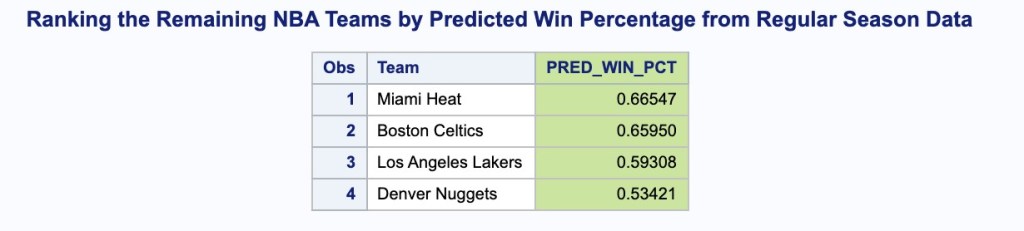
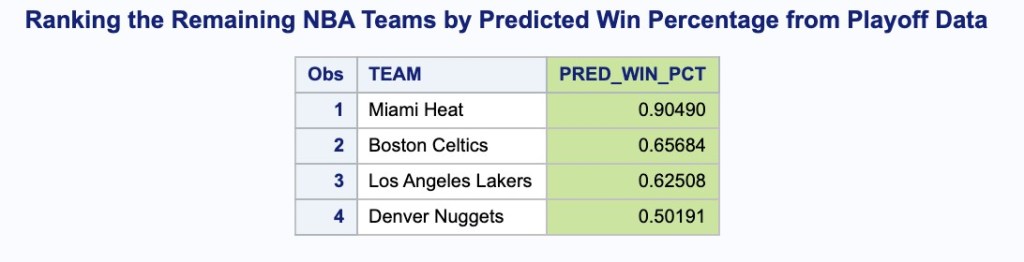
Using both the regular season and playoff data, the rankings are the same. The Miami heat have the highest predicted wins based on this model, followed closely by the Celtics in the regular season model. The Lakers fall behind the Heat by about 6% in the playoff model but the playoff model displays a massive margin between the Heat and the rest. It appears that the Lakers and Heat are very comparable using the regular season data, but in the playoffs the heat are projected to produce a 90% win rate, which is far above that of the Lakers and any other team in this data set. Judging by regular season data, I can make no conclusion about which team is more likely to win any given game, but if we look at purely playoff data, the Heat are definitely rolling. Irrespective of opponent, the Heat are much more likely than the Lakers to win the series. Unfortunately, the opponent matters so this model does not adequately take into account the matchup between the 2 teams. One thing these results do show us, however, is that Miami is performing significantly better in the areas that this model favors. In other words, Miami is supposed to produce a lot of wins given their playoff performance. Using this statistic, the Heat should win the Finals.
Obviously, there is a lot more at play here, including depth, star power, possible injuries, luck, etc., but this win percentage statistic, at least when applied to this year’s playoffs, appears to foreshadow a Heat victory if they can keep up their current pace against a powerful Lakers team led by 2 of the best players in the game.
Here is the link to my github repository with the SAS code if anyone is interested in more of the specifics. I am available to explain it and take suggestions/criticism (since I know some of the statistical methods are not sound):https://github.com/krodonnell7/NBA-Finals-2020
MVP or MV(OR)P?: Using Advanced Stats to See How Often the NBA gets MVP Voting Right
Kevin White
October 1st, 2020
With the NBA season having restarted in July after the COVID-19 pandemic forced it to shut down in March, one topic that was heavily debated was who the MVP award should have gone to. Before the shutdown, the award was two horse race. Giannis Antetokounmpo was the reigning MVP and the best player on a Milwaukee Bucks team with the best record in the NBA. In the bubble, his team got knocked off in 5 games by the Eastern Conference champion Miami Heat in the second round. On the other hand, LeBron James, a season after getting injured and missing the playoffs, has shown no signs of slowing down in his 17th season. In the bubble, he and Anthony Davis have led the Lakers to the NBA Finals, dismantling the Blazers, Rockets, and Nuggets in 5 games each. So who deserved the award? On paper it seemed to be obvious: Giannis led LeBron in points, rebounds, blocks, eFG%, TS%, box plus minus (BPM), value over replacement player (VORP), and win shares (WS), while LeBron led Giannis in assists, FT%, and 3P%. Not to mention that the Bucks had a better regular season record than the Lakers, and while their roster is deeper, the Bucks don’t have any co-stars nearly as good as Anthony Davis. While Khris Middleton was an All-Star in the East this year, Anthony Davis finished First Team All-NBA alongside LeBron. Fans and media alike raved about how LeBron is 35 and doing things that we’ve never seen before from a player this late in his career, but does that really matter?
In the following chart you’ll see the league leader for each of three catch-all advanced stats. The first is VORP, an acronym for value over replacement player. VORP attempts to capture how good a player is in comparison to the average (replacement) player in the NBA. This metric was used in this analysis to account for the simple MVP argument that is based around which player is the most valuable, league-wide, regardless of team or situation. A complex definition of VORP, as well as the other advanced stats being used here, can be found on Basketball Reference where all of these stats are being pulled from. Next is BPM, an acronym for box plus minus. BPM basically tries to account for a player’s contribution to their specific team when they are on the court. This metric was used in the analysis to account for the MVP argument that is based on a player’s relative value to their specific team. Lastly, the third column in the chart is WS, short for win shares. WS attempt to capture how much a particular player contributes to a win for their team and this metric was thrown in to account for better teams (that earn more wins) usually being the only ones with a chance to have an MVP candidate. VORP and BPM are only tracked back to the 1973-74 season but for a larger sample size, I decided to make the chart begin in the 1969-70 season as win shares were still calculated that far back. This provides 50 years to work with including the current 2019-20 season.
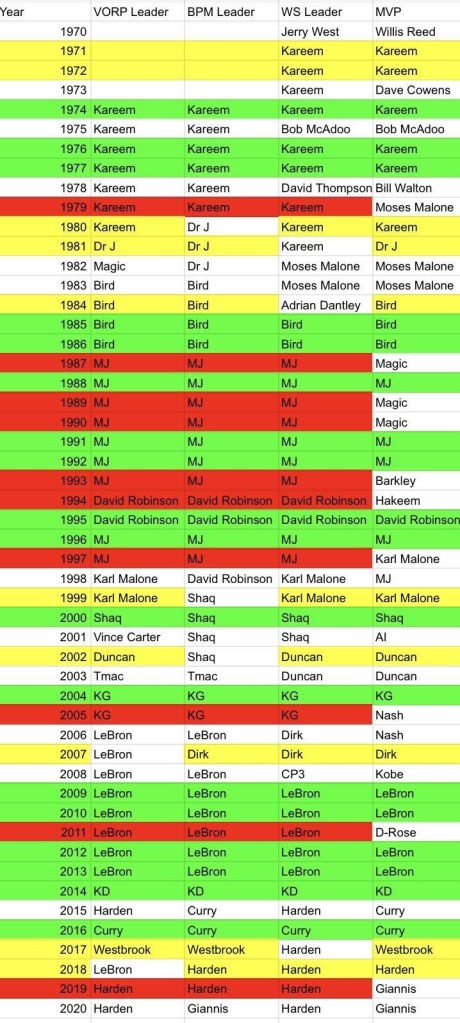
The chart is color coded denoting how the MVP voting played out in comparison to the league leaders of the aforementioned advanced stats. Green represents a year where the voting was relatively simple on paper. The MVP was awarded to the league leader in VORP, BPM, and win shares. Examples include Stephen Curry’s unanimous MVP award in 2016, when Warriors broke the record for wins in a year, going 73-9 and LeBron James’ 2013 MVP where the Heat had a 27 game winning streak and he was one vote away from also being unanimously voted as MVP. Yellow rows show years where the MVP winner led in two categories (usually VORP or BPM and win shares). Examples include Dirk in 2007 and Harden in 2018. While LeBron may have challenged both on paper in terms of overall value, his teams having far worse records eliminated his case. The years where only win shares are displayed, and the MVP winner led in win shares are also highlighted yellow. Years that are left white are years in which there were three different leaders in the three listed categories and/or the winner only led in one category. If the winner did not lead any categories but there also was not a player who led all three, the row is also left white (i.e. AI in ‘01). These years can be seen, relatively as toss ups. Red years on paper show years where a player may have gotten robbed. They led in all three advanced stats listed, but the MVP was awarded to someone else for one reason or another.
One thing you will notice if you look closely is that only one player in the chart has won three consecutive MVPs (Larry Bird 1984-1986). This is very interesting considering that most people would select Kareem, MJ, and LeBron above Bird when making a list ranking the greatest players of all time. One possible reason for this may be voter fatigue. The media and the fans might get bored seeing the same player win MVP year after year. According to the chart, Kareem hypothetically could have won 10 (!!) straight MVPs from 1971-1980, MJ could’ve won 7 in a row (maybe even 11 without his first retirement) from 1987-1993, and LeBron could have secured 6 straight from 2008-2013. You could see how fans could easily become complacent if generational talents dominated MVP races year after year. To officially put it into perspective, since 1974, when a player leads the league in VORP, BPM, and WS, they have won the award 18 out of 27 times (66%), which means players got ‘robbed’ 9 years. So why does this happen? Why doesn’t the most valuable player, according to analytics, win the award 100% of the time?
Well for starters, there are many flaws in this simple analysis. While I attempted to use three very respectable ‘catch-all’ stats, they do not always tell the entire story for what happened in a particular season. For example, in 2005 even with Kevin Garnett having a monster season, the Timberwolves finished with a 44-38 record, a game short of reaching the playoffs in a stacked Western Conference. Nash’s Suns, conversely, were 62-20, tops in the league, a year after finishing 13th in the conference at 29-53 without him. Next, the chart only displays league leaders. In some cases, even if a player did not lead the league in the advanced stats, they were a very close second, and their team being better overall may have given them the edge. In 1987, MJ, having already burst on the scene in his third year in the league, carried a weaker Bulls roster to a 40-42 record, good for 8th seed in the East. While MJ led every advanced category, Magic’s Lakers were 65-17 (1st in the West) and Magic was a narrow 2nd in WS, 1st WS/48 min, and 3rd in VORP and BPM. When shown in more context, it was an easy decision. Lastly, there are so many other metrics that voters use to determine MVP after they get past the eye test. One major category that I left off for simplicity was Player Efficiency Rating (PER), and looking at this year alone, Giannis blows everyone out of the water and even broke Wilt Chamberlain’s record for highest PER in a season. Others include net rating (accounting for offensive and defensive rating) and 538’s RAPTOR.
In conclusion, the league for the most part gets the MVP award right and there is not a singular, perfect method that can be used to prove that otherwise. Did I secretly set out to prove that LeBron should have won 5 straight MVPs and was robbed in 2011? Admittedly, yes. But after further review, D-Rose also had an MVP caliber season, averaging 25 points for a Bulls team that finished with 62 wins despite their defensive anchor, Joakim Noah, missing significant time. On paper, it does seem like the NBA and the media have a bit of an agenda when it comes to MVP voting and parity with recipients. Maybe Harden did have a point when he said that the media just picks up a story and runs with it when it comes to MVP voting. Looking at this season alone, I think if LeBron had won, it would have been one of those years where a storyline took over the voting. With the Bucks having the best overall record, Giannis being 2nd in VORP, 1st in BPM (by a wide margin), 2nd in WS, and 1st in WS/48, even as a huge LeBron fan, I have to say that the award rightfully went to Giannis. On that note, there have been plenty of years where the runner up in regular season MVP has felt slighted for not being the winner, which inspired them to prove that they were the most valuable in the playoffs. Anyone that watched “The Last Dance” knows that MJ did this twice (once in the 1993 Finals against Charles Barkley’s Suns and once in the 1997 Finals against Karl Malone’s Jazz). We saw LeBron James take exception to many people calling Stephen Curry the best player in the league in 2016, as LeBron went on to become the Finals MVP that year. LeBron once again felt disrespected by the 2020 MVP voting, but the numbers showed that Giannis was the clear winner. While Giannis did not perform up to those standards in the bubble, that is exactly why there is a clear distinction between regular season MVP and Finals MVP. In this upcoming NBA Finals, we will see if LeBron proves himself to be the best in the league or if this Miami Heat team was really built to knock off two MVP candidates in one playoff run.
 Villanova Sports Analytics Club