
Lane Kiffin’s Exit and the Flawed College Football Calendar
Anthony Loh
December 8th, 2025
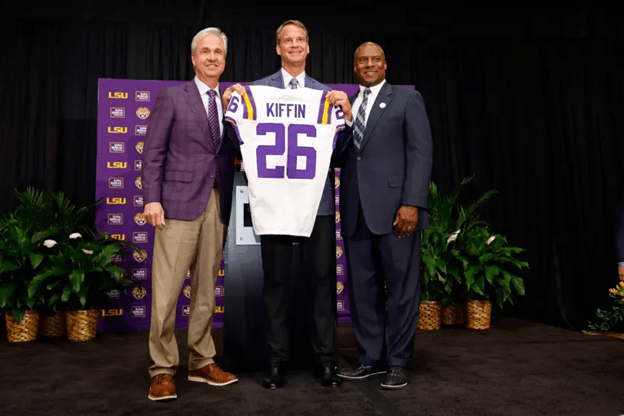
In the high-stakes world of college football, few moves have sparked as much controversy as Lane Kiffin’s abrupt departure from Ole Miss to LSU in late November 2025. Guiding the Rebels to an 11-1 record, Kiffin seemed poised for a deep postseason run, only to leave for a rival SEC program, creating one of the biggest news stories in CFB history. This “excruciating” decision, as Kiffin called it, wasn’t just about personal ambition; it exposed deeper cracks in college football’s scheduling system, where the transfer portal’s overlap with the playoffs and coaches’ dual recruiting duties create chaos. The system isn’t just “poorly timed”; it actively undermines the integrity of the sport, punishing success, and turns the postseason into a glorified exhibition. The college football calendar is broken, and it needs to be fixed.
The Kiffin Saga
Lane Kiffin’s move from Oxford to Baton Rouge is the peak of the calendar’s failings. After a stellar 2025 regular season capped by a 38-19 win over in-state rivals Mississippi State on November 29, Kiffin informed AD Keith Carter of his decision during a tense two-hour meeting, lobbying to coach the Rebels in the CFP despite his new role as Tigers HC. Carter refused, citing conflicts with an SEC rival and prioritizing staff stability amid the early signing period and impending portal opening. Kiffin claimed players asked him to stay for the playoffs to maintain performance, but three Rebels, offensive lineman Brycen Sanders, defensive lineman PJ Wilkins, and linebacker Suntarine Perkins, publicly disputed this via X to highlight Kiffin’s lies.
Kiffin’s tenure at OM was program-changing: He delivered four double-digit win seasons in six years, with a 55-19 overall record. All the program building ended up for nothing and created one of the messiest exits ever. Kiffin pressured assistants to join him at LSU, even stating that if they didn’t get on the plane with him to LSU, they wouldn’t have a spot on staff. Most offensive staff departed, though offensive coordinator Charlie Weis Jr. was allowed to just coach the CFP. Recruiting loomed large. #1 Overall commit Lamar Brown welcomed Kiffin, and the move also positioned him to poach Ole Miss players via the portal, as seen in his social media posts emphasizing LSU’s NIL advantages with a repost from Kiffin mentioning him signing more 5-stars in 5 days than he did in 6 years in Oxford.
There have been similar instances, just not to this extent. The 2021-22 carousel alone saw Brian Kelly (Notre Dame to LSU), Lincoln Riley (Oklahoma to USC), and Mario Cristobal (Oregon to Miami) all exit before bowls, sparking transfers and backlash that mirrored Kiffin’s fallout. The 2023 window saw Jonathan Smith (Oregon State to Michigan State) and Mike Elko (Duke to Texas A&M) as well. However, Kiffin’s is the most drastic and biggest show of “moving up,” being given a $13 million AAV contract, the 2nd highest in the entire country, as well as an over $30 million NIL budget, highlighting financial incentives driving such moves.
Playoff Overlap
The transfer portal’s timing exacerbates departures like Kiffin’s, creating a vicious cycle during playoffs. For the 2025-26 cycle, the portal opens January 2, the day after the CFP quarterfinals and closes January 16. This NCAA-approved shift from December aimed to preserve rosters through postseasons, yet players can commit instantly at 12:01 a.m. January 2, with deals pre-negotiated amid rampant tampering described as “legal tampering on steroids.”
Penn State’s Beau Pribula entered the portal on December 15, 2024, just before their SMU opener, citing overlapping timelines, landing at Missouri, and leaving them without their backup QB right before the CFP. Pribula played 193 snaps, most of which were not in garbage time, and played as a gadget guy with trick plays. Players must enter because of the way the spring semester begins, players cannot miss out on valuable spring practices and just expect to be the best version of themself for the team. Impacts include opt-outs surging 25% from 2023-2025, leading to lopsided contests like FSU’s 63-3 Orange Bowl loss in 2023 after mass exits and a playoff snub. Data from 247Sports showed over 4,424 portal entries in a recent cycle.
Not only players, but now full-on teams have started to reject postseason bowl games. This year alone, a record of 10 teams from Iowa State, Kansas State, Notre Dame, Florida State, Auburn, UCF, Rutgers, Baylor, Kansas, and Temple declined. Iowa State (8-4) won 6 of its last 7 games, voted as a team to skip a bowl, citing insufficient healthy players for safe practice and competition, plus the departure of head coach Matt Campbell to Penn State. Similarly, Kansas State (6-6) pointed to their coaching staff transition and also uncertainties around player availability. Both were fined $500,000 by the Big 12 for breaching affiliations with bowl partners, a penalty reflecting the conference’s emphasis on fulfilling contractual obligations despite transitional challenges.
Notre Dame finished 10-2 (ranked No. 9 in AP, No. 11 in CFP), declined after being the first team out of the 12-team playoff, opting to focus on 2026 national title aspirations rather than a lower-tier bowl. This decision aligns with a growing sentiment that non-CFP games lack value, especially with roster risks from opt-outs. The expanded playoffs’ devaluation of non-CFP games saw a 12% attendance drop (average 28,500 vs. 32,000 in 2023). Opting-out teams forfeit extra practices but use more time for recruiting. The message is clear: Why be involved in meaningless bowl games when you can get a head start on the next season?
Dual Duties
Coaches who leave for new programs but stay coaching current ones are responsible for coaching their old job while recruiting for their new one simultaneously. With national signing day on December 3 and the portal January 2-16, new hires must act fast to stabilize commits and avoid de-commitments of the best in their respective class.
While the dual-role carousel often yields a short-term roster of raids and long-term success for new hires, it can hurt the previous program. In this year alone, in 2025, when Ohio State offensive coordinator Brian Hartline accepted the head coaching job at USF on National Signing Day, he still remained as the Buckeyes’ play-caller through their postseason push. Despite Ohio State’s status as the nation’s most dominant team entering Big Ten Championship week, Hartline’s split attention manifested in “horrendous” red-zone play-calling, including two failed possessions inside the 10-yard line that yielded zero points in a 13-10 upset loss. Fans and analysts openly blamed the distraction, with calls for Ryan Day to immediately dismiss Hartline right before the playoffs, as Nick Saban did with Lane Kiffin when he was the OC at Alabama before he left for HC at FAU in 2017. The distraction potentially was a reason for the derailment of Ohio State’s undefeated season and the No. 1 seed. Similarly, North Texas head coach Eric Morris’s move to Oklahoma State after a breakout 11-1 regular season hung over the 2025 AAC Championship against Tulane, contributing to a 34-21 defeat that ended UNT’s chance for their CFP bid. Already hired away with a $3.8 million annual deal weeks before kickoff, Morris’s team jumped to a 7-0 lead but then collapsed, allowing 31 unanswered points amid three interceptions and two fumbles. These cases underscore the issues of coaches leaving old programs while staying and question whether it’s better to allow them to retain their role unchanged or remove them since they have left and have someone new in that position before a game.
Paths to Reform
Changes are urgent to mitigate the diminishing value of the non-CFP aspect of the sport. Texas Tech HC Joey McGuire proposed shifting seasons to early August for January 1 championships, then January 2-10 portals, potentially reducing opt-outs significantly. However, this schedule creates major academic conflicts: the August start requires training camp during mandatory summer classes, the December playoffs collide directly with final exams, and the tight January portal window makes it nearly impossible for university admissions offices to process transfers before the spring semester begins. Similarly, moving the portal entry time after the postseason doesn’t work either, as universities’ spring semesters will have started, and with the add/drop period to enroll in classes will have passed. If I were to give a solution, it would involve eliminating the conference championship weekend to free up the first weekend of December and have non-playoff bowl games during that week instead, while incorporating enhanced NIL financial incentives to the players to ensure full participation. Subsequently, the expanded College Football Playoff will commence the following week. This strategic sequencing ensures that all administrative and player attention remains focused on the postseason competition from bowl games to the playoff, with the entire athletic season concluding around New Year’s Day, entirely removing any chronological conflict with the portal.
The chaos precipitated by Lane Kiffin’s mid-playoff departure from Ole Miss is not an isolated scandal, but the inevitable consequence of a college football calendar that simultaneously demands peak competitive focus and maximum transactional freedom. When the transfer portal, early signing period, coaching carousel, and postseason all collide in December–January, loyalty becomes a luxury, preparation turns into distraction, and the games themselves risk devaluing into hollow exhibitions contested by backups. Until the NCAA makes changes, the sport will continue looking different and more radical.
What is the Ceiling for Every NFL Playoff Team?
Jack Springer
January 13th, 2024
NFL playoff season has finally arrived, and it features several high stakes matchups filled with opportunity for playoff every team. Was Matt Stafford or Jared Goff a better move? Will Tyreek Hill prove he’s even better than when he was with the Chiefs? Does Joe Flacco still have what it takes? These are just some of the few questions that will be answered on Wild Card Weekend. 14 different NFL fan bases feel if the ball bounces their way a few times they could see their team in Super Bowl LVIII. But some teams need a lot more breaks than others. Below I will predict what I feel is the ceiling for every team playing this weekend.
NFC
1 Seed: San Francisco 49ers- The niners may be the most complete team in the NFL when at their best. CMC is without the doubt been the best RB in the league, Deebo Samuel and Brandon Aiyuk anchor the receiving room, and George Kittle has proved a valuable weapon at TE. The niners also boast a top 10 defense with firepower coming from Fred Warner, Nick Bosa, and trade deadline addition Chase Young. The playoff run for this squad will hang in the hands of Brock Purdy, although he has played poorly, I have no doubt Kyle Shanahan will have him ready to roll.
Ceiling: Super Bowl
2 Seed: Dallas Cowboys- Everything seemed to go right for the Cowboys down the stretch, as opposed to another NFC East team we will mention later. Dak Prescott to CeeDee Lamb is one of the best QB-WR connections in the NFL, and the Cowboys seem once again to have one of the best O-Line’s in the league. Micah Parsons and rookie DaRon Bland hold down a solid 5th ranked defensive unit. The struggle for the Cowboys will be getting over the mental hump of playoff failures in recent years. However, as much as it pains me to say, this is the best Dallas team I’ve seen in years.
Ceiling: Super Bowl
3 Seed: Detroit Lions- What a year it has been for the Motor City Kitties. Dan Campbell has lit fire under the Lions and Jared Goff, Amon-Ra St. Bown, Jahmyr Gibbs and more have showed the world Detroit is here to be a playoff staple. There is no doubt the offense is one of the leagues best. The only issue with this unit could be a rash decision by Dan Campbell who at times this year has seemed on a different page than Jared Goff. My concerns come around the Lions defense, which has been extremely hit or miss. They will determine how far this team can go. Getting lit up by Nick Mullens last week didn’t give me a ton of confidence.
Ceiling: NFC Championship Game
4 Seed: Tampa Bay Bucs- The Bucs are the lucky champs of the lowly NFC South. To be honest I didn’t watch the Bucs a ton this year but can be sure that this team’s playoff fate rests solely on Baker Mayfield’s shoulders. The Bucs have shown flashes of greatness this year but have never really been able to string together a couple weeks of solid football. I could see them beating a reeling Philly squad, but not much after that.
Ceiling: NFC Divisional Round
5 Seed: Philadelphia Eagles- Slipping through the back door is the definition of how the Eagles made the playoffs. At one point this season they seemed poised for another super bowl run but that seems like five years ago seeing the Eagles in their present state. With Jalen Hurts and AJ Brown battling injuries, and a defense that reminded people of swiss cheese down the stretch it is hard to see a future past beating the Bucs for Philly.
Ceiling: NFC Divisional Round
6 Seed: Los Angeles Rams- The Rams got hot at the right time as they head into the playoffs, and I don’t see this team slowing down. Sean McVay has taken two Rams teams to the Super Bowl before, and I think they are certainly looking to spoil the party in Detroit. When at full strength, this Rams offense is one of the best, and despite their 20th spot in league rankings I think the LA defense can make them a sneaky dangerous team in the playoffs.
Ceiling: NFC Championship Game
7 Seed: Green Bay Packers- As a Vikings fan it pains me to even write this team’s name down. However, I will say that Jordan Love has exceeded expectations with young receiving corp. The Joe Barry slander has seemed to dull after two divisional wins at the end of the year giving up 10 and 9 points respectively. This Packers team has beaten the best but also has some very poor losses on the resume. These include Giants, Falcons, Josh McDaniels era Raiders, and nearly the Panthers in a must win game. Maybe they slip by their old friend Mike McCarthy, but they won’t win after that.
Ceiling: NFC Divisional Round
AFC
1 Seed: Baltimore Ravens- In my opinion the Ravens are the best team in the NFL. Lamar Jackson is playing some of the best football of his career, and the Ravens defense, lead by DC Mike Macdonald has looked like the Baltimore defense of old. There isn’t too much more to say about this team, as long as the Ravens stay healthy and out of their own way (which has led to their few losses) they are a Super Bowl contender.
Ceiling: Super Bowl
2 Seed: Buffalo Bills- There was a point this year where I would’ve sworn the Bills were dead in the water, but they’ve come all the way back and secured home field advantage in the playoffs. Being in Buffalo is an advantage too. The Bills playoff run will hinge on what it has all year, Josh Allen’s ability to make plays, and not turn the ball over. While you can argue the Bills have barely beat several non-playoff teams there’s something to be said about good teams finding a way to win. The Bills teams that showed up the last few weeks of the season: they were good. Don’t count the Bills out this year.
Ceiling: Super Bowl
3 Seed: Kansas City Chiefs- This year has not been a typical Chiefs year by any means. Stars like Patrick Mahomes and Travis Kelce are still playing well but the lack of wide receiver depth and ability has hindered the Chiefs offensive firepower. However, the Kansas City defensive was the 2nd best defense in the league this season and kept them in games that the offense struggled in. By no means are the Chiefs pushovers, but I think the dynasty may be ending.
Ceiling: AFC Championship Game
4 Seed: Houston Texans- The Texans came out of nowhere as one of the NFL’s biggest surprises this year. Much of this credit is to Rookie HC DeMeco Ryans, QB CJ Stroud, and Edge Rusher Will Anderson. They might have the most exciting future in the NFL. However, I think that the young core of this team is not ready yet. Joe Flacco picked apart the Houston defense on Christmas Eve and it is likely he will do it again. If Houston does slip by the Browns, I don’t think they can hang with the AFC juggernauts.
Ceiling: AFC Divisional Round
5 Seed: Cleveland Browns- That brings us to Mr. Elite, Joe Flacco. Flacco seemingly came off the couch at age 38 to save the Brown’s season and lead the team to the playoffs. Flacco is playing some of the best football of his career, and I think that will continue for at least 1-2 more weeks. Cleveland’s biggest asset, though, is their defense. The Browns D was dominant much of the year and was the top-rated defense in the league. This squad could be dangerous.
Ceiling: AFC Championship Game
6 Seed: Miami Dolphins- The Fins took the league by storm the first 5 weeks as Mike McDaniel’s offense just kept scoring. Since then, it has been a season of ups and downs for Miami. After a huge Christmas Eve win over the Cowboys, they proceeded to lay an egg in one of the most anticipated AFC matchups of the year. Not to mention they lost to Buffalo at home in week 18. With all that being said, a team with an explosive offense like the Fins can win games, but not championships.
Ceiling: AFC Championship Game
7 Seed: Pittsburgh Steelers: Mike Tomlin’s streak lives on, and the Steelers got the help they needed to make the playoffs. They are definitely just happy to be here. TJ Watt being out for the game at Buffalo dealt a huge blow to Pittsburgh, and I just can’t see Mason Rudolph winning a playoff game. However, the terrible weather in Buffalo could level the playing field, and couple that with Josh Allen’s turnover issues and you’ve got something. If that longshot win happens, the Steelers should just end on a high note, they’re not winning again.
Ceiling: AFC Divisional Round
CFB BOWL PICK ‘EM
Andrew Barry
December 13th, 2023
Well rather than decide to study for my Calc exam Friday, I decided to go make a CFB Bowl Game Pick ‘EM. My last article was incredibly sharp, so I know a little bit about what I’m saying.
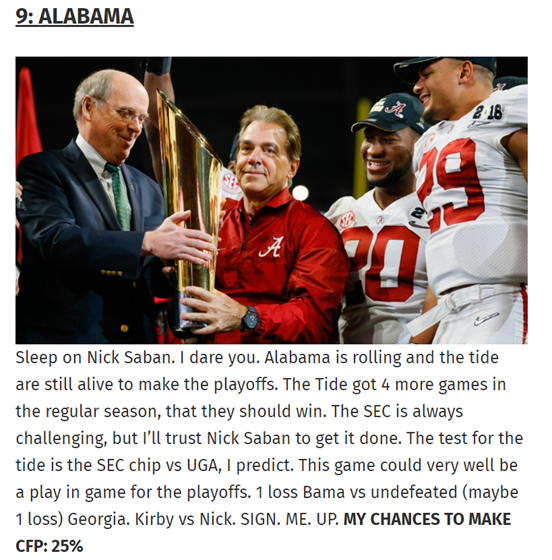
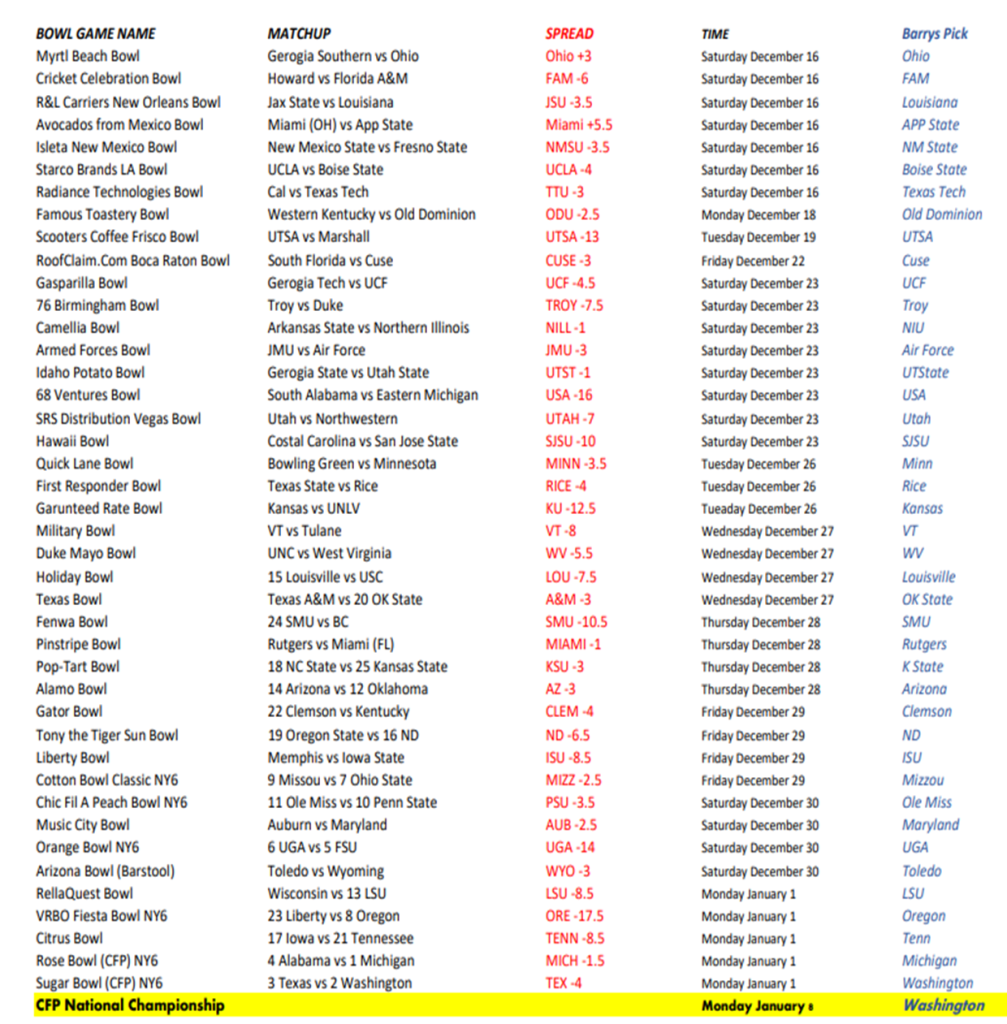
The Takes I was most proud of were on Michigan, Ohio State, Washington, Oregon, Alabama, and Penn State. Here’s a little throwback to when most people thought Bama had no chance to get in. When deciding on what games to go in detail about for Bowl Season, I realized this was basically impossible. Players are opting out left and right, and I truly have no idea who is going to win their bowl games … except for a few. But rather than type up long paragraphs, I’ll just pick the games. So, whoever is reading this, here are my picks for every CFB Bowl Game this season, and a National Champion as well… who else would I have picked?
The CFB Playoff Landscape
Andrew Barry
October 26th, 2023
With the month of November just one week away, I decided to go ahead and start writing about college football. While this is my first entry, hopefully it will gain some ground from CFB lovers like myself, or people who just want to read my current recap. I will give full credit of this style to Matthew Berry, who on his Love/Hate lists for fantasy football, opens with a blurb about life. So before I begin my CFB thoughts, I will note that this is being written before my ACS Essay due next week, before my ACS project due next week, before studying for my exam Friday, and before going to bed… I got my priorities in check clearly. While not much is very entertaining with life right now, November will have some great content so stay tuned. I read yesterday that people hate Pat McAfee???!!! That’s soft to me. I think Pat provides a young flare to College Gameday, especially after embarrassing college students after missing a field goal to win 60k. The reality with Pat is that he was brought on to add energy and put ESPN above Big Noon Kickoff on Fox, which sucks in my opinion. With Lee Corso getting older (Pain.), I believed two years ago that Pat would be the one to replace the irreplaceable Corso. College Gameday needs to have a headgear pick forever, and Pat would certainly be the guy to bring the juice I believe. Although I would not be opposed to retiring the headgear in honor of King Corso.
But enough with that, and lets get into my first CFB Playoff Outlook for each contending team:
1: GEORGIA
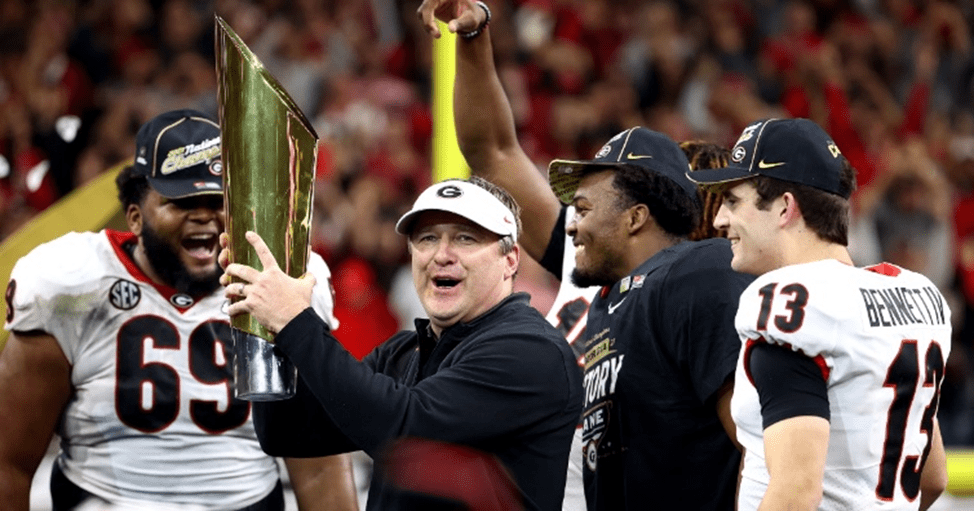
Wow what a surprise… I know. The Dogs just continue to get it done and continue to be the alpha males of the SEC and of the CFB world. Kirby Smart is one of the best coaches in the country, and his success at Georgia will keep the dogs as an elite program if he is there. And while its easy to predict that UGA will make the playoffs, and win its 3rd National championship in a row, I will play some devil’s
advocate with this squad. The easy answer starts at QB. Carson Beck has not convinced me that he is an elite QB, nor is he at the level of Stetson Bennet, per my eye test. The kid is completing 73.6% of passes and has thrown 12 TDS with 4ints. Fine for the best team in the country. My curiosity with Beck will be answered without arguably the best player in CFB, Brock Bowers. The first round TE has been an animal for the Dogs, with 567 yards and 4td. He is irreplaceable, even for Kirby Smart. This is where Georgia Scares me. How will this offense look without Brock, possibly for the rest of the season? Georgia plays 3 more ranked games before the SEC Championship. Home vs Missou, Home vs Ole Miss, and at Tennessee. That last one gives me baaaaddddd vibes. We all saw what happened to Bryce Young and Alabama down in Neyland last season… and the goal post did not come out alive. That game is a trap in my opinion. ESPN gives the Vols a 36% chance, I would say more like 44%. Should Georgia drop that game, at night in Knoxville, their CFB Playoff chances get sketchy and rely on the SEC Chip, against Alabama. If they survive, they will find themselves back to playing on New Years. MY CHANCES TO MAKE CFP: 65%
#2: MICHIGAN
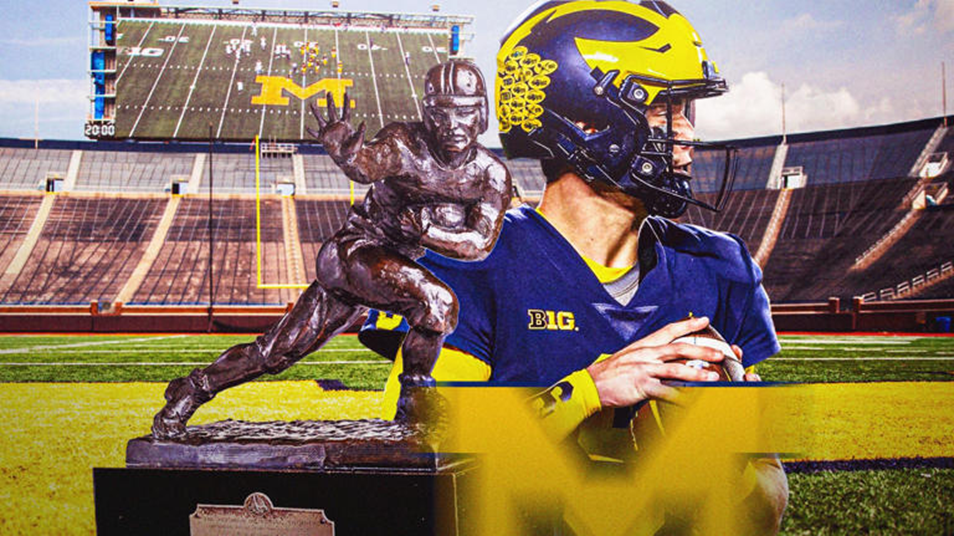
On the heels of all these cheating reports, I’ve begun to wonder if some karma will hit Harbaugh and his boys up north. But that is something I can’t analyze. Michigan has been, in my opinion, the best team and most complete team in CFB. If I was a voter, they would be my number one team in the country. The only issue for Michigan, is that their season starts in two weeks against Penn State. Playing at PSU is not easy, although a noon game definitely helps the Wolverines. But Drew Allar is too young and not good enough, yet, to knock of Michigan. But after our Thanksgiving meals are done being finished, they host Brutus for THE GAME. This could very well end the season for either Mich or OSU, as the Big Ten divisions are an absolute Joke. For Michigan, the path is simple. Beat Penn State and their Freshman QB, beat OSU at home, and beat whoever they have to play in the fugazy Big Ten Chip. Do this, and we will see Mich on New Years, and JJ McCarthy at the Heisman Ceremony. MY CHANCES TO MAKE CFP: 68%
3: OHIO STATE
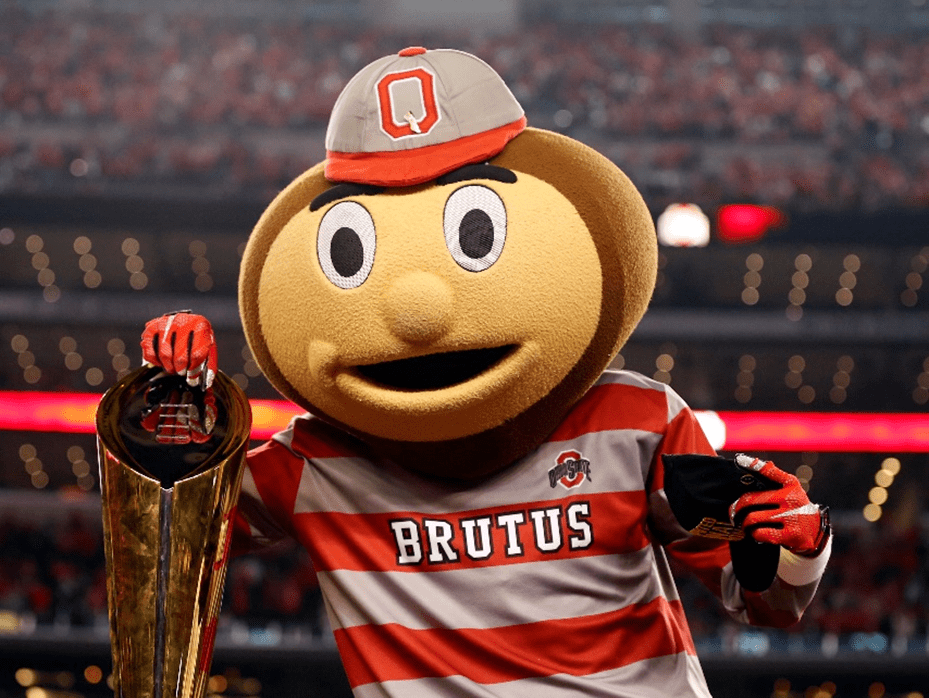
The Ohio State continues to win big time football games. And because of that, they very well could be locked into the CFB Playoff already. The win at Notre Dame was ELITE, and win vs PSU was a massacre. Kyle McCord continues to play well behind an outstanding defense and with help from Marv, Ebuka, and Henderson. The test for OSU will be THE GAME. I do not think they will win that game, leading to an 11-1 finish (Although don’t count out Wisconsin). If the Buckeyes finish 11-1 without a Conference Championship, the committee will have a major decision to make, likely dependent on how other teams finish. For OSU, win THE GAME, or start rooting for some upsets. MY CHANCES TO MAKE CFP: 49%
4: FSU

Jordan Travis. That’s all that needs to be said for Mike Norvell’s squad. The Noles continue to win football games, and with a weak ACC, an undefeated season looks promising. My hope for FSU, is that they take care of business in the Swamp to close the season (Scary Game), and take home an ACC crown. If they win out, they will be in the playoffs if people like it or not. This is a team Ohio State better hopes loses. PSA for UNC and Clemson… what are you doing this year? MY CHANCES TO MAKE CFP: 45%
5: WASHINGTON
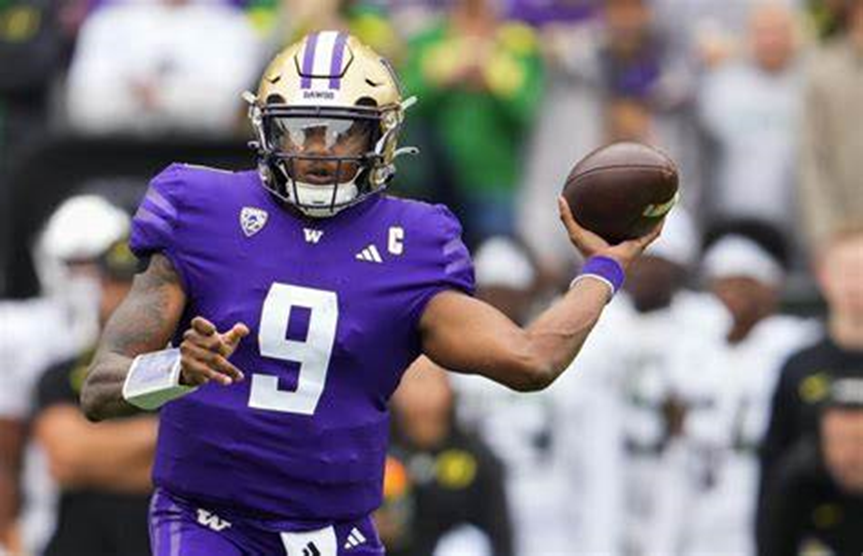
Michael He9sman Penix. If you don’t know the name, you should. The IU transfer has been sensational in his time at Washington and has brought the Huskies into the CFB Playoff picture. They, like FSU, continue to win. I love watching this team play but am scared of the reality of the PAC 12. After a botched attempt for a new media deal, the PAC 12 is in its last season. And of course it’s the best season for the conference in a while… almost too good. The Pac 12 is a gauntlet, and is going to pick each other apart. Washington has 3 more ranked games, including USC and Utah. Brutal. Washington will likely need to win out to make the playoffs, although 1 loss and a PAC 12 Chip will be a discussion. There are too many qualifying teams, and Washington has put themselves in a position where they control their own destiny. Win out and you’re in. If not, I’m scared the Huskies and He9sman will be on the outside looking in at #5. MY CHANCES TO MAKE CFP: 27%
6: OKLAHOMA

The Last undefeated team and the worst remaining one in my view. BV and Dillon Gabriel have been great for the Sooners, and a win at the Red River Rivalry was program saving. My belief is that even if OU wins out, they likely could still be on the outside looking in. They must win out to have a shot, and win the looming rematch with UT. MY CHANCES TO MAKE CFP: 15%
7: TEXAS

UT is now without their starting QB, and Sark needs his boys to win out. For any chance to be a CFP hopeful, the longhorns will need to win their looming rematch vs Boomer Sooner in their final Big 12 battle. I don’t see a world where they get in, other than ESPN loving the Revenue they generate. MY CHANCES TO MAKE CFP: 5%
8: OREGON

This is pure personal bias, but I hate Bo Nix. The 23yr old Transfer is a fraud, wasn’t good at Auburn, and now is meh at Oregon. The ducks lost their biggest game on the road, and have 3 more ranked games. They, very similarly to Washington, are going to fall victim to the Pac 12 Blood Bath that is coming soon. Should they win out and win the Pac 12, they got a chance. If not, 0% they make it. MY CHANCES TO MAKE CFP: 3%
9: ALABAMA
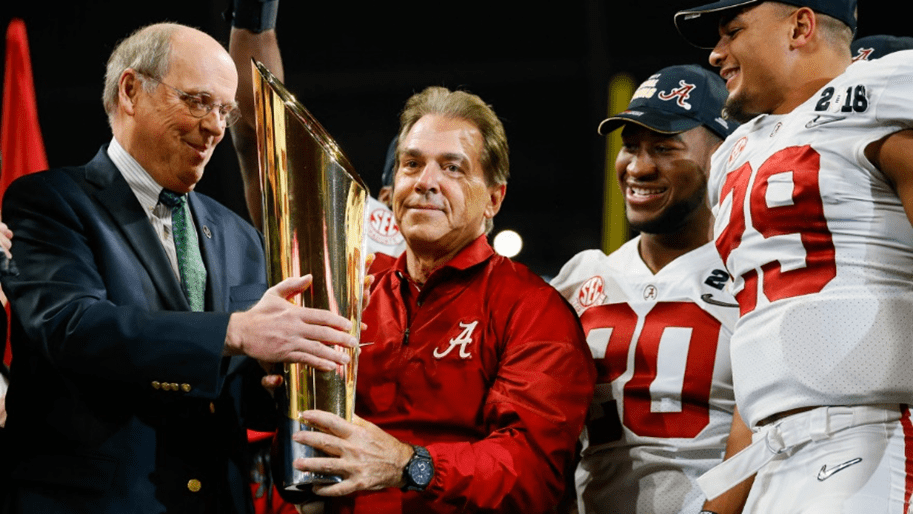
Sleep on Nick Saban. I dare you. Alabama is rolling and the tide are still alive to make the playoffs. The Tide got 4 more games in the regular season, that they should win. The SEC is always challenging, but I’ll trust Nick Saban to get it done. The test for the tide is the SEC chip vs UGA, I predict. This game could very well be a play in game for the playoffs. 1 loss Bama vs undefeated (maybe 1 loss) Georgia. Kirby vs Nick. SIGN. ME. UP. MY CHANCES TO MAKE CFP: 25%
10: PENN STATE

I don’t have much to say for Penn State, except to win out. If they do, which I know they wont, they have a very real shot (They have no chance). MY CHANCES TO MAKE CFP: 1%
If You Think an NFL Speedster Can Beat the World’s Best Sprinters, You’re Wrong
Matt McMullen
October 19th, 2021
As I was scrolling through my Instagram feed a few weeks back, a Bleacher Report post caught my eye. It proposed a hypothetical race between Tyreek Hill, one of the fastest players in the NFL right now, and Usain Bolt, the fastest human to ever walk this planet. It asked for people to comment on whom they think would win this race. As I scrolled through the comment section, it came as a surprise to see just how many people believe that Tyreek Hill had a chance to beat the nine-time Olympic Gold Medalist in a footrace. Later that day, I proposed this hypothetical race to a friend of mine while at dinner. Without hesitation, he profoundly told me why Tyreek Hill would beat the Jamaican, and that many of the NFL’s fastest players would be better than most professional sprinters.
As a Track and Field fan, it is outrageous for me to believe that professional sprinters, athletes who train solely to win footraces, are not capable of beating NFL stars in their bread and butter. This is not the first, nor the last time a hypothetical race between a professional sprinter and a professional football player has been proposed. But, sadly, the number of sports personalities and social media pages that have proposed the idea that the NFL houses the faster athletes has been said enough to make some believe it. Today, I am here to explain, with statistical evidence, how outlandish these claims are, and that the fastest NFL players have no chance of beating professional sprinters in any comparable distance or metric.
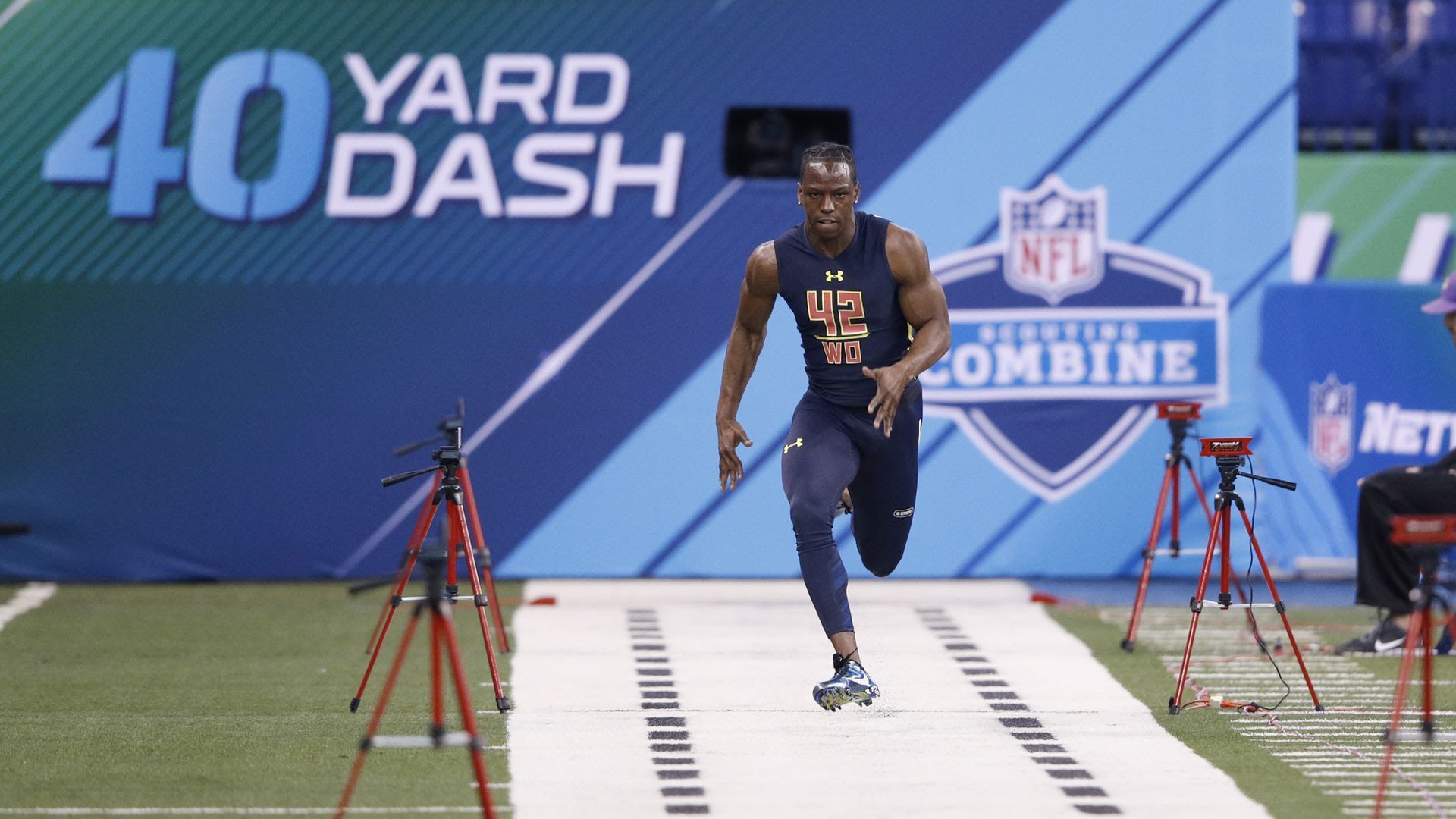
Each sport has its way of measuring speed. For football, it is the 40-yard dash. Raced on the grass, this short distance was first used by Head Coach Paul Brown in the 1950s. Brown wanted to see how fast players could cover punts and this distance was close to the average punting distance at the time. The distance has been electronically timed at the NFL Combine since 1999 and is still commonly used today as a way of measuring the speed of NFL players. Another common way that speed is measured across many sports, including football, is top speed. The NFL tracks the speed of all players in the game in a dataset, and these are publicly available. Many have begun using this data to analyze the fastest players in the NFL. In every major 100-meter dash race, 20-meter splits are recorded. It is easy to calculate the top speed of athletes over each 20-meter distance. In Track and Field, the best way of measuring speed is in the 100-meter dash. It is one of the few Olympic events that date back to the first modern Olympics in 1896 and has been raced at every world championship since 1983. The world champion of the 100-meter dash is given the title of “the world’s fastest man” or “the world’s fastest woman.”
First, let’s look at the 40-yard dash. The fastest official 40-yard dash record at the NFL combine is 4.22 seconds in 2017 by John Ross. While this is the official fastest 40-yard dash time recorded, many NFL players claim to have run faster. Scouts at the 1986 NFL draft claimed to have timed Bo Jackson at a 4.12-second 40-yard dash. A scout at Jakeem Grant’s pro day recorded a 40-yard dash time of 4.10 seconds in 2010. Darrell Green claimed to have recorded a 40-yard dash time of 4.09 seconds upon arriving at the Washington Redskins training camp in 1986. But, due to the lack of electronic timing and the possibility of human error, we can safely assume that John Ross holds the title as the fastest NFL player in the 40-yard dash.
Now, since we have found the fastest NFL player in this distance, we need to find which professional sprinter would be fastest in this distance as well. Many might assume that Usain Bolt would be the perfect candidate for this racing discipline, but they would be mistaken. Usain Bolt’s incredible top speed has made him dominate over the 100-meter distance, but his starting abilities leave some to desire. To find the fastest professional sprinter to cover the 40-yard dash, we need to look at a different sprinting distance, the 60-meter dash.
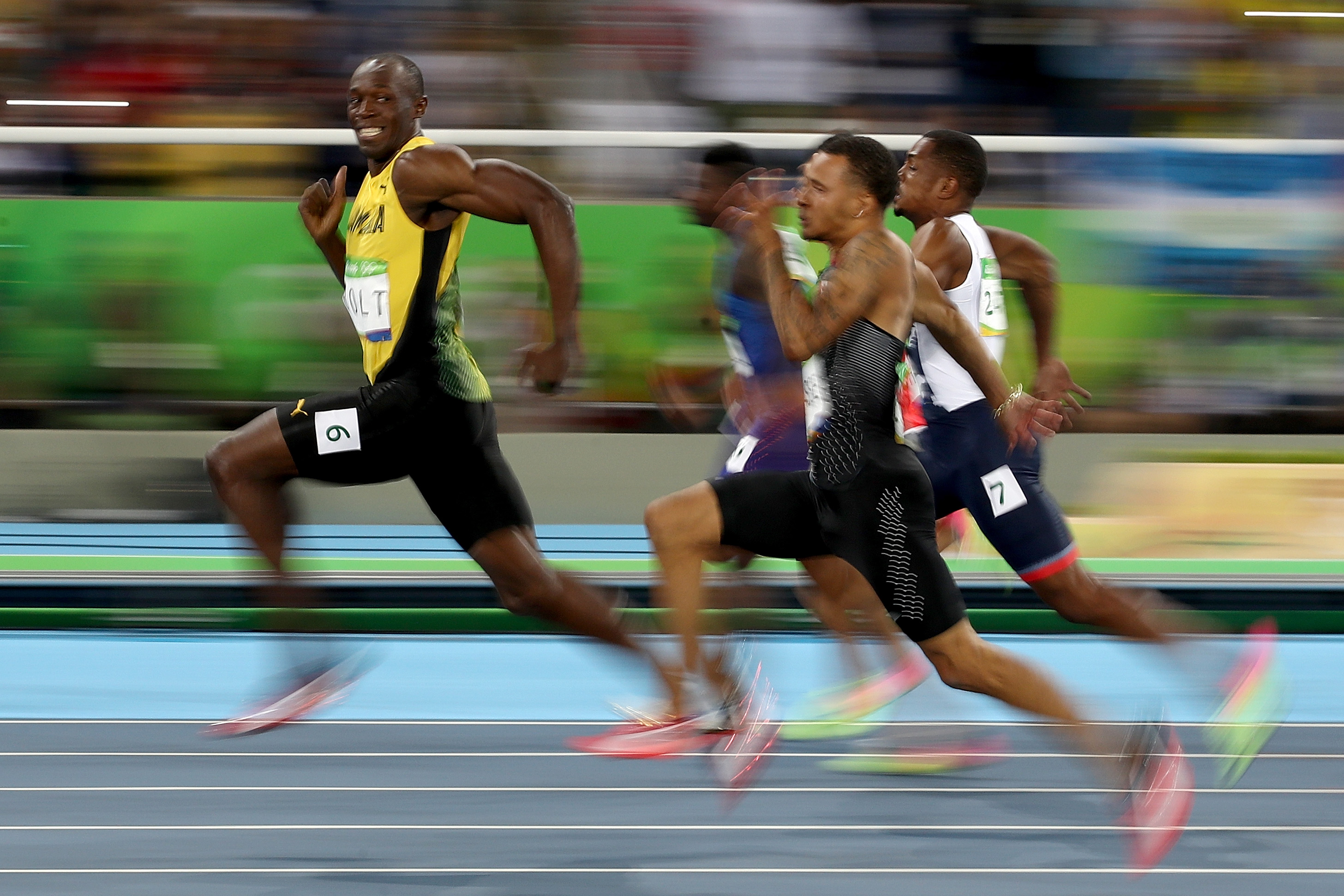
The 60-meter dash is a racing discipline typically ran on an indoor track and is the most common distance run under 100 meters by sprinters. The sprinters who have the best starts tend to dominate this event. When you look at the all-time fastest times in the 60-meter dash, many of the world’s greatest starters appear. Asafa Powell, the Jamaican sprinting legend who has broken the 100-meter dash world record twice, is the 8th fastest athlete in this discipline with a time of 6.44 seconds. Maurice Greene, one of the greatest American sprinters ever with 4 Olympic Gold Medals and a 5-time world champion, held the world record in this event in a time of 6.39 seconds for over 20 years. But, in 2018, American Christian Coleman beat Greene’s world record, running a time of 6.34 at the US Indoor Championships. Christian Coleman is known in the running world for being extremely quick out of the blocks and is arguably the best starter in the sport.
If I were to choose an athlete to race the 40-yard dash from the sport of Track and Field, it would be Christian Coleman. Lucky for us, in 2017, after John Ross broke the NFL combine record, Coleman decided to take to the turf to run a 40-yard dash. Still a collegiate athlete at the time and two years before he would become the 2019 world champion over the 100-meter distance, Coleman ran an electronically recorded time of 4.12 seconds, blowing away the NFL combine record. While the difference between 4.22 seconds and 4.12 seconds may not seem like a lot, but we can put this a different way. When Coleman would be finishing his 40-yard dash, Ross would have over 1.5 yards to cover before he would finish. In the 2017 World Championships in the 100-meter dash, a 1.5-yard difference would have been the difference between 1st and 6th place. This type of gap in sprinting is huge and would never be considered close.
Even if we were to use Usain Bolt in the 40-yard dash, it still wouldn’t be close. At a promotional event for Super Bowl in 2019, with no cleats on, he ran a 40-yard dash time of 4.22 seconds, tying the NFL combine record for the distance. Usain Bolt, a full two years after his retirement in 2017, still could run a time equivalent to the current NFL combine record. Usain Bolt had not been in tremendous sprinting shape in two years and was 13 years removed from his 100-meter world record time. I am convinced that many professional sprinters would not only beat the NFL combine record for the 40-yard dash but smash it by a wide margin.
NFL’s Next Gen stats tracks the top speed of players in-game, and if we look at each player’s top speed, track athletes would again sweep the board. In 2020, the fastest player tracked on-field by NFL’s Next Gen Stats was by Raheem Mostert at a top speed of 23.09 MPH. Many other players peaked at just under 23 MPH in 2020, such as Kenyan Drake, Tyreek Hill, and Jonathan Taylor. While running over 23 MPH is very fast, it is nothing compared to the top speed of the world’s fastest sprinters. In Usain Bolt’s world record 100-meter dash, he ran between the 60 meter and 80 meter marks in a time of 1.61 seconds. When we convert this, this comes out to a ridiculous top speed of 27.8 MPH, almost a full 5 miles per hour faster than the fastest top speed of any NFL player in 2020. If we take the same race Usain Bolt ran his world record 100-meter dash, Darvis Patton, who finished in last place, reached a top speed of 25.3 MPH. Professional sprinters reach much higher top speeds than NFL players, but that is to be expected. NFL players run these speeds on grass turf wearing heavy pads and while holding a football, while sprinters wear high tech spikes with no pads and with full arm movement. Professional sprinters reach higher top speeds, so using this measurement would be biased. But it is still important to note how much faster professional sprinters are than top NFL players. For Raheem Mostert to reach the same top speed as Usain Bolt has, he would need to run over 20% faster than his top speed in an NFL game. There is no chance Mostert could run that much faster with every tactical advantage in his favor.

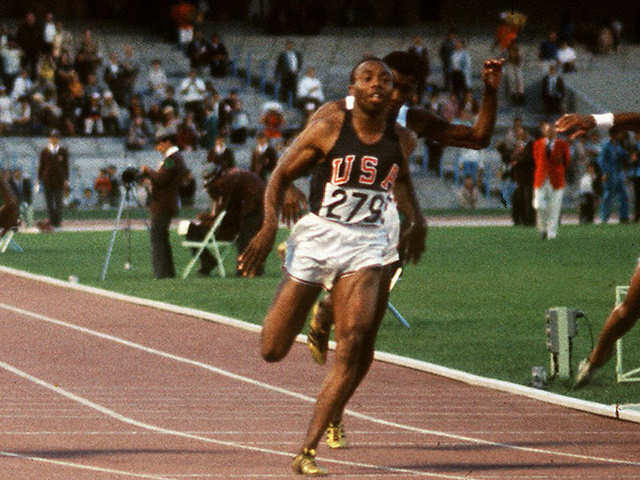
In the 100-meter dash, to no surprise, the fastest times belong to track and field athletes. Usain Bolt holds the current world record in the 100-meter dash in a time of 9.58 seconds. Many NFL players with track and field experience have competed in and posted times in the 100-meter dash. Darrell Green, mentioned previously to have run a 4.09 40-yard dash, has posted a time of 10.08 seconds in the 100-meter dash. The former Denver Bronco Trindon Holliday has the second-fastest 100-meter dash time by an NFL player at 10.00 seconds. Only one man has been able to break the 10-second barrier in the 100 meters and suit up in an NFL uniform. He happens to be the first man to ever break 10 seconds in the 100-meter dash, 1968 Olympic Gold medalist and American sprinting legend Jim Hines.
Jim Hines is much better known for his days on the track than his days on the gridiron, but he did happen to play for the Miami Dolphins and the Kansas City Chiefs between 1969 and 1970. The Dolphins selected him in the 6th round of the 1968 NFL Draft with no college football experience. The Dolphins, then a new franchise, believed they could unlock the potential out of Jim Hines on the football field. But Hines never turned into a regular starter, and only appeared in 5 games as a wide receiver over two years in the NFL. Hines was given the nickname, “Oops”, due to his lack of football knowledge and game IQ. While Jim Hines could not translate his track speed to the NFL, he has the fastest 100-meter dash time in NFL history at 9.95 seconds. This time was a world record that stood for 15 years, from 1968 to 1983. He is the only NFL player to date that has been able to break 10 seconds in the 100-meter dash. In comparison, there are over 150 track and field athletes that have run under 10 seconds in the 100-meter dash to date.
The main reason that NFL players are not as fast as track and field athletes is due to the differences in their training. In the NFL, while being fast is very important, other skills are needed to become the best NFL player. NFL players need to work on many different skills, such as agility, strength, and hand-eye coordination that greatly impact their performance. NFL players do not train to be as fast as they can be but to be the best NFL player they can be. For example, in May of 2021, Seattle Seahawks star wide receiver DK Metcalf competed in the 100 meters at the USATF Golden Games. Against some of the best sprinters the USA has to offer, he placed last in the first heat in a time of 10.37. At a meet that came very early in the racing year, this time ranked Metcalf as the 84th fastest athlete in the US at that time. Metcalf had stated before the race that he had trained “two to three months” for this race but was also preparing for his upcoming minicamp at the time. Metcalf’s training did not translate to being a great track and field sprinter, and it showed in the results of this race.
I am not saying that NFL players are not fast athletes. NFL players are some of the most athletically gifted humans on earth, but NFL players are not the fastest athletes on the planet. No NFL player has come close to running a 40-yard dash time faster than Christian Coleman ran as a collegiate sprinter. No NFL player has a comparable in game top speed measurement to the top speed of some of the world’s best sprinters. Only one NFL player has ever broken the illustrious 10-second barrier in the 100-meter dash, while over 150 professional sprinters have. NFL athletes do not have the speed to keep up with the world’s best track and field sprinters in any discipline or metric, and it’s not even close.
The Chiefs Offense in 2019, and Why They Will Be Even Better in 2020
Harry Lazerwitz, Football Chairman
September 16th, 2020
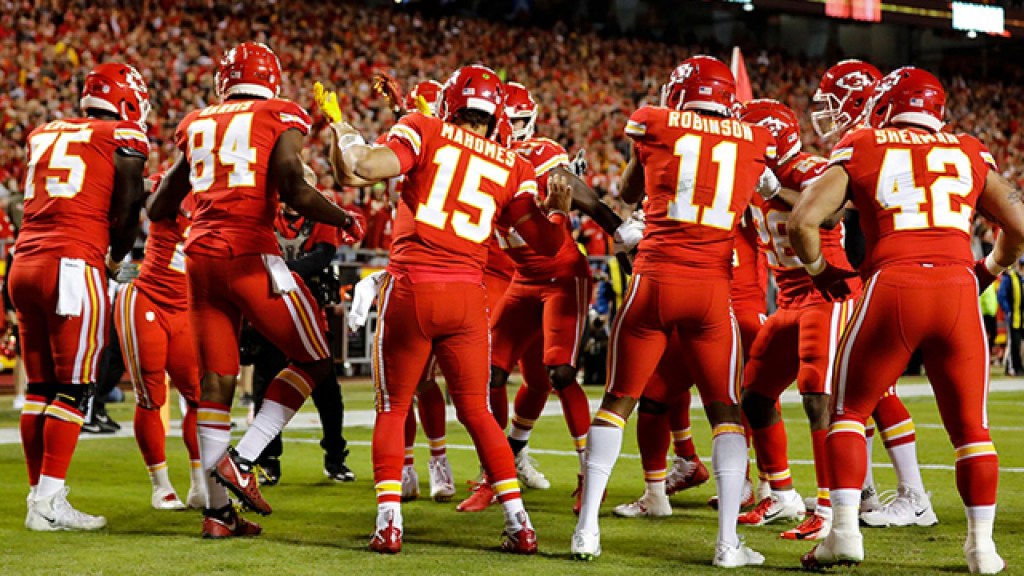
The Super Bowl champion Chiefs had a scary good offense in 2019 and in 2020 they are showing no signs of slowing down. While Patrick Mahomes did not have the crazy numbers that he did in his 2018 MVP season, in the 13 games in 2019 where Mahomes was fully healthy, the Chiefs went 10-3 and scored at least 20 points in all but one game. That one game came against the Colts where they scored only 13. The Colts seemed to have “cracked the code” of the Chiefs offense in their week 5 matchup.
In week 4, the Chiefs played the Lions, who were 2nd in the league in man coverage percentage. Against the Chiefs, the Lions played man coverage 85% of the time that they were in a traditional coverage. The Lions kept it close and inspired the Colts for the next week. In 2019, the Colts were generally a zone coverage heavy team playing zone 67.4% of the time. However, they chose to play man 68.6% of the time against the Chiefs, holding them to 13 points.
The Colts formula of man coverage was used the next week by the Texans who played 66.7% man coverage against the Chiefs despite playing man only 42.6% of the time all season. Again, the man coverage game plan worked, leading to a Texans 31-24 win. The only other loss with Mahomes healthy was against the Titans, who again played much more man coverage against the Chiefs than they did the rest of the season.
As all great offenses do, the Chiefs had a counter to this defensive adjustment. That counter’s name was Sammy Watkins. While Watkins was not the top option (3rd on the team in receiving yards), he was highly successful against man coverage. Watkins had 3 of his 4 best games against man coverage heavy teams. On the other side, his 3 worst games came against zone heavy teams. To add to this, Watkins did not play in the losses to the Texans and Colts. After their bye, the Chiefs had Mahomes and Watkins both healthy, and they won 8 straight games en route to a Super Bowl victory.
“The Colts seemed to have ‘cracked the code’ of the Kansas City Chiefs”
In 2020, the Chiefs offense returns almost everyone (Damien Williams and Laurent Duvernay-Tardif both opted out) and adds Clyde Edwards-Helaire. Edwards-Helaire rushed for a league-leading 138 yards in the Chiefs 34-20 win in week 1. He did not catch a pass despite being targeted twice; he averaged around 4 catches per game last year at LSU. Edwards-Helaire adds another dimension to the Chiefs offense with his rushing and receiving abilities.
The week 1 win over the Texans showed that the Chiefs offense will likely be even better this year than it was last year. In that game, Watkins continued his success against man coverage, leading the team with 7 catches for 82 yards. Sammy Watkins’ health and the addition of Clyde Edwards-Helaire mean that defenses will likely be deterred from playing as much man as last year. However, the Chiefs still have Tyreek Hill and Travis Kelce who can beat zone coverage. At this point, the Chiefs offense will score no matter what the defensive coverage is; the only difference is who will score those points.
(References: Sports Info Solutions and Pro Football Reference)
 Villanova Sports Analytics Club